Rogers PCBs are widely recognized for their high-performance material properties, making them an ideal choice for high-frequency, RF (radio frequency), and microwave applications. Unlike traditional FR4 boards, Rogers PCBs offer superior electrical, mechanical, and thermal characteristics that are essential for advanced electronics. These high-quality laminates are designed to minimize signal loss, ensure impedance stability, and operate effectively in demanding environments such as aerospace, military, medical, and telecommunications industries.
[caption id="attachment_3049" align="alignnone" width="300"]
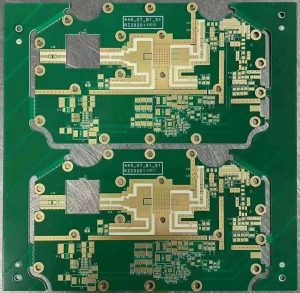
Rogers PCB[/caption]
What is Rogers PCB?
Rogers PCB refers to printed circuit boards manufactured using materials from Rogers Corporation, a global leader in high-frequency laminate solutions. These PCBs are engineered to provide excellent electrical performance, enhanced thermal management, and long-term durability. They are highly regarded for applications that require stable performance across a broad range of frequencies and environmental conditions.
Key Properties
Rogers PCBs stand out due to their unique material composition, offering several advantages over conventional PCB materials:
- Low Dielectric Loss: Reduces signal attenuation, making it ideal for RF, microwave, and high-speed applications.
- Stable Dielectric Constant (Dk): Maintains consistency across different temperatures and frequencies, ensuring reliable signal integrity.
- High Thermal Conductivity: Enhances heat dissipation, reducing the risk of component failures due to excessive heat.
- Low Moisture Absorption: Improves durability and performance stability in humid or extreme environments.
- Superior Mechanical Stability: Resists material expansion and contraction, making it suitable for precise circuit designs with strict tolerances.
- High Power Handling Capability: Supports power amplifiers and high-frequency transmission applications.
- Chemical and Environmental Resistance: Withstands exposure to harsh chemicals, radiation, and environmental stressors.
Common Types
Rogers Corporation offers a variety of high-performance laminates designed for different applications. Some of the most commonly used Rogers PCB materials include:
- Rogers 4000 Series (RO4000):
- A cost-effective, high-frequency laminate with low dielectric loss.
- Ideal for RF applications, including antennas, power amplifiers, and radar systems.
- Rogers RT/duroid Series:
- Known for its exceptional thermal and electrical stability.
- Frequently used in aerospace, military, and satellite communication systems.
- Rogers 5000 Series:
- Optimized for power amplifier and antenna applications requiring high-frequency performance.
- Features excellent signal integrity and low passive intermodulation (PIM).
- Rogers 6000 Series:
- Designed for extremely low-loss, high-frequency applications.
- Suitable for millimeter-wave (mmWave) technology, satellite communications, and 5G infrastructure.
- Rogers 3000 Series:
- Preferred for automotive radar sensors and advanced driver-assistance systems (ADAS).
- Offers stable dielectric properties and robust environmental resistance.
Applications
Due to their superior material properties, Rogers PCBs are extensively used in high-performance applications across various industries:
- Aerospace and Defense: Used in radar systems, avionics, satellite communications, and military-grade electronic warfare systems.
- Telecommunications: Essential for 5G infrastructure, RF amplifiers, antennas, and base station equipment.
- Medical Devices: Utilized in MRI systems, imaging equipment, and high-frequency medical instruments.
- Automotive Electronics: Key component in ADAS, automotive radar, and vehicle-to-everything (V2X) communication systems.
- Industrial and IoT Devices: Applied in wireless communication systems, sensors, and high-speed data processing applications.
- Consumer Electronics: Used in high-frequency devices such as smart antennas, signal boosters, and wearable communication technology.
Rogers PCB vs. FR4 PCB: A Comparative Analysis
| Feature |
Rogers PCB |
FR4 PCB |
| Dielectric Loss |
Very Low |
Moderate |
| Frequency Range |
High |
Low to Medium |
| Thermal Stability |
Excellent |
Moderate |
| Moisture Absorption |
Low |
High |
| Power Handling |
High |
Low to Moderate |
| Cost |
Higher |
Lower |
Factors to Consider When Choosing Rogers Material
Selecting the right Rogers PCB material depends on several key factors:
- Operating Frequency: The material must support the required frequency range of the application.
- Thermal Performance: High-power applications require materials with superior heat dissipation capabilities.
- Mechanical Durability: Low coefficient of thermal expansion (CTE) ensures long-term reliability in temperature-sensitive environments.
- Chemical Resistance: Some applications demand materials resistant to harsh chemicals or radiation.
- Cost vs. Performance Balance: Higher-performance materials come at a premium; selecting the right one requires a cost-benefit analysis.
Advantages of Using Rogers PCBs
- Improved Signal Integrity: Maintains stable performance at high frequencies, preventing signal degradation.
- Enhanced Reliability: Withstands extreme environmental conditions, ensuring longevity in demanding applications.
- Lower Design Complexity: Enables simplified circuit design for high-frequency performance.
- Broad Industry Adoption: Trusted across aerospace, medical, telecommunications, and automotive industries.
- Future-Proof Technology: Compatible with next-generation technologies such as 5G, satellite communications, and AI-driven electronics.
Future Trends in Rogers PCB Technology
As technology advances, it continues to evolve. Some of the future trends in Rogers PCB manufacturing include:
- Integration with AI and IoT: The growing demand for smart electronics is driving innovations in high-frequency circuit board materials.
- Advancements in 5G and Beyond: Rogers PCBs will play a critical role in next-generation telecommunications and mmWave technologies.
- Higher Efficiency and Miniaturization: With the push for more compact devices, Rogers PCBs are being developed with even lower dielectric losses and higher precision.
- Sustainable PCB Manufacturing: Efforts to reduce electronic waste and improve material recyclability are shaping the future of PCB production.
Conclusion
Rogers PCBs are the preferred choice for industries requiring high-performance circuit boards with superior dielectric properties, thermal stability, and mechanical reliability. Their ability to support high-frequency applications makes them indispensable in aerospace, telecommunications, medical, and automotive electronics. By carefully selecting the right Rogers PCB material, engineers and manufacturers can achieve optimal performance, efficiency, and long-term reliability in their electronic designs. As technology advances, Rogers PCBs will continue to play a pivotal role in the development of cutting-edge electronic solutions.
our
linkedin sqpcb.com

 Quote
Quote
 E-mail