-->
Rogers PCB Manufacturer
Special PCB
Rogers PCB Manufacturer

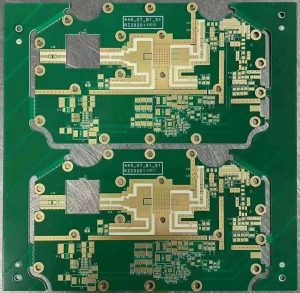
SQPCB  Rogers PCBs manufactures for RF, microwave, high-speed, telecom, radar, antenna, and other high-frequency applications.

We support Rogers materials including RO4350B, RO4003C, RO4450F, RT/duroid 5880, RT/duroid 5870, RO3003, RO3006, RO3010, and RO6002, as well as Rogers + FR4 hybrid multilayer PCB constructions.

With controlled impedance, multilayer lamination, precision drilling, ENIG and other surface finishes, we support both prototype and production Rogers PCB requirements.

Order Now
Dimensions(Recommended):

Rogers PCB Manufacturer

SQPCB provides Rogers PCB manufacturing for RF, microwave, high-frequency, high-speed, antenna, telecom, radar, industrial, and other demanding electronic applications.

We support a wide range of Rogers materials, including RO4350B, RO4003C, RO4450F, RT/duroid 5880, RT/duroid 5870, RO3003, RO3006, RO3010, and RO6002, as well as Rogers + FR4 hybrid multilayer PCB constructions.

With in-house multilayer lamination, precision drilling, LDI imaging, controlled impedance production, ENIG and other surface finishes, electrical testing, and engineering review, SQPCB supports Rogers PCB projects from prototype to volume production.

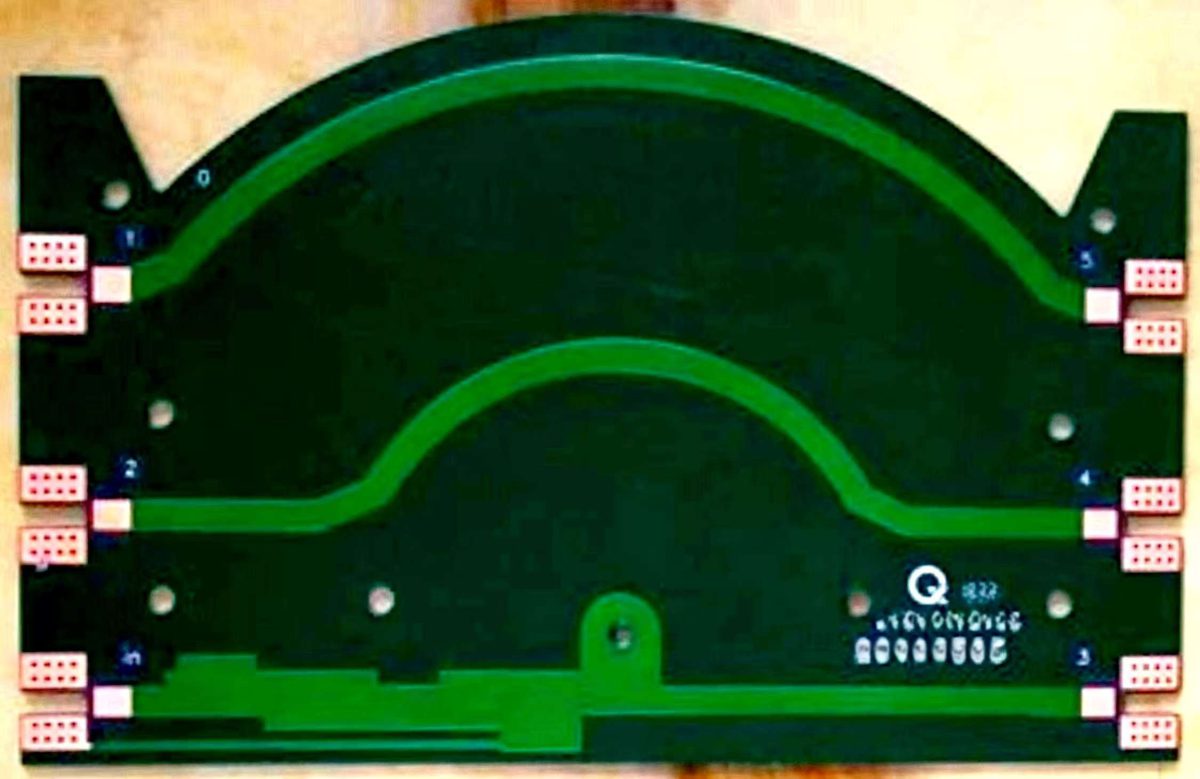
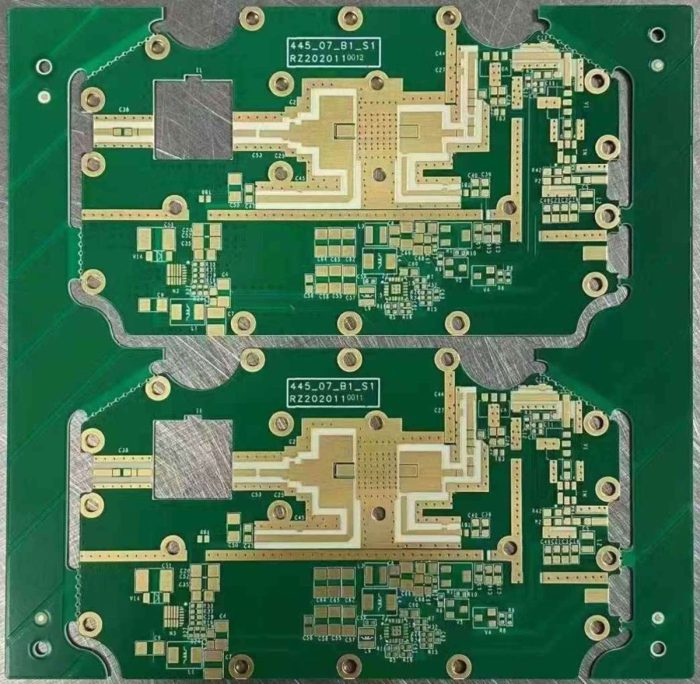
[caption id="attachment_2862" align="alignnone" width="2560"]RO3003 High-Frequency PCB, Rogers PCB Manufacturer RO3003 High-Frequency PCB, Rogers PCB Manufacturer[/caption]

If you already have Gerber files, stack-up requirements, impedance requirements, or specified Rogers materials, send them to us for engineering review and quotation.

Rogers PCB Manufacturing Capabilities

Item Capability
PCB Type Rogers PCB, RF PCB, Microwave PCB, High-Frequency PCB, Hybrid Rogers + FR4 PCB
Rogers Materials RO4350B, RO4003C, RO4450F, RT5880, RT5870, RO3003, RO3006, RO3010, RO6002
Layer Count 2–20 Layers
Hybrid Construction Rogers + FR4 multilayer PCB supported
Copper Weight 0.5 oz to heavy copper, depending on design
Controlled Impedance Available
Fine Line / Space Available according to material and copper thickness
Surface Finish ENIG, HASL, Immersion Tin, OSP and other finishes
Imaging LDI circuit imaging and solder mask LDI
Testing Flying probe and electrical testing
Production Type Prototype, small batch and volume production
Engineering Support Stack-up, DFM and manufacturability review

Actual manufacturing capability depends on the selected Rogers material, dielectric thickness, copper thickness, PCB structure, line width/spacing, hole size, impedance requirements, and other design conditions.

What Is a Rogers PCB?

A Rogers PCB is a printed circuit board manufactured using high-performance laminate materials from Rogers Corporation.

Compared with conventional FR4, Rogers materials are commonly selected for applications requiring better control of dielectric properties and lower signal loss at high frequencies.

They are widely used in:

  • RF circuits
  • Microwave systems
  • Antennas
  • Radar
  • 5G communication equipment
  • Base stations
  • Satellite communication
  • High-speed communication systems
  • Automotive radar
  • Test and measurement equipment
  • Industrial RF equipment

However, there is no single “Rogers PCB material.”

Different Rogers laminates have different dielectric constants, dissipation factors, thermal properties, processing requirements, and costs. Material selection should therefore be based on the actual frequency, impedance, stack-up, thermal requirement, and application.

Rogers Materials We Commonly Support

Rogers RO4350B

RO4350B is one of the most widely used Rogers high-frequency PCB materials.

It is commonly used for:

  • RF amplifiers
  • Antennas
  • Base stations
  • Radar equipment
  • High-frequency communication systems
  • Automotive electronics

RO4350B is also frequently combined with FR4 materials in multilayer hybrid PCB constructions.

For detailed material properties, see our Rogers 4350B Datasheet guide.

Rogers RO4003C

RO4003C is commonly used in RF and microwave circuits requiring stable electrical performance and relatively low dielectric loss.

Typical applications include:

  • RF communication
  • Antennas
  • Radar
  • RF modules
  • High-frequency test equipment
  • Wireless communication systems
For detailed material properties, see our rogers 4003c datasheet guide.

Rogers RO4450F

RO4450F is commonly used as a bonding material in multilayer Rogers PCB stack-ups.

It is particularly important when building multilayer constructions using RO4000-series laminates.

The lamination process must be properly controlled because high-frequency multilayer PCB performance depends not only on the core material but also on the bonding structure, dielectric thickness, copper distribution, and final stack-up.

Rogers RT/duroid 5880

RT/duroid 5880 is widely used for very high-frequency and low-loss RF and microwave applications.

Typical applications include:

  • Radar
  • Microwave communication
  • Satellite systems
  • Antennas
  • RF test equipment
  • Millimeter-wave applications

PTFE-based materials such as RT5880 require greater attention during PCB manufacturing because their mechanical and processing characteristics differ significantly from conventional FR4.

For detailed material properties, see our RT5880 datasheet guide.

Rogers RT/duroid 5870

RT/duroid 5870 is another PTFE-based Rogers laminate used in demanding RF and microwave applications.

Manufacturing requires careful control of material handling, drilling, surface preparation, registration, and multilayer processing.

Rogers RO3003 / RO3006 / RO3010

The RO3000 series is used in RF and microwave applications requiring controlled dielectric properties.

Different dielectric constants allow PCB designers to select materials according to circuit size, impedance, frequency, and electrical performance requirements.

Rogers RO6002

RO6002 is used in microwave and high-frequency applications where stable electrical characteristics are important.

For all Rogers materials, the exact material grade and thickness should be clearly specified in the PCB fabrication drawing or stack-up documentation.

Rogers + FR4 Hybrid PCB Manufacturing

Not every layer of a high-frequency multilayer PCB needs to use Rogers material.

In many designs, Rogers laminate is used only on the critical RF layers, while conventional FR4 or high-Tg FR4 is used for other signal, power, or control layers.

This creates a Rogers + FR4 hybrid PCB.

The main advantage is cost optimization.

Using Rogers material only where high-frequency performance is required can significantly reduce material cost compared with building the entire multilayer PCB from high-frequency laminate.

However, hybrid construction introduces additional manufacturing considerations.

Important factors include:

  • Material thickness
  • Stack-up symmetry
  • Copper distribution
  • Lamination parameters
  • Different material expansion behavior
  • Registration control
  • Resin flow
  • Drilling quality
  • Impedance control
  • Final PCB thickness

For hybrid Rogers PCB projects, SQPCB recommends reviewing the stack-up before production.

A small stack-up adjustment at the engineering stage can often reduce manufacturing risk and avoid unnecessary material cost.

Controlled Impedance for Rogers PCB

Controlled impedance is one of the most important requirements in RF and high-frequency PCB manufacturing.

Actual impedance is affected by:

  • Dielectric constant
  • Dielectric thickness
  • Copper thickness
  • Trace width
  • Trace spacing
  • Solder mask
  • Finished copper thickness
  • PCB stack-up

For this reason, Rogers PCB production should not rely only on the nominal trace dimensions in the Gerber files.

The PCB manufacturer should review the complete stack-up and impedance requirement before manufacturing.

SQPCB can provide impedance engineering review and production control according to customer requirements.

Typical structures include:

  • 50 Ω single-ended impedance
  • Differential impedance
  • Microstrip
  • Stripline
  • Coplanar waveguide structures

For critical RF projects, please provide the required impedance value together with your stack-up and design files.

Key Rogers PCB Manufacturing Considerations

Rogers PCB manufacturing requires more process control than standard FR4 PCB production.

1. Material Selection

Different Rogers materials are designed for different frequency ranges, dielectric requirements, thermal conditions, and applications.

The most expensive material is not automatically the best choice.

The correct material should balance:

  • Electrical performance
  • Reliability
  • Manufacturability
  • Availability
  • PCB cost

2. Material Storage and Handling

High-frequency materials should be correctly stored and handled before production.

Contamination, scratches, incorrect storage, or improper handling can affect later manufacturing processes and final reliability.

3. Lamination Control

Multilayer Rogers PCBs require controlled lamination parameters.

Temperature, pressure, heating rate, material combination, bonding material, and stack-up all affect the final result.

This becomes even more important for Rogers + FR4 hybrid PCB structures.

4. Drilling

Different Rogers materials may behave differently during mechanical drilling.

Drilling parameters should be selected according to:

  • Material type
  • Hole diameter
  • PCB thickness
  • Stack-up
  • Copper thickness

Poor drilling control can affect hole-wall quality and subsequent copper plating reliability.

5. Registration

High-frequency PCBs often use relatively precise RF structures.

Layer-to-layer registration and solder mask registration therefore require good process control.

SQPCB uses LDI for circuit imaging and solder mask exposure, helping improve registration control compared with traditional film-based exposure processes.

6. Copper Thickness

Finished copper thickness can influence RF trace geometry and impedance.

The relationship between base copper, plating thickness, line width, and final copper thickness should be considered during DFM review.

7. Surface Finish

Common surface finishes for Rogers PCB include:

  • ENIG
  • Immersion Tin
  • HASL
  • OSP
  • Other application-specific finishes

The correct finish depends on assembly requirements, component pitch, RF design, bonding requirements, storage time, and application.

For fine-pitch components and BGA designs, ENIG is commonly selected because of its relatively flat surface.

Rogers PCB vs FR4 PCB

Feature Rogers PCB Standard FR4 PCB
High-Frequency Performance Excellent Limited at higher frequencies
Dielectric Loss Generally Lower Generally Higher
Dk Stability Better controlled for RF applications Depends on FR4 grade
Material Cost Higher Lower
RF / Microwave Applications Highly suitable Limited depending on frequency
Hybrid Multilayer Design Available Common
Manufacturing Difficulty Higher Lower
Material Selection Application-specific Broad general-purpose use

FR4 remains the better choice for many ordinary electronic applications because of its lower cost and mature manufacturing process.

Rogers material should be selected when the electrical requirements justify it.

A good PCB design does not simply use the highest-performance material available.

It uses the right material in the right location at the right cost.

Applications of Rogers PCB

Rogers PCBs are widely used in applications where signal integrity and high-frequency performance are important.

RF and Microwave Equipment

Used in:

  • RF amplifiers
  • Filters
  • Mixers
  • RF modules
  • Microwave circuits

Antennas

Rogers materials are frequently used in antenna PCB designs because dielectric properties directly influence antenna performance.

5G and Telecommunications

Applications include:

  • Base stations
  • RF front-end modules
  • Communication infrastructure
  • High-frequency transmission systems

Radar

Rogers PCB materials are commonly used in:

  • Automotive radar
  • Industrial radar
  • Aerospace radar
  • Detection systems

Automotive Electronics

High-frequency laminates are increasingly used for:

  • ADAS
  • Automotive radar
  • Communication modules
  • Vehicle connectivity

Aerospace and Satellite Communication

Low-loss high-frequency materials are suitable for demanding communication and RF applications where stable electrical performance is important.

Test and Measurement Equipment

RF test equipment frequently requires controlled impedance, stable dielectric properties, and low-loss transmission structures.

How to Reduce Rogers PCB Cost

Rogers material cost can be significantly higher than standard FR4, so material utilization should be considered during PCB design.

Several methods may help reduce cost.

Use Hybrid Rogers + FR4 Stack-Ups

If only the RF layers require Rogers material, other layers may use FR4.

This is often one of the most effective ways to reduce multilayer Rogers PCB cost.

Avoid Unnecessary Layer Count

PCB layer count remains an important cost driver.

A simpler stack-up can reduce:

  • Material consumption
  • Lamination complexity
  • Manufacturing steps
  • Production risk
  • Lead time

Select the Correct Rogers Material

Different Rogers materials have different costs and performance characteristics.

Using a material with performance far beyond the real application requirement may unnecessarily increase PCB cost.

Optimize Panel Utilization

PCB size and panel utilization directly affect material consumption.

For expensive high-frequency laminates, improving panel utilization can have a noticeable impact on PCB cost.

Review the Stack-Up Before Production

Early communication between the PCB designer and manufacturer can identify unnecessary material, thickness, or structural requirements before production begins.

For Rogers PCB projects, early DFM review is often particularly valuable.

Why Choose SQPCB for Rogers PCB Manufacturer?

SQPCB combines PCB manufacturing capability with direct engineering communication for high-frequency and special-material PCB projects.

Our manufacturing support includes:

  • Rogers PCB manufacturing
  • Rogers + FR4 hybrid multilayer PCB
  • Controlled impedance
  • Multilayer lamination
  • Precision drilling
  • Circuit LDI
  • Solder mask LDI
  • ENIG and other surface finishes
  • Flying probe and electrical testing
  • Prototype production
  • Small-batch production
  • Volume production
  • DFM and engineering review

With experience in multilayer, high-frequency, HDI, heavy copper, impedance-controlled and other special PCB constructions, we focus not only on whether a PCB can be manufactured, but also on manufacturing reliability, cost, lead time, and process stability.

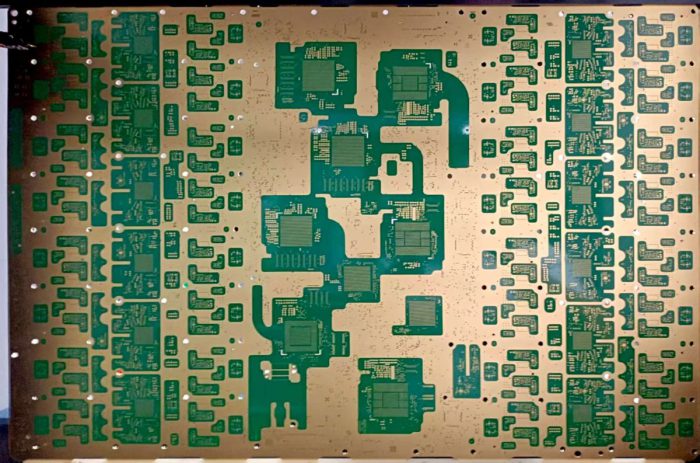
[caption id="attachment_5516" align="alignnone" width="1279"]Automatic Solder mask LDI Automatic Solder mask LDI[/caption]

Get a Rogers PCB Quote

For a fast and accurate Rogers PCB quotation, please send:

  • Gerber files
  • PCB quantity
  • Rogers material specification
  • Stack-up
  • PCB thickness
  • Copper thickness
  • Surface finish
  • Impedance requirements
  • Special manufacturing requirements

If the material or stack-up has not yet been finalized, our engineering team can also review the design and provide manufacturing suggestions.

Send your Rogers PCB files to SQPCB for quotation and DFM review.

FAQs

What is a Rogers PCB?

A Rogers PCB is a printed circuit board manufactured using high-performance laminate materials from Rogers Corporation. These materials are commonly used in RF, microwave, antenna, radar, telecommunications, and other high-frequency applications.

Can Rogers material be combined with FR4?

Yes. Rogers + FR4 hybrid multilayer PCB construction is commonly used when only certain layers require high-frequency material. This can reduce PCB cost while maintaining the required RF performance.

What Rogers materials can SQPCB manufacture?

SQPCB supports materials including RO4350B, RO4003C, RO4450F, RT/duroid 5880, RT/duroid 5870, RO3003, RO3006, RO3010, and RO6002.

Can you manufacture controlled impedance Rogers PCB?

Yes. Controlled impedance PCB manufacturing is available. Please provide the required impedance values and stack-up information for engineering review.

Is ENIG suitable for Rogers PCB?

Yes. ENIG is commonly used on Rogers PCB, particularly for fine-pitch components and BGA applications. However, the best surface finish depends on the specific RF, assembly, bonding, reliability, and cost requirements.

Is Rogers PCB more expensive than FR4 PCB?

Generally, yes. Rogers materials usually cost more than standard FR4, and some Rogers PCB structures also require additional manufacturing control. Hybrid Rogers + FR4 construction can often help reduce overall material cost.

Can SQPCB produce Rogers PCB prototypes?

Yes. We support Rogers PCB prototypes, small batches, and production quantities. Lead time depends on material availability, layer count, PCB structure, surface finish, and other manufacturing requirements.

What information is required for a Rogers PCB quotation?

Gerber files, quantity, material type, stack-up, board thickness, copper thickness, surface finish, impedance requirements, and any special technical requirements are recommended for accurate quotation.

PRODUCT LIST
Product Center
Contact Us

Get A Quote

    Quote
    E-mail
    info@sqpcb.com
    Whatsapp
    +86 136 0306 3656