Rogers 4350B is a high-performance hydrocarbon ceramic-filled laminate designed for radio frequency (RF), microwave, and high-speed digital applications. It offers low dielectric loss, stable electrical properties, and excellent thermal performance, making it ideal for 5G networks, radar systems, aerospace, and automotive RF applications.
Unlike traditional FR-4 materials, Rogers 4350B provides consistent dielectric properties, lower loss, and better thermal stability, ensuring superior signal integrity in high-frequency circuits.
This article provides a detailed datasheet-style overview of Rogers material 4350B, covering its material properties, benefits, and applications.
2. Rogers 4350B Datasheet – Key Material Properties
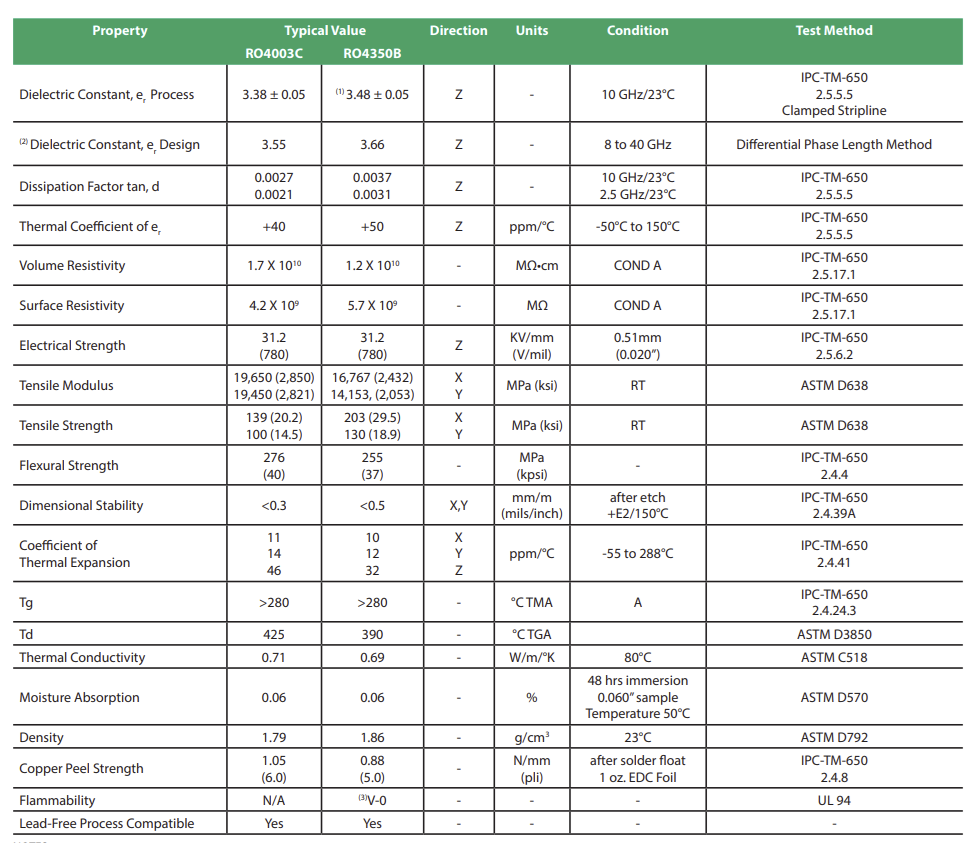
Rogers 4350B
3. Key Benefits of Rogers 4350B
1. Superior High-Frequency Performance
- Rogers material 4350B is specifically engineered for RF and microwave applications, offering a low dielectric constant (Dk) of 3.48 and an ultra-low dissipation factor (Df) of 0.0037, ensuring minimal signal loss at high frequencies.
- Unlike traditional FR-4 materials, Rogers 4350B maintains stable dielectric properties over a wide frequency range, making it ideal for applications requiring tight impedance control and high-speed signal integrity.
- The low-loss characteristics make it perfect for 5G networks, radar systems, satellite communications, and high-frequency PCBs.
2. High Thermal Stability
- Rogers material 4350B has a high glass transition temperature (Tg) of over 280°C and a thermal decomposition temperature (Td) of more than 400°C, making it highly resistant to thermal degradation and oxidation.
- With a low coefficient of thermal expansion (CTE) of 30 ppm/°C, it minimizes material deformation during high-temperature soldering and operation, preventing mechanical stress, via cracking, and delamination in multilayer PCBs.
- This thermal stability makes Rogers 4350B ideal for high-power RF amplifiers, microwave circuits, and applications that require extreme durability.
3. Excellent Moisture Resistance
- Rogers material 4350B has a moisture absorption rate of ≤0.1%, which is significantly lower than standard FR-4 materials.
- This property ensures stable electrical performance even in humid and outdoor environments, making it suitable for telecommunications, aerospace, and military applications that require long-term reliability.
- In contrast, standard FR-4 materials tend to absorb more moisture, which can lead to variations in dielectric properties, increased signal loss, and potential electrical failures over time.
4. High Power Handling and Heat Dissipation
- Rogers material 4350B offers thermal conductivity of 0.6 W/mK, which is significantly higher than standard FR-4 materials.
- This enhanced heat dissipation capability allows it to be used in high-power RF amplifiers, base stations, and radar systems, where managing thermal loads is crucial for performance and longevity.
- The combination of low loss and high heat resistance ensures that Rogers 4350B maintains signal integrity and reliability in high-frequency and high-power applications.
5. Compatibility with Standard PCB Manufacturing
- Unlike other high-frequency RF materials that require special processing techniques, Rogers material 4350B is compatible with standard FR-4 PCB manufacturing processes, reducing production complexity and costs.
- It can be processed using conventional PCB fabrication techniques, including mechanical drilling, copper plating, and standard multilayer lamination, without requiring special modifications.
- This allows manufacturers to integrate Rogers 4350B into existing production workflows, making it a cost-effective solution for high-performance RF and microwave circuits.
4. Applications of Rogers 4350B
Given its low loss, high thermal stability, and excellent electrical properties, Rogers material 4350B is widely used in various high-frequency and high-reliability applications, including:
1. RF and Microwave Circuits
- Used extensively in 5G base stations, antennas, and microwave communication systems for low signal attenuation and high reliability.
- Ideal for RF power amplifiers and radar systems, where stable dielectric properties are critical for consistent performance.
- Applied in satellite communication modules and GPS tracking systems, where low-loss transmission and high-frequency stability are required.
2. High-Speed Digital PCBs
- Enables low-loss signal transmission in networking devices, high-speed backplanes, and data center servers.
- Used in fiber-optic transceivers, AI-driven computing systems, and high-speed routers, ensuring efficient data transfer at GHz frequencies.
3. Aerospace and Military Applications
- Rogers 4350B is widely adopted in avionics, airborne radar systems, and secure military communications, where extreme environmental conditions demand highly reliable PCB materials.
- Used in missile guidance systems, navigation electronics, and space-grade communication modules, requiring low outgassing, high durability, and consistent performance.
4. Automotive ADAS and Radar Systems
- Essential for Advanced Driver Assistance Systems (ADAS), millimeter-wave radar, and vehicle-to-vehicle (V2X) communication.
- Used in long-range automotive radars, collision avoidance systems, and parking sensors, where signal integrity is crucial for safety.
5. Industrial and IoT Wireless Communication
- Rogers material 4350B is used in smart grid communication, RFID tracking, and industrial IoT sensor networks that require stable RF performance in challenging environments.
- Applied in remote monitoring systems, automation controls, and real-time asset tracking solutions, where low-power, high-frequency performance is essential.
5. Rogers 4350B vs. Other PCB Materials
| Feature | Rogers 4350B | Isola 370HR (High-Speed FR-4) | Standard FR-4 |
|---|---|---|---|
| Dielectric Constant (Dk, 10GHz) | 3.48 | 4.04 | 4.5 |
| Dissipation Factor (Df, 10GHz) | 0.0037 | 0.020 | 0.025 |
| Tg (Glass Transition Temperature, °C) | >280 | 180 | 130-140 |
| CTE (Z-Axis, ppm/°C) | 30 | 45 | 55-70 |
| Thermal Decomposition Temperature (Td, °C) | >400 | ~340 | ~310 |
| Moisture Absorption (%) | ≤ 0.1 | ≤ 0.1 | ~0.2 |
| Thermal Conductivity (W/mK) | 0.6 | 0.4 | 0.25 |
| Application Areas | 5G, RF, microwave, aerospace | High-speed digital, multilayer PCBs | General consumer electronics |
Key Takeaways:
- Choose Rogers 4350B for RF, microwave, and high-speed applications requiring low signal loss and high thermal stability.
- Isola 370HR is better suited for high-speed digital PCBs but is not optimized for RF performance.
- Standard FR-4 is a low-cost solution, but unsuitable for high-frequency applications.
6. Considerations for Using Rogers 4350B
1. Manufacturing Compatibility
- Rogers material 4350B is compatible with standard FR-4 PCB fabrication processes, reducing production complexity and costs compared to other high-frequency materials like PTFE-based laminates.
2. Material Cost
- While more expensive than standard FR-4, Rogers 4350B provides significant performance benefits in RF, microwave, and 5G applications, making it a cost-effective investment for high-performance circuits.
3. Layer Stack-Up Design
- Requires careful impedance matching, via design, and copper thickness selection to optimize RF performance and minimize signal reflections.
- Rogers 4350B can be combined with other PCB materials in hybrid stack-ups to achieve the best balance of cost, performance, and manufacturability.
7. Conclusion
Rogers 4350B is a leading PCB material for high-frequency, RF, and microwave applications, offering low loss, stable dielectric properties, and excellent thermal performance. It is widely used in 5G networks, radar systems, aerospace, and automotive applications.
For custom Rogers 4350B PCB manufacturing, Shuoqiang Electronics provides high-precision RF PCB solutions tailored for high-speed and high-frequency applications. Contact us today for expert guidance on RF PCB design and fabrication!

- long board pcb
- Flexible PCBs
- Special PCB
- Express Printed Circuit Board
- Pcb Prototype
- LED PCB
- PCB
- Printed Circuit Board
- Pcb meaning
- Pcb manufacturer
- Rigid pcb board
- Rigid Flex PCB
 Quote
Quote
 E-mail