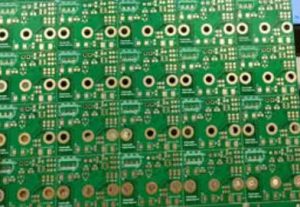
Lead-Free HASL
Understanding Lead-Free HASL
Definition of Lead-Free HASL
Lead-Free HASL, also known as LF-HASL, refers to a PCB surface finishing process in which exposed copper pads are coated with a lead-free solder alloy through immersion in molten solder followed by hot air leveling. The process protects copper surfaces from oxidation while creating a solderable finish suitable for component assembly.
Traditional HASL used tin-lead solder alloys, typically Sn63/Pb37. However, environmental regulations such as the Restriction of Hazardous Substances (RoHS) directive prohibited the widespread use of lead in electronic products. As a result, PCB manufacturers transitioned toward lead-free solder alloys containing tin combined with silver, copper, nickel, germanium, or other alloying elements.
The basic workflow of LF-HASL includes:
- PCB cleaning
- Micro-etch preparation
- Flux coating
- Immersion in molten lead-free solder
- Hot air knife leveling
- Cooling and solidification
- Surface inspection
The objective is to leave a uniform solder coating on exposed copper circuitry while removing excess solder using high-pressure heated air knives.
Unlike immersion coatings that deposit only thin metallic layers, Lead-Free HASL creates a relatively thick solder coating. This thickness provides excellent solderability and strong oxidation resistance, especially for boards stored over extended periods.
From an engineering viewpoint, one of the most valuable properties of LF-HASL is its forgiving process window during assembly. Minor handling contamination, oxidation, or thermal variations that might affect delicate finishes often have less impact on HASL-coated boards.
Lead-Free HASL Compared with Other Surface Finishes
Lead-Free HASL vs ENIG
| Feature | LF-HASL | ENIG |
|---|---|---|
| Cost | Lower | Higher |
| Flatness | Moderate | Excellent |
| Shelf life | Good | Excellent |
| Fine-pitch suitability | Limited | Excellent |
| Mechanical robustness | Strong | Strong |
| Assembly flexibility | Excellent | Excellent |
ENIG offers superior flatness but involves higher processing complexity.
LF-HASL remains attractive for cost-sensitive products.
Lead-Free HASL vs OSP
| Feature | LF-HASL | OSP |
|---|---|---|
| Shelf life | Longer | Shorter |
| Rework durability | Better | Limited |
| Cost | Moderate | Low |
| Oxidation resistance | Strong | Moderate |
| Handling sensitivity | Lower | Higher |
OSP provides low cost but requires careful handling.
LF-HASL offers more robust manufacturing tolerance.
Lead-Free HASL Process Stability in Modern PCB Manufacturing
One of the most underestimated strengths of Lead-Free HASL is process stability in high-volume manufacturing environments. In PCB production, consistency is often more valuable than theoretical performance advantages. A surface finish may look excellent in laboratory testing, but if it introduces unstable yields during large-scale manufacturing, its practical value decreases significantly.
Lead-Free HASL has remained competitive partly because manufacturers understand the process deeply after decades of industrial use. The equipment architecture, solder chemistry, thermal behavior, and defect mechanisms are all well documented. This accumulated process knowledge allows factories to optimize production with predictable outcomes.
Modern LF-HASL production lines now integrate automated temperature profiling systems, closed-loop solder pot monitoring, and airflow calibration technologies that were unavailable years ago. These improvements help reduce common defects such as uneven solder thickness, solder bridging, excessive copper dissolution, and thermal warpage.
From my observation, mature process technologies often survive because manufacturers know how to control them efficiently. LF-HASL is a perfect example. Although newer finishes receive considerable marketing attention, many production engineers still trust LF-HASL because it consistently delivers acceptable performance with manageable process risks.
The stability of the process also benefits contract manufacturers. Assembly houses prefer finishes that behave predictably during reflow, wave soldering, and repair operations. LF-HASL offers this predictability in many conventional electronic products.
Conclusion
Lead-Free HASL has become one of the most important PCB surface finishing technologies in the modern electronics industry. By replacing traditional tin-lead solder with environmentally compliant lead-free alloys, LF-HASL enables manufacturers to meet RoHS requirements without sacrificing assembly reliability or solderability.
Although the process introduces challenges related to higher thermal exposure and surface flatness, its advantages remain highly compelling. LF-HASL offers strong solder joint reliability, excellent oxidation resistance, robust assembly compatibility, long shelf life, and competitive cost performance. These qualities explain why it continues to be widely used across automotive, industrial, power, and consumer electronic sectors.
The future of LF-HASL will depend on ongoing improvements in alloy chemistry, process control, thermal management, and automation technologies. While advanced packaging trends may favor smoother surface finishes for certain applications, LF-HASL remains exceptionally valuable wherever durability, affordability, and process stability are prioritized.
Ultimately, the continued success of Lead-Free HASL demonstrates that engineering excellence is not always about adopting the newest technology. Sometimes, the most effective solution is the one that consistently delivers dependable performance under real-world manufacturing conditions.
FAQ
1. What is the difference between Lead-Free HASL and traditional HASL?
Traditional HASL uses tin-lead solder alloys containing lead, while Lead-Free HASL uses environmentally compliant lead-free alloys such as SAC305 or tin-copper systems. LF-HASL supports RoHS compliance and reduces environmental risks while maintaining strong solderability.
2. Why does Lead-Free HASL require higher processing temperatures?
Lead-free solder alloys have higher melting points than tin-lead solder. As a result, LF-HASL processes typically operate between 260°C and 270°C, which introduces additional thermal stress on PCB materials and manufacturing equipment.
3. Is Lead-Free HASL suitable for fine-pitch SMT components?
LF-HASL may not be ideal for ultra-fine-pitch components because the solder coating can create uneven surface topography. For very small BGA or CSP packages, flatter finishes such as ENIG are often preferred.
4. What industries commonly use Lead-Free HASL?
LF-HASL is widely used in automotive electronics, industrial automation, power electronics, LED lighting, home appliances, and various cost-sensitive electronic products requiring durable solder joints.
5. How does Lead-Free HASL affect PCB reliability?
Lead-Free HASL generally provides excellent mechanical durability, oxidation resistance, and solder joint reliability. The thick solder coating helps protect copper surfaces and supports long-term operational stability under thermal and mechanical stress.

- long board pcb
- Flexible PCBs
- Special PCB
- Express Printed Circuit Board
- Pcb Prototype
- LED PCB
- PCB
- Printed Circuit Board
- Pcb meaning
- Pcb manufacturer
- Rigid pcb board
- Rigid Flex PCB
 Quote
Quote
 E-mail