Beyond Mechanical Drilling: The Precision Revolution of Laser-Drilled Microvias in PCBs
Introduction: Why Laser-Drilled Microvias Mark a Turning Point
For decades, mechanical drilling defined the physical limits of printed circuit board interconnection. Drill bit diameter, tool wear, aspect ratio constraints, and registration tolerance quietly dictated what designers could—or could not—build. As long as signal speeds were moderate and component pitches forgiving, these limits were acceptable. However, the rise of high-density interconnect (HDI) architectures, advanced packaging, and multi-gigahertz signaling has pushed conventional drilling to its breaking point.
This is where Laser-Drilled Microvias fundamentally alter the trajectory of PCB manufacturing. They are not simply a smaller hole; they represent a philosophical shift—from subtractive, force-based processing to energy-controlled, precision material removal. In my view, laser drilling is one of the rare manufacturing innovations that simultaneously empowers designers, improves electrical performance, and redefines fabrication capability.
This article explores that transformation in depth, moving beyond surface-level explanations to examine why Laser-Drilled Microvias are now indispensable to modern electronics.
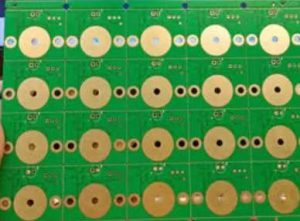
Laser-Drilled Microvias
Laser-Drilled-Microvias Definition and Technical Fundamentals
Laser-Drilled-Microvias as an Interconnection Concept
Laser-Drilled-Microvias are small-diameter vias—typically ≤150 μm—created using focused laser energy rather than mechanical drill bits. They are most commonly used to connect adjacent layers in HDI PCBs, such as layer 1 to layer 2 or layer 2 to layer 3.
Unlike traditional through-holes, these vias:
-
Do not penetrate the full board thickness
-
Are often blind vias
-
Enable sequential lamination structures
From a system-level perspective, Laser-Drilled Microvias exist to solve one core problem: how to interconnect increasingly dense circuitry without sacrificing electrical integrity or manufacturability.
Laser-Drilled-Microvias Materials Interaction and Process Physics
Laser-Drilled-Microvias and Dielectric Ablation Behavior
Laser drilling operates by selectively removing dielectric material while stopping on the copper target layer. The laser wavelength—CO₂ or UV—determines how energy couples with resin systems and fillers.
-
CO₂ lasers interact strongly with organic resin but poorly with copper
-
UV lasers offer finer control and reduced heat-affected zones
The real challenge lies not in drilling the via, but in controlling the termination depth consistently across an entire panel. Poor energy control leads to:
-
Overburning
-
Glass fiber protrusion
-
Copper damage
This is where process engineering, not just equipment capability, determines success.
Laser-Drilled Microvias and Resin System Compatibility
Not all dielectric materials respond equally to laser energy. High-Tg, low-loss materials often exhibit different ablation thresholds compared to standard FR-4.
From my experience, manufacturers that truly master Laser-Drilled Microvias invest heavily in material-process matching, rather than treating laser drilling as a generic step. This is a critical but often underestimated differentiator between average HDI suppliers and elite ones.
Laser-Drilled Microvias Design Principles for Advanced PCBs
Laser-Drilled Microvias and Aspect Ratio Optimization
One of the most important design rules for Laser-Drilled Microvias is maintaining a low aspect ratio, typically ≤1:1. Unlike mechanical vias, microvias rely on reliable copper plating in extremely confined geometries.
Designers must balance:
-
Via diameter
-
Dielectric thickness
-
Copper thickness
Exceeding plating limits leads to voids, thin copper coverage, and early-life reliability failures.
Laser-Drilled Microvias and Via-in-Pad Implementation
Laser-Drilled Microvias enable via-in-pad designs without the penalties associated with mechanically drilled vias. When properly filled and capped, they:
-
Shorten signal paths
-
Reduce parasitic inductance
-
Improve thermal conduction
However, this design freedom demands tight coordination with the fabricator. In this context, working with experienced HDI manufacturers such as SQ PCB can significantly reduce risk, as process capability must match design ambition.
Laser-Drilled Microvias Impact on Electrical Performance
Laser-Drilled Microvias and Signal Integrity Enhancement
From an electrical standpoint, Laser-Drilled Microvias dramatically reduce:
-
Stub length
-
Via barrel inductance
-
Impedance discontinuities
This becomes increasingly important as rise times shrink and edge rates, not frequency alone, dominate signal behavior. In high-speed digital designs, the via often becomes the weakest link—and microvias strengthen that link.
Laser-Drilled Microvias and Power Integrity Control
Shorter interconnects also improve power delivery networks (PDN). Laser-Drilled Microvias reduce loop area, lowering inductance and improving transient response.
In my opinion, this benefit is frequently underappreciated. Designers focus on signal nets while ignoring that power integrity failures silently undermine system reliability. Microvia-based layer transitions offer a subtle but powerful solution.
Laser-Drilled-Microvias Reliability and Failure Mechanisms
Laser-Drilled Microvias and Thermal Cycling Behavior
Reliability concerns often center on copper fatigue at the via knee. Because Laser-Drilled Microvias are short and wide relative to depth, they experience lower Z-axis strain during thermal cycling.
Field data consistently shows that well-fabricated microvias outperform deep mechanically drilled vias under accelerated life testing—provided plating quality is controlled.
Laser-Drilled-Microvias Cost Structure and Economic Trade-Offs
Laser-Drilled-Microvias Versus Mechanical Drilling Cost Reality
At first glance, Laser-Drilled Microvias appear more expensive than mechanical vias due to capital equipment costs and longer process chains. However, this comparison is incomplete.
When evaluated at the system level, microvias often reduce:
-
Layer count
-
Board size
-
Signal conditioning components
-
Re-spin frequency
In advanced designs, the question is not whether Laser-Drilled Microvias cost more per via, but whether not using them increases total product cost.
Laser-Drilled-Microvias and Yield Economics
Yield loss from via-related defects—voids, cracks, misregistration—can dominate total PCB cost. Because Laser-Drilled Microvias reduce aspect ratio stress and eliminate drill wear variability, they often produce more predictable yields once processes are stabilized.
This predictability is especially valuable in high-mix, low-volume environments, where learning cycles are short and tolerance for iteration is limited.
Laser-Drilled Microvias vs. Mechanical Drilled Vias
| Parameter | Laser-Drilled Microvias | Mechanical Drilled Vias |
|---|---|---|
| Typical Diameter | 50–150 μm | ≥200 μm |
| Via Type | Blind / Buried | Through-hole |
| Aspect Ratio | ≤1:1 | Up to 10:1 |
| Tool Wear | None | Significant |
| Registration Accuracy | Very High (Optical) | Moderate (Mechanical) |
| Stub Length | Minimal | Often Excessive |
| Suitability for HDI | Excellent | Limited |
| Signal Integrity Impact | Low parasitics | Higher parasitics |
Conclusion
The transition from mechanical drilling to laser-based interconnection is not merely a tooling upgrade; it represents a structural evolution in how PCBs are conceived, designed, and manufactured. Laser-Drilled-Microvias redefine what “precision” means in interconnect engineering by shifting control from mechanical tolerance to energy modulation and process integration.
From an engineering perspective, the most profound value of Laser-Drilled Microvias lies in their ability to compress electrical distance without compressing reliability margins. Shorter vertical transitions directly improve signal integrity, reduce parasitic effects, and stabilize power delivery networks—advantages that compound as data rates climb and voltage margins shrink.
From a manufacturing standpoint, Laser-Drilled-Microvias reward discipline. They expose weaknesses in material selection, desmear chemistry, plating uniformity, and registration control. In doing so, they elevate PCB fabrication from a sequence of isolated steps into a tightly coupled system. Manufacturers capable of mastering this system gain not only higher yields, but strategic relevance in advanced electronics supply chains.
From a design philosophy perspective, Laser-Drilled-Microvias enable a shift away from rule-constrained layouts toward intent-driven architectures. Designers are no longer forced to route around drilling limitations; instead, they can architect boards around performance objectives, trusting that precision interconnection is achievable when design intent aligns with fabrication capability.
Ultimately, Laser-Drilled Microvias are not a niche HDI feature—they are the infrastructure of modern PCB complexity. As electronics continue to demand higher density, cleaner signals, and longer service life under harsher conditions, laser-drilled interconnection will remain not just relevant, but indispensable.
FAQs
1. Will Laser-Drilled Microvias eventually replace mechanical drilling entirely?
Unlikely. Mechanical drilling remains efficient for large-diameter vias. Laser-Drilled Microvias will continue to complement, rather than replace, mechanical methods in advanced PCB designs.
2. How small can Laser–be in practical PCB manufacturing?
While laboratory conditions can achieve extremely small diameters, most production environments reliably support Laser-Drilled Microvias in the 50–100 μm range, depending on material and plating capability.
3. Are Laser-Drilled-Microvias always more reliable than mechanically drilled vias?
Not automatically. When properly designed and fabricated, Laser-Drilled Microvias often outperform mechanical vias in thermal cycling, but poor metallization or surface preparation can negate these advantages.
4. Can Laser-Drilled-Microvias be used in via-in-pad designs?
Yes. One of the major advantages of Laser-Drilled Microvias is their suitability for via-in-pad structures, especially when filled and planarized correctly.
5. Do Laser-Drilled-Microvias increase PCB cost significantly?
They may increase per-via fabrication cost, but often reduce overall system cost by enabling fewer layers, smaller board size, and improved electrical performance.

- long board pcb
- Flexible PCBs
- Special PCB
- Express Printed Circuit Board
- Pcb Prototype
- LED PCB
- PCB
- Printed Circuit Board
- Pcb meaning
- Pcb manufacturer
- Rigid pcb board
- Rigid Flex PCB
 Quote
Quote
 E-mail