FR4 is a widely used glass fiber-reinforced epoxy laminate material in the PCB industry, known for its excellent electrical insulation, mechanical stability, and cost-effectiveness. One of its critical properties is its dielectric strength, which plays a vital role in determining a circuit board’s electrical performance and reliability.
This article explores the dielectric strength, dielectric constant, frequency dependency, and impact on signal integrity of FR4, along with key factors that engineers must consider when designing high-performance PCBs.
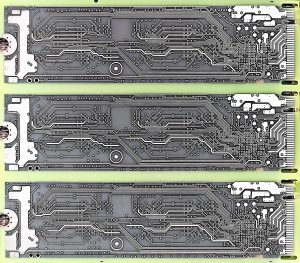
FR4 dielectric strength
Understanding FR4 Dielectric Strength
Dielectric strength refers to the maximum voltage a material can withstand before undergoing dielectric breakdown. It is a key indicator of the insulating capability of FR4 and is measured in volts per mil (V/mil) or kilovolts per millimeter (kV/mm).
Typical FR4 Dielectric Strength Values
- 800 V/mil to 1500 V/mil (31 kV/mm to 59 kV/mm)
- Measured under standard AC power frequency conditions
- Varies based on the resin composition, thickness, and glass fiber content
FR4’s high dielectric strength ensures its ability to prevent electrical breakdown, making it an ideal material for insulating high-voltage circuits and multilayer PCBs.
FR4 Dielectric Constant and Its Importance
The dielectric constant (Dk) of FR4 determines how well it can store and distribute electrical energy within an electric field. It is a critical parameter in signal transmission and impedance control.
FR4 Dielectric Constant (Dk) Range
- Typically between 3.8 and 4.8 MHz
- Commonly ranges from 4.0 to 4.7 at lower frequencies
- Varies with temperature, humidity, and frequency
A higher dielectric constant helps improve electrical insulation and reduces interference between signals in PCB circuits. However, at high frequencies, a higher Dk can lead to signal propagation delays and phase shifts, impacting high-speed applications.
The Relationship Between Dielectric Strength and Dielectric Constant
1. Definitions
- Dielectric Strength: Measures how well a material resists electrical breakdown under high voltage.
- Dielectric Constant (Dk): Describes a material’s ability to store and distribute electrical charge in an electric field.
2. Effect of Temperature on Dielectric Constant
- As temperature increases, molecular interactions weaken, leading to:
- A decrease in dielectric constant (Dk).
- A drop in dielectric strength, making breakdown more likely.
- Thermal expansion also affects material stability, requiring proper PCB design strategies for high-temperature environments.
3. Dielectric Constant vs. Signal Propagation
- Higher Dk → Slower signal propagation (signal delays and interference).
- Lower Dk → Faster signal propagation (better for high-speed applications).
Understanding this relationship is essential for designing PCBs that balance insulation performance and signal integrity.
FR4 Dielectric Constant vs. Frequency
At higher frequencies, the dielectric constant of FR4 decreases, which can significantly affect signal integrity.
Effects on High-Frequency PCB Design
- Above 5 GHz, the Dk of FR4 drops from ~4.7 to nearly 4.0, a phenomenon known as dispersion.
- Different frequency components propagate at different speeds, causing signal distortion.
- The higher the frequency, the greater the dielectric loss, leading to attenuation of signals.
Engineers must carefully consider material selection for high-frequency applications to minimize signal degradation.
Signal Propagation and Losses in FR4 PCBs
1. Signal Propagation Speed
- Signal velocity is inversely proportional to the square root of the dielectric constant.
- As Dk decreases at high frequencies, signal speed increases, which can cause timing mismatches in PCB layouts.
2. Signal Attenuation & Losses
- At high frequencies, dielectric loss (Df) increases, leading to:
- Weakened signal strength over transmission distance.
- Increased power consumption due to signal degradation.
- Reduced reliability in high-speed digital circuits.
For high-frequency PCBs, engineers often consider alternative materials such as PTFE (Teflon) or ceramics, which provide lower dielectric losses and better signal integrity.
Impact of FR4 Dielectric Strength on PCB Reliability
1. Electrical Breakdown & Safety Considerations
- When the electric field strength exceeds the dielectric strength of FR4, the material undergoes electrical breakdown, resulting in:
- Short circuits or catastrophic PCB failure.
- Permanent damage to electronic components.
- Proper design techniques, such as trace spacing, insulation barriers, and protective coatings, are necessary to prevent electrical failure.
2. Selecting the Right Material for High-Voltage Applications
- For circuits operating near FR4’s dielectric limits, engineers may choose:
- Higher-grade FR4 variants with enhanced insulation properties.
- Hybrid laminates combining FR4 with PTFE or ceramic materials for improved dielectric strength.
Optimizing PCB Design for High Dielectric Strength
To maximize the electrical reliability of FR4-based PCBs, consider the following best practices:
1. Use Proper PCB Layout Techniques
✅ Increase trace spacing to prevent arcing and short circuits.
✅ Use ground planes and shielding layers to improve electromagnetic compatibility (EMC).
✅ Minimize trace lengths in high-speed circuits to reduce signal delays and losses.
2. Consider Alternative Materials for High-Frequency Circuits
✅ PTFE (Teflon) laminates – Excellent for RF and microwave applications.
✅ Ceramic substrates – High thermal stability and low signal attenuation.
✅ Hybrid materials – Combine FR4 with advanced dielectric composites for better insulation performance.
3. Thermal Management Strategies
✅ Proper heat dissipation prevents dielectric degradation over time.
✅ Use thermal vias and heat sinks to maintain consistent material properties.
✅ Ensure material stability under operating temperature variations.
By applying these strategies, engineers can optimize PCB performance, maintain signal integrity, and enhance the lifespan of electronic devices.
Conclusion
FR4 remains the industry-standard material for PCB manufacturing due to its high dielectric strength, cost-effectiveness, and reliable insulation properties. However, its dielectric constant and performance vary with frequency and temperature, requiring careful consideration in high-speed and high-frequency circuit designs.
Key Takeaways
✔ FR4 dielectric strength ranges from 800 V/mil to 1500 V/mil, ensuring excellent insulation performance.
✔ Dielectric constant (Dk) varies between 3.8 and 4.8 MHz and decreases at higher frequencies, affecting signal propagation.
✔ High-frequency circuits require materials with lower dielectric losses, such as PTFE or ceramics, to maintain signal integrity.
✔ Proper PCB layout, trace spacing, and thermal management are essential for maximizing dielectric strength and electrical reliability.
As technology advances, understanding FR4’s electrical properties and adapting design strategies will be crucial in building high-performance, reliable PCBs for modern electronics.
our linkedin sqpcb.com

- long board pcb
- Flexible PCBs
- Special PCB
- Express Printed Circuit Board
- Pcb Prototype
- LED PCB
- PCB
- Printed Circuit Board
- Pcb meaning
- Pcb manufacturer
- Rigid pcb board
- Rigid Flex PCB
 Quote
Quote
 E-mail