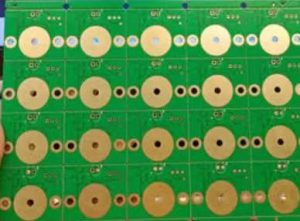
FR-4
FR-4 Definition and Industry Significance
FR-4 is a glass-fiber-reinforced epoxy laminate material used extensively in printed circuit board manufacturing. The designation “FR” stands for “Flame Retardant,” while the number “4” identifies a specific grade classification established by the National Electrical Manufacturers Association (NEMA).
The material consists primarily of woven fiberglass cloth impregnated with epoxy resin. After curing under controlled heat and pressure, the resulting composite exhibits excellent electrical insulation, mechanical rigidity, and flame resistance.
Several key characteristics define this laminate:
- High dielectric insulation
- Excellent mechanical stability
- Strong moisture resistance
- Good dimensional accuracy
- Cost-effective manufacturing
- UL94 V-0 flame retardant compliance
The widespread use of this material has created a global manufacturing ecosystem optimized around its properties. PCB fabricators, assembly houses, component manufacturers, and design engineers have developed processes specifically tailored to its performance characteristics.
In many ways, the modern electronics industry has been built upon this material platform.
FR-4 Material Composition and Structure
The exceptional balance of properties originates from the combination of fiberglass reinforcement and thermosetting epoxy resin.
Fiberglass Reinforcement
Fiberglass cloth provides:
- Mechanical strength
- Dimensional stability
- Low thermal expansion
- Structural rigidity
The woven glass fabric acts as the skeleton of the laminate.
Common glass styles include:
| Glass Style | Typical Thickness | Common Uses |
|---|---|---|
| 106 | Very Thin | HDI PCBs |
| 1080 | Thin | Fine-line circuits |
| 2116 | Medium | Multilayer PCBs |
| 7628 | Thick | Standard multilayer boards |
Epoxy Resin System
The epoxy resin provides:
- Electrical insulation
- Adhesion to copper foil
- Moisture resistance
- Chemical resistance
Different resin formulations may be used depending on thermal and electrical performance requirements.
Copper Foil Integration
Copper foil is laminated onto the substrate surfaces.
Common copper weights include:
| Copper Weight | Thickness |
|---|---|
| 0.5 oz | 17 μm |
| 1 oz | 35 μm |
| 2 oz | 70 μm |
| 3 oz | 105 μm |
The copper layer ultimately forms the conductive circuitry.
FR-4 Resin Systems and Their Impact on PCB Performance
Although FR-4 is often discussed as a single material, numerous resin formulations exist within the category. Different resin systems can significantly affect the final performance of a PCB.
The epoxy resin serves several important functions within the laminate structure. It binds the fiberglass layers together, provides electrical insulation, protects against moisture penetration, and contributes to thermal and mechanical stability. Modifications to the resin chemistry can enhance specific performance characteristics depending on application requirements.
Standard epoxy systems are typically sufficient for consumer electronics and general industrial applications. However, products exposed to harsh environments may require advanced resin formulations offering higher thermal resistance or improved chemical stability.
For example, high-Tg epoxy systems are widely used in automotive electronics, industrial control equipment, and communication infrastructure. These materials maintain structural integrity at elevated temperatures and reduce the risk of delamination during multiple lead-free soldering cycles.
Low-loss resin systems represent another important development. As data transmission speeds continue increasing, signal attenuation becomes a growing concern. Low-loss variants reduce dielectric losses and improve signal integrity without requiring designers to transition to significantly more expensive high-frequency materials.
From my perspective, one of the reasons FR-4 remains so successful is its adaptability. Rather than being a static material, it has evolved through continuous resin innovation, allowing it to satisfy the requirements of increasingly demanding electronic applications.
FR-4 Manufacturing Yield and Cost Efficiency
Another reason for the dominance of FR-4 is its exceptional manufacturing efficiency.
Because the material has been used extensively for decades, fabrication processes have become highly optimized. Equipment manufacturers, laminate suppliers, and PCB fabricators all understand its behavior in great detail.
This maturity provides several advantages:
- Higher manufacturing yields
- Lower scrap rates
- Faster process development
- Reduced engineering risk
- Shorter lead times
Compared with exotic substrate materials, FR-4 generally requires fewer process modifications and less specialized equipment.
For PCB buyers, these efficiencies translate directly into lower costs and more predictable delivery schedules.
When evaluating total product cost, engineers should consider not only laminate pricing but also manufacturing yield, supply chain stability, and production scalability. In many cases, FR-4 remains the most economical solution because it minimizes overall production risk.
Conclusion
FAQ
1. How does FR-4 affect PCB reliability?
The material influences thermal stability, dimensional accuracy, insulation performance, and plated-through-hole reliability. Proper material selection, stackup design, and manufacturing control help ensure long-term PCB reliability in demanding operating environments.
2. What does FR-4 stand for?
“FR” means Flame Retardant, while “4” identifies a specific NEMA material classification. The material is designed to provide excellent electrical insulation, mechanical strength, and flame resistance.
3. Is FR-4 suitable for high-frequency PCB applications?
It performs well for many digital and moderate-frequency applications. However, for very high-frequency RF and microwave designs above several gigahertz, specialized low-loss materials such as PTFE- or Rogers-based laminates are often preferred.
4. What is the typical glass transition temperature of FR-4?
Standard grades usually have a Tg of approximately 130–140°C, while high-Tg versions can reach 170–200°C, providing improved thermal reliability for demanding applications.
5. Why is FR-4 the most widely used PCB substrate?
Its popularity comes from the combination of low cost, good electrical insulation, strong mechanical performance, widespread availability, mature manufacturing processes, and compatibility with virtually all standard PCB fabrication technologies.

- long board pcb
- Flexible PCBs
- Special PCB
- Express Printed Circuit Board
- Pcb Prototype
- LED PCB
- PCB
- Printed Circuit Board
- Pcb meaning
- Pcb manufacturer
- Rigid pcb board
- Rigid Flex PCB
 Quote
Quote
 E-mail