Electroless Nickel Immersion Gold (ENIG) Under Pressure: When Surface Finish Becomes a Cost Driver
Introduction
In the evolving landscape of printed circuit board (PCB) manufacturing, surface finishes are no longer a secondary consideration—they are strategic cost drivers and performance enablers. Among these finishes, Electroless Nickel Immersion Gold has emerged as one of the most widely adopted solutions due to its excellent flatness, corrosion resistance, and compatibility with fine-pitch components.
However, the very advantages that make this finish desirable have also turned it into a focal point of cost pressure. Rising gold prices, tighter environmental regulations, and increasing performance demands from high-speed electronics have elevated the importance of understanding its economic and technical implications.
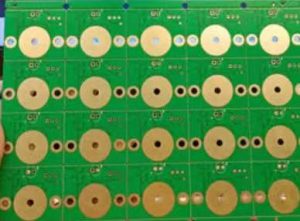
Electroless Nickel Immersion Gold
2. ENIG Definition and Fundamental Principles of ENIG
Electroless Nickel Immersion Gold is a dual-layer metallic coating applied to exposed copper pads on a PCB. It consists of an electroless nickel layer followed by a thin immersion gold layer.
2.1 Core Definition of ENIG
At its core, this surface finish involves two sequential chemical deposition processes:
- Electroless Nickel Deposition:
A chemical reduction process deposits a uniform nickel-phosphorus alloy layer onto copper without external current. - Immersion Gold Deposition:
A displacement reaction replaces the top surface of nickel with a thin gold layer.
The resulting structure typically includes:
- Nickel thickness: 3–6 µm
- Gold thickness: 0.05–0.1 µm
This layered configuration provides both mechanical durability and excellent solderability.
2.2 Functional Role of ENIG in PCB Manufacturing
This finish serves multiple critical roles:
- Acts as a diffusion barrier preventing copper migration
- Provides a solderable surface for component assembly
- Ensures planarity for fine-pitch devices such as BGAs
- Enhances corrosion resistance during storage and operation
Unlike HASL (Hot Air Solder Leveling), it offers a flat surface ideal for modern miniaturized electronics.
2.3 Why ENIG Became an Industry Standard
Several factors contributed to its widespread adoption:
- Compatibility with lead-free soldering processes
- Suitability for high-density interconnect (HDI) designs
- Stable electrical performance in high-frequency applications
- Long shelf life compared to organic coatings
From my perspective, the rise of this finish mirrors the broader shift toward precision electronics. As component pitches shrink and signal speeds increase, surface uniformity becomes non-negotiable—and this is where ENIG excels.
3. ENIG Process Flow and Chemical Mechanisms of ENIG
Understanding the process flow is essential to grasp both cost drivers and reliability risks.
3.1 Step-by-Step Process Flow of ENIG
The process typically includes:
- Cleaning and micro-etching
- Pre-treatment and activation
- Electroless nickel deposition
- Rinsing
- Immersion gold deposition
- Final rinsing and drying
Each step must be tightly controlled to avoid defects such as black pad or poor adhesion.
3.2 Chemical Reactions Behind ENIG
- Nickel Deposition Reaction:
Nickel ions are reduced by a chemical reducing agent (commonly sodium hypophosphite), forming a nickel-phosphorus alloy. - Gold Deposition Reaction:
Gold ions replace nickel atoms via a displacement reaction, forming a thin protective layer.
This dual chemistry introduces complexity—especially in bath maintenance and contamination control.
3.3 Process Sensitivity and Control Challenges in ENIG
Key variables include:
- Bath temperature
- pH levels
- Metal ion concentration
- Contaminants
Small deviations can result in:
- Uneven thickness
- Poor solderability
- Increased defect rates
This sensitivity directly translates into higher operational costs, as tighter process control demands advanced equipment and skilled labor.
4. ENIG Cost Structure and Economic Drivers of ENIG
The cost of this surface finish is influenced by multiple interrelated factors.
4.1 Raw Material Costs in ENIG
The most significant contributor is gold:
- Gold prices are volatile and globally traded
- Even thin layers contribute significantly to cost
Nickel, while cheaper, also adds cost due to its thickness and deposition requirements.
4.2 Chemical and Process Costs in ENIG
- Chemical bath maintenance
- Waste treatment and environmental compliance
- Energy consumption
- Equipment depreciation
These hidden costs often exceed raw material costs in high-volume production.
4.3 Yield and Defect Costs in ENIG
Defects such as black pad can lead to:
- Scrap boards
- Rework costs
- Reliability failures in the field
Yield loss is a major but often underestimated cost driver.
4.4 Market Dynamics Affecting ENIG Pricing
- Gold market fluctuations
- Supply chain disruptions
- Increasing demand from AI, automotive, and 5G industries
From a strategic standpoint, ENIG is no longer just a technical choice—it is a financial decision.
5. ENIG Impact on PCB Electrical and Mechanical Performance
The influence of surface finish extends far beyond solderability. It plays a critical role in defining the electrical behavior, mechanical integrity, and long-term reliability of a PCB.
5.1 Electrical Conductivity Characteristics of ENIG
The outer gold layer provides excellent conductivity, but due to its extremely thin thickness, the primary conductive path is actually through the nickel layer beneath.
Key considerations include:
- Nickel has higher resistivity than copper, which can slightly impact signal transmission
- The thin gold layer ensures low contact resistance at interfaces
- Skin effect at high frequencies shifts current flow toward the surface
From a practical standpoint, the nickel layer becomes increasingly relevant as signal frequencies rise.
5.2 Signal Integrity and High-Speed Performance in ENIG
In high-speed digital and RF circuits:
- The skin effect causes current to flow primarily through the outer layers
- Since nickel is less conductive, it introduces additional insertion loss
- This can degrade signal integrity in GHz-range applications
However, the thin gold layer partially mitigates oxidation, ensuring consistent performance over time.
In my view, ENIG represents a trade-off: while not the best performer in ultra-high-frequency scenarios, it offers a balanced solution between reliability and manufacturability.
Comparative Table: ENIG vs Other PCB Surface Finishes
| Parameter | ENIG | HASL (Lead-Free) | OSP | Immersion Silver | Immersion Tin |
|---|---|---|---|---|---|
| Surface Planarity | Excellent | Poor | Good | Excellent | Good |
| Solderability | Excellent | Good | Moderate | Excellent | Good |
| Shelf Life | Long | Long | Short | Moderate | Moderate |
| Cost Level | High | Low | Very Low | Medium | Medium |
| Process Complexity | High | Low | Low | Medium | Medium |
| Suitable for Fine Pitch | Yes | No | Limited | Yes | Yes |
| Oxidation Resistance | Excellent | Good | Poor | Moderate | Moderate |
| Electrical Performance (High Frequency) | Moderate | Good | Good | Excellent | Good |
| Mechanical Durability | Excellent | Good | Poor | Moderate | Moderate |
| Risk Factors | Black pad | Uneven surface | Handling sensitivity | Tarnishing | Tin whiskers |
| Environmental Impact | High (chemical use) | Moderate | Low | Moderate | Moderate |
| Typical Applications | HDI, BGA, Aerospace | Consumer electronics | Low-cost PCBs | RF, High-speed | General electronics |
Conclusion
Electroless Nickel Immersion Gold has firmly established itself as one of the most reliable and versatile surface finishes in modern PCB manufacturing. Its ability to deliver excellent planarity, strong corrosion resistance, and consistent solderability makes it indispensable in high-density, high-performance electronic designs.
Yet, as the electronics industry evolves, this once “default” finish is increasingly being scrutinized through the lens of cost efficiency. The rising price of gold, combined with tightening environmental regulations and growing process complexity, has transformed it into a significant cost driver within the PCB value chain.
From a technical standpoint, the dual-layer structure provides a unique balance: the nickel layer ensures mechanical strength and diffusion resistance, while the gold layer preserves surface integrity and solderability. However, this same structure introduces challenges—particularly in high-frequency applications where nickel’s electrical properties can impact signal performance.
From my perspective, the real value of ENIG lies not in its universal application, but in its strategic deployment. It should be used where its advantages—such as reliability, flatness, and durability—clearly outweigh its cost. In lower-end or cost-sensitive designs, alternative finishes may provide a better balance.
Moreover, the importance of process control and supplier capability cannot be overstated. Poor implementation can negate all theoretical advantages, leading to defects such as black pad and ultimately increasing total lifecycle cost. This is why collaboration with experienced manufacturers remains essential.
Looking ahead, ENIG will continue to play a critical role, especially in advanced sectors such as AI hardware, automotive electronics, and aerospace systems. However, its future will likely involve:
- Greater process optimization
- Selective usage strategies
- Integration with hybrid surface finish technologies
- Continued innovation in plating chemistry
In conclusion, ENIG is no longer just a finishing step—it is a strategic engineering and economic decision. Companies that understand and optimize its application will be better positioned to navigate the dual pressures of performance demands and cost constraints.
FAQ
1. How can manufacturers reduce ENIG costs?
By optimizing layer thickness, improving process control, increasing yield, and selecting experienced suppliers.
2. What are the main advantages of ENIG over other surface finishes?
It offers excellent flatness, strong corrosion resistance, and reliable solderability, making it ideal for fine-pitch and high-density designs.
3. Why is ENIG considered expensive?
The primary reason is the use of gold, along with complex chemical processes and strict quality control requirements.
4. What is the black pad issue in ENIG?
It is a defect caused by excessive nickel corrosion, leading to weak solder joints and potential reliability failures.
5. Is ENIG suitable for high-frequency applications?
It can be used, but the nickel layer may introduce signal loss at very high frequencies, making alternatives preferable in some RF designs.

- long board pcb
- Flexible PCBs
- Special PCB
- Express Printed Circuit Board
- Pcb Prototype
- LED PCB
- PCB
- Printed Circuit Board
- Pcb meaning
- Pcb manufacturer
- Rigid pcb board
- Rigid Flex PCB
 Quote
Quote
 E-mail