Subtitle: Accurate Calculation of Raw Material Cost Increase for 4-Layer ENIG PCBs – Empower PCB Procurement Teams with Negotiation & Cost Control Tools
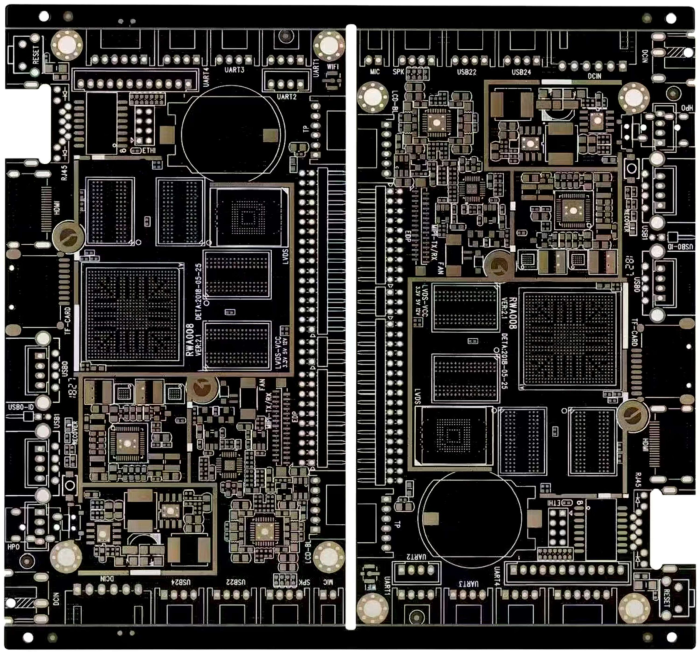
4-Layer ENIG PCB
I. Core Basic Data: Material Consumption for 1㎡ 4-Layer ENIG PCBs (Mass Production Tested)
Copper: Consumption Composition/Process Standard – 1. Substrate copper foil (4 layers: 2 outer layers + 2 inner layers; outer layers 0.5OZ≈18μm, inner layers 1OZ≈35μm); 2. Electroplated copper balls (supplement for conductive circuits and via filling); Actual Consumption per 1㎡ – 1.132kg/m²; Key Notes – Including 25% etching loss and electroplating bath loss; same copper thickness configuration as 4-layer HASL PCBs, about 1.7 times the copper consumption of double-sided PCBs.
Tin: Consumption Composition/Process Standard – Circuit tin plating (negative process, tin plating after copper plating); Actual Consumption per 1㎡ – 0.05kg/m²; Key Notes – Including 8% plating bath waste and circuit redundancy; compliant with RoHS standards, the tin consumption of ENIG PCBs is much lower than that of HASL PCBs.
PP (Prepreg/Glass Cloth): Consumption Composition/Process Standard – Routine ratio for 1.6mm 4-layer PCBs (for lamination and interlayer bonding); Actual Consumption per 1㎡ – 7 sheets/m²; Key Notes – Suitable for 4-layer lamination structure, 1 sheet of PP for each lamination interface, consistent with the PP consumption of 4-layer HASL PCBs, meeting the requirements of interlayer bonding strength.
Gold: Consumption Composition/Process Standard – ENIG process (2μin thickness, 20% gold-plated billing area, industry universal minimum threshold); Actual Consumption per 1㎡ – 0.196088g/m²; Key Notes – Complies with IPC-4552 Class 2 standard, precise gold deposition amount without additional loss; most suppliers calculate orders with less than 20% gold-plated area at 20%.
II. Raw Material Price Comparison: Pre vs. Post-Sept 2025 (User-Specified + Industry-Verified)
Copper: Pre-Sept 2025 Price – 78 CNY/kg (78,000 CNY/ton); Post-Sept 2025 Price – 102 CNY/kg (102,000 CNY/ton); Price Increase – 24 CNY/kg (3.31 USD/kg); Increase Rate – 30.77%
Tin: Pre-Sept 2025 Price – 270 CNY/kg (270,000 CNY/ton); Post-Sept 2025 Price – 460 CNY/kg (460,000 CNY/ton); Price Increase – 190 CNY/kg (26.22 USD/kg); Increase Rate – 70.37%
PP (Prepreg): Pre-Sept 2025 Price – 13 CNY/sheet; Post-Sept 2025 Price – 15 CNY/sheet; Price Increase – 2 CNY/sheet (0.28 USD/sheet); Increase Rate – 15.38%
Gold: Pre-Sept 2025 Price – 700 CNY/g (user-specified); Post-Sept 2025 Price – 1100 CNY/g (user-specified); Price Increase – 400 CNY/g (55.20 USD/g); Increase Rate – 57.14%
III. Accurate Cost Increase Calculation for 1㎡ 4-Layer ENIG PCBs (Excluding Processing Fees)
Single Material Increase = Actual Consumption per 1㎡ × Unit Price Increase
Total Increase = Copper Increase + Tin Increase + PP Increase + Gold Increase
1. Material-Specific Cost Increase Details (Accurate to Two Decimal Places)
Copper: Consumption per 1㎡ – 1.132kg; Unit Price Increase – 24 CNY/kg; Cost Increase per 1㎡ – 27.17 CNY (3.75 USD); Calculation Process – 1.132 × 24 = 27.168 ≈ 27.17
Tin: Consumption per 1㎡ – 0.05kg; Unit Price Increase – 190 CNY/kg; Cost Increase per 1㎡ – 9.50 CNY (1.31 USD); Calculation Process – 0.05 × 190 = 9.50
PP: Consumption per 1㎡ – 7 sheets; Unit Price Increase – 2 CNY/sheet; Cost Increase per 1㎡ – 14.00 CNY (1.93 USD); Calculation Process – 7 × 2 = 14.00
Gold: Consumption per 1㎡ – 0.196088g; Unit Price Increase – 400 CNY/g; Cost Increase per 1㎡ – 78.44 CNY (10.82 USD); Calculation Process – 0.196088 × 400 = 78.4352 ≈ 78.44
Total: Cost Increase per 1㎡ – 129.11 CNY (≈129 CNY/m²) / 17.81 USD (≈17.8 USD/m²)
2. Total Increase Summary & Key Insights
Gold Price Hike Contribution: Cost Increase – 78.44 CNY/m²; Contribution Ratio – 60.75%; Key Impact – The absolute core driver of cost increase; the gold unit price increased by more than 57%, and despite low physical consumption, the high unit price makes it the material with the largest price increase.
Copper Price Hike Contribution: Cost Increase – 27.17 CNY/m²; Contribution Ratio – 21.04%; Key Impact – The largest physical consumption with a moderate unit price increase, the contribution ratio is stable and consistent with the copper price hike contribution of 4-layer HASL PCBs.
PP Price Hike Contribution: Cost Increase – 14.00 CNY/m²; Contribution Ratio – 10.84%; Key Impact – Small single-sheet price increase, the cumulative increase of 7 sheets is controllable, which is a general consumable increase for 4-layer PCBs without the impact of process particularity.
Tin Price Hike Contribution: Cost Increase – 9.50 CNY/m²; Contribution Ratio – 7.37%; Key Impact – Only for circuit tin plating without full-board tin spraying, the tin consumption of ENIG PCBs is much lower than that of HASL PCBs, so the impact of tin price hike is minimal.
Total Raw Material Increase: Cost Increase – 129.11 CNY/m²; Contribution Ratio – 100%; Key Note – Pure raw material cost only; the cost increase of 4-layer ENIG PCBs is about twice that of 4-layer HASL PCBs, and the difference is entirely caused by gold consumption and price hike.
IV. Common FAQs for PCB Procurement Teams
Q1: Why is the cost increase of 4-layer ENIG PCBs much higher than that of 4-layer HASL PCBs? What is the core reason?
Q2: Does the 129 CNY/m² increase include processing fees and auxiliary material costs?
Q3: How to calculate the cost increase for customized 4-layer ENIG PCBs (e.g., full-board gold plating, 2OZ inner layer)?
A3: It can be adjusted proportionally based on the standard data in this article with the core formula unchanged:
① Full-board gold plating (100% billing area): Gold consumption increases to 0.98044g/m², and the gold price increase surges to 392.20 CNY/m²;
② 2OZ inner layer copper thickness: Copper consumption doubles to 2.264kg/m², and the copper price increase rises to 54.34 CNY/m²;
Contact us to get a free customized cost calculation sheet based on your specific parameters.
Q4: How to control the procurement cost of 4-layer ENIG PCBs amid the gold price surge?
Control the gold-plated area: On the premise of meeting product performance, keep the gold-plated area within the 20% billing threshold and only plate gold on key pins/areas;
Lock in gold prices: Sign 1-3 year long-term fixed-price agreements with reliable suppliers or hedge through gold futures to avoid the risk of continuous price fluctuations;
Optimize copper thickness specifications: For non-high-current circuits, maintain the conventional specification of 0.5OZ outer layer and 1OZ inner layer without blind thickening to reduce copper consumption.
Q5: Will the raw material cost of 4-layer ENIG PCBs continue to rise in 2026?
V. Industry Practical Suggestions (Empower Negotiation & Cost Control)
Judge the Reasonableness of Supplier Price Hikes: If the total price increase of the PCB supplier‘s finished product quotation exceeds 139 CNY/m² (including raw materials, processing fees, and auxiliary materials), there is a high probability of a premium. Use the copper, tin, PP and gold price increase data in this article to negotiate and refute unreasonable premiums.
Optimize Gold Plating Design: On the premise of ensuring product reliability, reduce the gold-plated area as much as possible, only plate gold on the core conductive areas, and use OSP process for other areas, which can reduce gold consumption by 50%-80%.
Verify Material Consumption Data: Request suppliers to provide copper, tin, PP and gold consumption reports for each batch, and compare them with the tested data in this article to avoid overcharging caused by “false gold consumption”.
Explore Alternative Processes: For non-extreme high-reliability application scenarios, replace the ENIG process with immersion silver/OSP process to completely eliminate gold consumption, and the raw material cost of 4-layer PCBs can be reduced by 60%-70%.
VI. Call to Action
Core SEO Keywords

- long board pcb
- Flexible PCBs
- Special PCB
- Express Printed Circuit Board
- Pcb Prototype
- LED PCB
- PCB
- Printed Circuit Board
- Pcb meaning
- Pcb manufacturer
- Rigid pcb board
- Rigid Flex PCB
 Quote
Quote
 E-mail