The Transparent Bridge: How Through-Glass Via Technology Is Revolutionizing High-Frequency and Advanced Packaging
Introduction
The relentless demand for higher data rates, lower signal loss, tighter integration, and more compact electronic systems is reshaping how interconnections are designed and manufactured. As traditional printed circuit board (PCB) and organic substrate technologies approach their physical and electrical limits—particularly in high-frequency, millimeter-wave, and advanced packaging applications—engineers are increasingly exploring unconventional materials and structures to bridge the performance gap.
One of the most compelling developments in this landscape is the emergence of glass as a functional interposer and substrate material. Long valued for its optical clarity and chemical stability, glass is now being re-evaluated as an electrical platform, enabled by breakthroughs in precision drilling, metallization, and thermal management. At the center of this transformation lies Through-Glass Via Technology, a structural and electrical innovation that allows vertical interconnection through glass substrates with unprecedented signal integrity and dimensional stability.
In my view, the real significance of this technology is not simply that it replaces silicon or organic interposers in certain applications, but that it introduces an entirely new design philosophy—one where electrical performance, mechanical stability, and scalability are no longer mutually exclusive trade-offs.
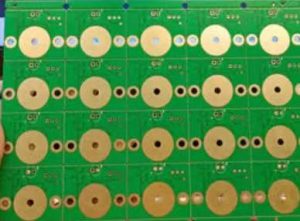
Through-Glass Via Technology
Understanding the Definition of Through-Glass Via Technology
The Fundamental Concept of Through-Glass Via Technology
Through-Glass Via Technology refers to the process of forming electrically conductive vertical interconnections that pass completely through a glass substrate. These vias function similarly to through-silicon vias (TSVs) or plated through holes (PTHs) in traditional PCBs, but they are implemented within glass rather than silicon or organic laminate materials.
At its core, Through-Glass Via Technology involves three essential steps:
-
Precision via formation in glass
-
Electrical insulation and surface preparation
-
Metallization and via filling
The challenge—and innovation—lies in adapting these steps to a material that is electrically insulating, brittle, and chemically inert, yet dimensionally stable and extremely smooth at the microscopic level.
Material Characteristics That Enable Through-Glass Via Technology
Glass offers a combination of properties that make it uniquely attractive for advanced interconnect applications:
-
Low dielectric constant (Dk) and low dielectric loss (Df)
-
Excellent surface smoothness, ideal for fine-line metallization
-
Near-zero moisture absorption, unlike organic substrates
-
Superior dimensional stability across temperature cycles
These attributes form the foundation upon which Through-Glass Via Technology delivers its electrical and mechanical advantages. Unlike FR-4 or other resin-based laminates, glass does not swell, warp, or absorb moisture, which directly translates into improved impedance control and long-term reliability.
Via Formation Methods in Through-Glass Via Technology
One of the defining technical challenges of Through-Glass Via Technology is creating high-aspect-ratio holes in glass without inducing cracks or micro-fractures. Several methods are currently in industrial and pilot-scale use:
-
Laser drilling, including picosecond and femtosecond lasers
-
Wet etching using photosensitive glass formulations
-
Plasma-based dry etching for ultra-fine vias
Laser drilling dominates today due to its flexibility and compatibility with volume manufacturing. When properly optimized, laser-drilled vias can achieve diameters below 50 µm with smooth sidewalls, which is essential for uniform metallization.
Metallization Approaches in Through-Glass Via Technology
Once vias are formed, they must be converted into reliable electrical conductors. This typically involves:
-
Surface activation
-
Seed layer deposition (often sputtered copper or titanium/copper stacks)
-
Electroplating or electroless copper filling
Compared to silicon vias, Through-Glass Via Technology allows for more relaxed thermal mismatch constraints, since glass has a coefficient of thermal expansion (CTE) closer to copper than organic materials. In my experience, this significantly reduces stress concentration at the via-to-substrate interface, especially during thermal cycling.
Key Advantages of Through-Glass Via Technology and Their Impact on PCB Performance
Electrical Advantages of Through-Glass Via Technology in High-Frequency Applications
Perhaps the most compelling advantage of Through-Glass Via Technology lies in its electrical performance at high frequencies. Glass substrates typically exhibit dielectric constants in the range of 4–6, with extremely low loss tangents. When paired with smooth copper conductors, this results in:
-
Lower insertion loss
-
Reduced signal dispersion
-
Improved impedance stability
For RF, mmWave, and high-speed digital designs, these improvements directly translate into higher data throughput and cleaner signal eye diagrams. Compared with conventional PCB vias, glass vias introduce less parasitic capacitance and inductance, which becomes increasingly critical above 10 GHz.
Mechanical and Thermal Stability Enabled by Through-Glass Via Technology
Unlike organic PCB materials, glass maintains its shape and dimensions over wide temperature ranges. This stability enhances PCB performance in several ways:
-
Consistent via alignment in multi-layer or stacked configurations
-
Reduced warpage, improving assembly yield
-
Lower mechanical stress on solder joints and interconnects
In advanced packaging scenarios—such as chiplet integration or 2.5D architectures—Through-Glass Via Technology enables tighter pitch designs without compromising reliability. This is an area where I believe glass will increasingly outperform both silicon interposers and high-end organic substrates.
Manufacturing Scalability and Design Flexibility of Through-Glass Via Technology
From a manufacturing standpoint, Through-Glass Via Technology occupies an interesting middle ground. While more complex than standard PCB drilling, it avoids many of the cost and yield challenges associated with silicon interposers.
Glass panels can be processed in large formats, similar to PCB panels, enabling economies of scale. Leading PCB manufacturers—including advanced suppliers such as SQ PCB, which actively explores emerging substrate technologies—are well positioned to integrate Through-Glass Via Technology into hybrid PCB and packaging solutions.
Impact of Through-Glass Via Technology on Signal Integrity and Power Delivery
Another often overlooked benefit is power integrity. The low loss and uniform dielectric properties of glass reduce noise coupling between power and signal paths. This allows designers to:
-
Route power delivery networks closer to sensitive signals
-
Minimize decoupling capacitor count
-
Improve overall electromagnetic compatibility (EMC)
In high-density designs, these improvements can simplify layout complexity while enhancing system robustness.
Through-Glass Via Technology vs. Traditional Via Technologies
| Feature | Through-Glass Via Technology | PCB Plated Through Hole | Through-Silicon Via |
|---|---|---|---|
| Substrate Material | Glass | Organic laminate | Silicon |
| Typical Via Diameter | 30–100 µm | 150–300 µm | <10–50 µm |
| Parasitic Capacitance | Low | Moderate to high | Moderate |
| High-Frequency Performance | Excellent | Limited | Good |
| Moisture Sensitivity | Minimal | High | Minimal |
| Manufacturing Infrastructure | Panel-level compatible | Mature and widespread | Wafer-level |
Conclusion
Through-Glass Via Technology represents a quiet but profound shift in how vertical interconnections are conceived for high-frequency and advanced packaging applications. By leveraging the intrinsic electrical stability, smoothness, and moisture resistance of glass, this technology addresses limitations that have long constrained organic substrates and, in some cases, silicon interposers.
What makes Through-Glass Via Technology particularly compelling is not just its performance advantages, but its architectural flexibility. It enables new forms of integration—hybrid substrates, transparent packaging, and scalable interposer designs—that align closely with the future trajectory of electronics.
From my perspective, the success of Through-Glass Via Technology will not be measured by how quickly it replaces existing solutions, but by how effectively it integrates into the broader ecosystem of PCB manufacturing and advanced packaging. As high-speed, high-density systems become the norm rather than the exception, glass-based interconnects are poised to transition from experimental curiosity to essential infrastructure.
FAQs
1. Will Through-Glass Via Technology replace silicon interposers?
It is unlikely to fully replace silicon interposers. Instead, Through-Glass Via Technology complements them by offering lower loss, larger panel sizes, and potentially lower cost for applications where extreme miniaturization is not required.
2. How does Through-Glass Via Technology differ from traditional PCB vias?
Traditional PCB vias pass through organic laminate materials, which can absorb moisture and exhibit dielectric variability. Through-Glass Via Technology forms vias in glass substrates, resulting in lower dielectric loss, improved dimensional stability, and reduced parasitic effects—especially at high frequencies.
3. Is Through-Glass Via Technology suitable for mass production?
While still less mature than conventional PCB processes, Through-Glass Via Technology is increasingly compatible with panel-level manufacturing. Advances in laser drilling, metallization, and inspection are steadily improving yield and scalability.
4. What frequency ranges benefit most from Through-Glass Via Technology?
Applications operating above 10 GHz benefit significantly due to glass’s low dielectric loss and stable electrical properties. This makes the technology particularly attractive for RF, mmWave, and high-speed digital systems.
5. Are glass substrates more fragile than traditional PCB materials?
Glass is inherently brittle, but modern formulations and handling processes mitigate this risk. When properly designed and assembled, glass-based substrates demonstrate excellent mechanical reliability in operational environments.

- long board pcb
- Flexible PCBs
- Special PCB
- Express Printed Circuit Board
- Pcb Prototype
- LED PCB
- PCB
- Printed Circuit Board
- Pcb meaning
- Pcb manufacturer
- Rigid pcb board
- Rigid Flex PCB
 Quote
Quote
 E-mail