Beyond Silicon and Organic Substrates: The Promise of Through-Glass Via for Next-Generation PCBs
Introduction
For decades, the evolution of printed circuit boards has followed a relatively predictable material trajectory. Silicon-based interposers, organic substrates, and traditional FR-4 laminates have formed the backbone of electronic interconnection, scaling alongside Moore’s Law and the relentless push toward higher density and faster signal speeds. Yet as advanced packaging, heterogeneous integration, and high-frequency applications converge, the limitations of conventional substrates are becoming increasingly visible. Signal integrity degradation, thermal mismatch, dielectric loss, and dimensional instability are no longer marginal issues; they are defining constraints.
In this context, glass has re-emerged not as a legacy material, but as a strategic alternative. Enabled by modern laser processing, precision metallization, and wafer-level handling techniques, glass substrates are now technically viable for high-density interconnection. At the heart of this transformation lies Through-Glass Via, a vertical interconnection technology that allows electrical signals to traverse glass substrates with exceptional electrical and dimensional performance.
The promise of Through-Glass Via is not merely incremental improvement. It represents a potential shift in how next-generation PCBs and advanced substrates are conceptualized—moving beyond silicon and organic materials toward platforms that prioritize signal fidelity, dimensional stability, and long-term reliability. However, like all emerging technologies, its value must be examined critically, balancing theoretical advantages against manufacturing realities.
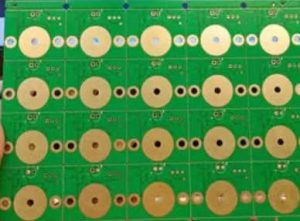
Through-Glass Via
Definition and Structural Fundamentals of Through-Glass Via
What Is Through-Glass Via in Advanced PCB Context
Through-Glass Via refers to a vertical electrical interconnection formed by creating vias through a glass substrate and subsequently metallizing those vias to establish conductive pathways between layers. Structurally, a Through-Glass Via consists of three essential elements: a precision-drilled via hole through glass, an insulating glass sidewall with controlled surface roughness, and a conductive metal fill or lining—typically copper—forming the electrical conduit.
Unlike traditional plated through-holes in organic PCBs, the surrounding medium in a Through-Glass Via is an electrically insulating, low-loss, and dimensionally stable glass matrix. This fundamental material difference drives many of the electrical and mechanical advantages associated with the technology.
From an architectural perspective, Through-Glass Via enables vertical interconnect density comparable to silicon TSVs, while avoiding some of silicon’s cost, fragility, and thermal limitations. At the same time, it surpasses organic substrates in dielectric performance and dimensional precision, particularly at high frequencies.
How Through-Glass Via Differs from TSV and Organic Vias
While Through-Glass Via is often discussed alongside Through-Silicon Via (TSV), the two technologies are not interchangeable. TSVs are typically fabricated within silicon wafers using semiconductor processes, optimized for ultra-fine pitch and short interconnect lengths. However, silicon’s relatively high dielectric loss and coefficient of thermal expansion mismatch with organic boards can introduce reliability and signal integrity challenges at the system level.
Organic substrate vias, on the other hand, are cost-effective and well-suited for large-area PCBs, but they suffer from higher dielectric loss, moisture absorption, and dimensional instability—particularly as frequencies move into the millimeter-wave range.
Through-Glass Via occupies a middle ground. It leverages glass’s intrinsic electrical insulation, near-zero moisture absorption, and excellent surface flatness, while remaining compatible with panel-level or wafer-level manufacturing approaches. This hybrid positioning is precisely what makes Through-Glass Via compelling for next-generation PCB architectures that demand both performance and scalability.
Glass as a Substrate Material: Why It Matters
Glass is not a new material in electronics, but its application as a structural interconnect substrate is relatively recent. Modern glass substrates used in Through-Glass Via applications are engineered with controlled thickness, tailored coefficients of thermal expansion, and optimized dielectric properties.
From a signal propagation standpoint, glass offers a low dielectric constant and extremely low dielectric loss tangent compared to organic laminates. This translates directly into reduced signal attenuation, lower insertion loss, and improved phase stability—attributes that are critical for high-speed digital interfaces and RF systems.
Equally important is glass’s dimensional stability. Unlike organic materials, glass does not warp, swell, or absorb moisture over time. This stability enables tighter registration tolerances, higher layer alignment accuracy, and more predictable via geometries, all of which enhance yield consistency in high-density designs.
Manufacturing Principles of Through-Glass Via Formation
Through-Glass Via Drilling Technologies and Process Logic
The manufacturing of Through-Glass Via begins with the creation of precise, high-aspect-ratio holes in a brittle and chemically inert material. This step alone differentiates glass-based interconnection from organic PCB fabrication, where mechanical drilling remains dominant.
In practical production, laser drilling is the most widely adopted method for Through-Glass Via formation. Ultrafast laser systems—such as picosecond and femtosecond lasers—are favored because they minimize heat-affected zones and microcracking around the via perimeter. This is critical, as even microscopic cracks can propagate under thermal cycling and compromise long-term reliability.
Alternative approaches, including wet chemical etching and hybrid laser–chemical processes, have also been explored. While chemical etching can produce smoother via sidewalls, it typically lacks the positional accuracy and scalability required for dense interconnect layouts. As a result, laser-based drilling remains the most commercially viable pathway for Through-Glass Via fabrication at both wafer and panel scales.
From an engineering standpoint, the drilling phase defines not only via geometry but also downstream metallization quality. Poorly controlled sidewall roughness or taper angles can introduce voids, non-uniform copper thickness, and electrical discontinuities.
Through-Glass Via Metallization and Conductive Filling
Once the via holes are formed, metallization becomes the central challenge. Unlike silicon, glass is chemically inert and does not naturally support seed layer adhesion. Therefore, Through-Glass Via metallization typically requires a multi-step surface activation process.
A thin adhesion layer is first deposited to promote copper bonding, followed by seed layer formation using physical vapor deposition or chemical techniques. Electroplating is then employed to either line the via walls or fully fill the via with copper, depending on electrical and mechanical requirements.
From my perspective, this metallization step is where theory and manufacturing reality often diverge. While fully filled vias offer lower resistance and better thermal conductivity, they also increase internal stress due to copper’s higher coefficient of thermal expansion relative to glass. Lined vias, although electrically sufficient for many applications, may present higher inductance at extreme frequencies.
Choosing between these options is not merely a materials decision; it reflects system-level priorities such as signal integrity, thermal management, and reliability under cyclic loading.
Dimensional Control and Yield Challenges in Through-Glass Via Processing
Glass offers exceptional dimensional stability, but that advantage does not automatically translate into high yield. Through-Glass Via fabrication demands tight control over via diameter, taper, and placement accuracy—often within single-digit micrometers.
At scale, even small deviations can accumulate, leading to misalignment with redistribution layers or surface-mounted components. This is particularly relevant in advanced PCB designs that integrate fine-pitch interposers or high-density RF routing.
In my experience, one of the understated challenges of Through-Glass Via manufacturing is defect inspection. Traditional PCB inspection methods are not always sufficient for transparent substrates. Optical clarity helps in some respects, but detecting internal voids or metallization defects still requires advanced imaging techniques, adding cost and process complexity.
Cost Structure and Manufacturing Scalability of Through-Glass Via
Despite its technical appeal, Through-Glass Via remains a premium technology. Laser drilling, surface activation, and precision metallization all contribute to a higher cost base compared to organic PCB vias.
However, it is important to view cost in context. For applications where signal loss, jitter, or thermal drift impose severe penalties—such as millimeter-wave communication or high-speed computing—the performance gains of Through-Glass Via can offset higher fabrication costs by reducing design margins and system-level compensation measures.
That said, scalability remains uneven. Wafer-level glass processing is relatively mature, while large-panel glass substrates are still evolving. Until panel-scale Through-Glass Via manufacturing achieves consistent yield and throughput, adoption will likely remain concentrated in high-value, performance-driven markets.
Advantages of Through-Glass Via and Their Influence on PCB Performance
Electrical Advantages of Through-Glass Via in High-Speed Signal Transmission
One of the most compelling advantages of Through-Glass Via lies in its electrical behavior under high-speed and high-frequency conditions. Glass, as a dielectric medium, exhibits a low dielectric constant and an exceptionally low loss tangent when compared with conventional organic PCB materials. This directly translates into reduced signal attenuation and improved eye diagram integrity for high-speed digital interfaces.
In Through-Glass Via structures, vertical signal paths experience less dielectric-induced dispersion, particularly at multi-gigahertz frequencies. As data rates continue to climb beyond 56 Gbps and into the realm of 112 Gbps and above, even minor dielectric losses become system-limiting factors. The use of glass mitigates this risk by preserving signal amplitude and minimizing phase distortion across vertical interconnects.
From my perspective, this is where Through-Glass Via begins to move from “interesting” to “strategically necessary” for certain applications. Rather than compensating for material losses with complex equalization schemes, designers can address the root cause at the substrate level.
Through-Glass Via Impact on Signal Integrity and Crosstalk Control
Signal integrity is not determined by loss alone. Impedance consistency, return path continuity, and crosstalk suppression all play decisive roles. Through-Glass Via offers advantages in each of these areas due to its precise geometry and homogeneous dielectric environment.
Glass substrates enable tighter control over via diameter, spacing, and alignment. This precision reduces impedance discontinuities commonly observed in mechanically drilled vias within organic laminates. Moreover, the insulating nature of glass minimizes parasitic coupling between adjacent vias, lowering near-end and far-end crosstalk in dense vertical interconnect arrays.
In RF and microwave PCB designs, these characteristics are particularly valuable. Through-Glass Via structures can maintain predictable impedance profiles across wide frequency bands, improving phase stability and reducing insertion loss variation. This predictability simplifies modeling and reduces the gap between simulation and real-world performance.
Thermal Performance Benefits of Through-Glass Via in Advanced PCBs
Thermal management is often perceived as a weakness of glass due to its relatively low bulk thermal conductivity compared to metals. However, this assessment oversimplifies the role of Through-Glass Via in real PCB systems.
When copper-filled or copper-lined Through-Glass Via structures are strategically deployed, they can function as effective vertical heat conduits. Unlike organic substrates, which may degrade or deform under sustained thermal stress, glass maintains its structural integrity across wide temperature ranges.
In high-power or high-density applications, this stability becomes a reliability advantage. Through-Glass Via does not soften, absorb moisture, or exhibit creep over time. As a result, thermal cycling induces less mechanical fatigue at via interfaces, reducing the likelihood of crack initiation and propagation.
In my view, the thermal value of Through-Glass Via should be evaluated not by raw conductivity numbers, but by long-term dimensional and mechanical stability under thermal load.
Mechanical and Reliability Advantages of Through-Glass Via Structures
Reliability is where Through-Glass Via quietly outperforms many established interconnect solutions. Glass exhibits near-zero moisture absorption, eliminating one of the most persistent reliability risks in organic PCBs. This property alone significantly reduces the probability of delamination, conductive anodic filament formation, and dielectric swelling.
Additionally, glass substrates provide exceptional flatness and rigidity. Through-Glass Via interconnects benefit from this stability by maintaining consistent contact interfaces, even after thousands of thermal cycles. For applications requiring extended service lifetimes—such as aerospace, telecommunications infrastructure, and industrial systems—this reliability profile is highly attractive.
That said, glass brittleness must be acknowledged. While Through-Glass Via structures are robust in operation, they require careful handling during assembly and integration. Reliability gains at the system level must be supported by appropriate mechanical design practices.
Through-Glass Via and High-Density Interconnection Capability
As PCB designs push toward higher interconnect density, vertical routing becomes as critical as horizontal trace optimization. Through-Glass Via supports fine-pitch vertical interconnects with high aspect ratios, enabling compact multilayer architectures without the compromises often seen in organic substrates.
The transparency and dimensional consistency of glass also enable more accurate layer registration and alignment. This capability supports advanced routing strategies, such as short vertical interconnect paths and minimized stubs, which further enhance signal integrity.
From a system integration standpoint, Through-Glass Via allows designers to rethink layer stacking and functional partitioning. Instead of treating vias as unavoidable parasitics, they can be engineered as controlled interconnect elements with predictable behavior.
Through-Glass Via vs. Silicon TSV vs. Organic PCB Vias
| Attribute | Through-Glass Via | Through-Silicon Via (TSV) | Organic PCB Vias |
|---|---|---|---|
| Substrate Material | Glass | Silicon | Epoxy-based laminates (FR-4, BT, ABF) |
| Dielectric Loss | Very low | Moderate | High |
| Dimensional Stability | Excellent | Excellent | Limited (moisture & thermal sensitivity) |
| Moisture Absorption | Near zero | Near zero | Moderate to high |
| Via Geometry Control | High precision | Ultra-high precision | Limited by mechanical drilling |
| Signal Integrity (High Frequency) | Excellent | Good | Limited |
| Thermal Stability | Excellent | Good | Moderate |
| Mechanical Robustness | Brittle during handling | Brittle | Flexible and robust |
| Manufacturing Cost | High | Very high | Low |
| Scalability | Emerging (panel-level evolving) | Wafer-level mature | Highly scalable |
| Typical Applications | RF, AI interposers, advanced packaging | High-density chip interposers | Consumer, industrial, general electronics |
| Design Flexibility | High (vertical optimization) | Limited by silicon processes | High (cost-driven) |
| Long-Term Reliability | Very high (if well-processed) | High | Moderate |
Conclusion
The evolution of PCB technology has never been driven by materials alone, but by the constant negotiation between performance demands, manufacturing realities, and system-level constraints. As electronic systems move beyond the limits of silicon interposers and organic substrates, Through-Glass Via emerges not as a universal replacement, but as a carefully positioned solution for a new class of interconnect challenges.
What distinguishes Through-Glass Via is not novelty, but alignment. Its low dielectric loss, excellent dimensional stability, and resistance to environmental degradation directly address the bottlenecks encountered in high-frequency, high-speed, and advanced packaging applications. In these domains, traditional materials increasingly rely on compensation techniques—equalization, shielding, and conservative margins—that add complexity without solving root causes.
At the same time, Through-Glass Via introduces its own constraints. Manufacturing cost, process sensitivity, and mechanical handling requirements prevent it from becoming a default PCB technology. Its adoption demands disciplined design-for-manufacturability, early supplier collaboration, and a clear understanding of where its advantages deliver measurable system-level value.
From my perspective, the real promise of Through-Glass Via lies in intentional deployment. When selected to serve clearly defined electrical, thermal, and reliability objectives, it enables PCB architectures that are otherwise difficult—or impossible—to realize with silicon or organic substrates. As the manufacturing ecosystem matures and panel-level processes stabilize, its role will continue to expand, particularly in RF systems, AI computing, and heterogeneous integration.
The future of next-generation PCBs will not belong to a single substrate material. It will belong to engineers who choose the right material for the right purpose. In that landscape, Through-Glass Via stands as a powerful, precision-oriented interconnect technology—one that rewards clarity of intent and depth of engineering judgment.
FAQs
1. When should designers choose Through-Glass-Via over organic PCB vias?
Through-Glass Via is most appropriate when signal integrity, frequency performance, and dimensional stability are critical system requirements and justify higher manufacturing complexity and cost.
2. How does Through-Glass-Via differ from Through-Silicon Via in practical PCB applications?
Through-Glass Via uses glass as the insulating substrate, offering lower dielectric loss and better dimensional stability than silicon. While TSVs enable ultra-fine pitch interconnects, Through-Glass Via often provides superior signal integrity for high-frequency PCB and interposer applications.
3. Is Through-Glass-Via suitable for mass production?
Through-Glass Via is technically manufacturable at scale, but mass production remains limited by equipment cost, yield control, and ecosystem maturity. It is currently best suited for high-performance, lower-volume applications.
4. Does glass fragility limit the reliability of Through-Glass-Via PCBs?
Glass is brittle during handling, but once properly integrated, it offers excellent long-term reliability due to its resistance to moisture absorption, thermal deformation, and chemical degradation.
5. How does Through-Glass-Via affect thermal management in PCBs?
While glass itself has low thermal conductivity, copper-filled or copper-lined Through-Glass Via structures can effectively conduct heat vertically, providing stable thermal pathways without material degradation.

- long board pcb
- Flexible PCBs
- Special PCB
- Express Printed Circuit Board
- Pcb Prototype
- LED PCB
- PCB
- Printed Circuit Board
- Pcb meaning
- Pcb manufacturer
- Rigid pcb board
- Rigid Flex PCB
 Quote
Quote
 E-mail