ENIG (Electroless Nickel Immersion Gold): The Gold Standard for Solderability and Flatness
1. The Gold Standard: Definition and Fundamental Understanding of ENIG
Electroless Nickel Immersion Gold (ENIG) is widely regarded as The Gold Standard in PCB surface finishing due to its exceptional balance between solderability, planarity, and long-term reliability. Unlike traditional finishes that rely heavily on electroplating or organic coatings, ENIG is a dual-layer metallurgical system consisting of an electroless nickel layer deposited directly onto copper, followed by a thin immersion gold layer. This configuration is not accidental; it is engineered to deliver both mechanical robustness and chemical protection.
The nickel layer, typically ranging from 3 to 6 microns, serves as a barrier between the copper substrate and the external environment. It provides structural integrity, supports solder joints, and prevents copper diffusion, which can otherwise degrade electrical performance over time. The immersion gold layer, although extremely thin (usually 0.05 to 0.1 microns), plays a critical role in protecting the nickel from oxidation and ensuring excellent solder wetting during assembly.
When discussing The Gold Standard, it is essential to recognize that ENIG is not merely a coating—it is a controlled chemical process. The electroless nickel deposition is autocatalytic, meaning it does not require external electrical current. Instead, it relies on a chemical reduction reaction that deposits nickel uniformly across all exposed copper surfaces, including complex geometries such as vias and fine-pitch pads. This uniformity is one of the defining reasons ENIG earns its reputation.
From a manufacturing perspective, ENIG provides an extremely flat surface, making it ideal for advanced packaging technologies such as BGA (Ball Grid Array), CSP (Chip Scale Package), and fine-pitch SMT components. The flatness ensures consistent solder paste printing and reliable component placement, reducing defects such as tombstoning or insufficient solder joints.
In essence, The Gold Standard in ENIG refers to a combination of attributes: superior solderability, excellent planarity, strong barrier protection, and compatibility with high-density interconnect (HDI) designs. It represents a benchmark against which other surface finishes—such as HASL, OSP, or immersion tin—are often compared.
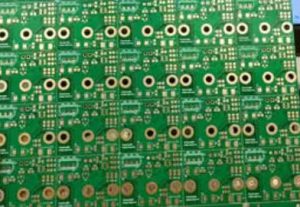
The Gold Standard
2. The Gold Standard: Chemical Process Flow and Layer Formation
Understanding why ENIG is considered The Gold Standard requires a closer look at its process flow. The sequence of chemical treatments is highly controlled and directly influences the final quality of the finish.
The process begins with thorough cleaning and micro-etching of the copper surface. This step removes oxides, contaminants, and surface irregularities, ensuring optimal adhesion for the subsequent nickel layer. Any inconsistency at this stage can propagate through the entire process, leading to defects such as poor plating adhesion or uneven thickness.
Following surface preparation, the board is immersed in an electroless nickel bath. Here, a chemical reduction reaction deposits nickel uniformly across the copper surface. The thickness of this layer must be tightly controlled; too thin, and it may fail as a diffusion barrier; too thick, and it can introduce brittleness into solder joints.
Once the nickel layer is established, the board undergoes immersion gold plating. Unlike electroplating, this process involves a displacement reaction where gold ions replace nickel atoms at the surface. This self-limiting reaction ensures that the gold layer remains thin and uniform, preserving cost efficiency while providing oxidation resistance.
What makes this process The Gold Standard is its consistency across varying geometries. Whether dealing with fine traces, microvias, or large pads, ENIG delivers uniform coverage without the edge effects or thickness variations common in electroplated finishes.
However, the process is not without challenges. Issues such as “black pad” can occur if the nickel layer becomes excessively corroded during gold deposition. This highlights the importance of precise process control, bath chemistry management, and supplier expertise.
3. The Gold Standard: Cost Factors and Economic Considerations
One of the most discussed aspects of ENIG as The Gold Standard is its cost structure. Compared to alternatives like HASL or OSP, ENIG is undeniably more expensive. However, this cost must be evaluated in the context of performance, yield, and long-term reliability.
The primary cost driver in ENIG is gold. Although the gold layer is extremely thin, the price of gold as a commodity introduces volatility into the overall cost of the finish. Even small fluctuations in gold pricing can significantly impact PCB manufacturing costs, especially in high-volume production.
The second major cost factor is the complexity of the chemical process. ENIG requires multiple controlled steps, specialized chemical baths, and continuous monitoring. This increases both capital investment and operational expenses for PCB manufacturers.
Additionally, yield loss can contribute to cost. Because ENIG is sensitive to contamination and process variations, defects such as black pad or uneven deposition can lead to scrap or rework. High-quality manufacturers mitigate this through stringent process control, but the risk still exists.
Despite these costs, The Gold Standard remains economically justified in many applications. This is because ENIG reduces downstream assembly issues, improves solder joint reliability, and enhances product lifespan. In high-reliability industries such as aerospace, medical devices, and telecommunications, these benefits far outweigh the initial cost premium.
From a total cost of ownership perspective, ENIG often proves more economical. Reduced rework, fewer field failures, and improved product consistency all contribute to lower lifecycle costs.
4. The Gold Standard: Impact on PCB Performance and Reliability
The designation of ENIG as The Gold Standard is deeply tied to its impact on PCB performance. This influence extends across electrical, mechanical, and thermal domains.
From an electrical standpoint, the nickel layer introduces a higher resistivity compared to copper. While this may raise concerns for high-frequency applications, the effect is generally minimal because current primarily flows through the outer gold layer and underlying copper. However, in RF and microwave designs, engineers must consider skin effect and potential signal loss.
Mechanically, ENIG provides excellent solder joint integrity. The nickel layer forms a strong intermetallic compound with solder, ensuring robust connections that can withstand thermal cycling and mechanical stress. This makes ENIG particularly suitable for applications requiring long-term reliability.
Thermally, ENIG performs well under repeated heating cycles. The stable interface between nickel and solder resists degradation, maintaining consistent performance even in harsh environments.
One of the most significant advantages of The Gold Standard is its flatness. Unlike HASL, which can create uneven surfaces due to molten solder leveling, ENIG provides a perfectly planar finish. This is crucial for modern electronics, where component pitches continue to shrink and placement accuracy becomes increasingly critical.
Furthermore, ENIG offers excellent shelf life. The gold layer prevents oxidation, allowing PCBs to be stored for extended periods without degradation in solderability. This is particularly valuable in supply chains with long lead times or inventory cycles.
In summary, the performance benefits of ENIG justify its reputation. It is not merely a premium option—it is a strategic choice for designs where failure is not an option.
5. The Gold Standard: Comparison with Alternative Surface Finishes
To fully appreciate why ENIG is considered The Gold Standard, it is useful to compare it with other common PCB surface finishes.
HASL (Hot Air Solder Leveling) is one of the oldest and most cost-effective finishes. However, its uneven surface makes it unsuitable for fine-pitch components. In contrast, ENIG offers superior flatness and consistency.
OSP (Organic Solderability Preservative) is another low-cost option. While it provides good initial solderability, it lacks durability and has a limited shelf life. ENIG, on the other hand, maintains its properties over extended periods.
Immersion silver and immersion tin offer good performance but come with their own challenges, such as susceptibility to tarnishing or whisker formation. ENIG avoids these issues through its stable gold layer.
In high-end applications, ENEPIG (Electroless Nickel Electroless Palladium Immersion Gold) is sometimes considered an upgrade to ENIG. However, its higher cost limits widespread adoption.
Ultimately, The Gold Standard designation reflects a balance. ENIG is not the cheapest option, nor is it the most advanced in every scenario, but it consistently delivers reliable performance across a wide range of applications.
The Gold Standard: Comparative Table of PCB Surface Finishes
Below is a comprehensive comparison table highlighting how ENIG, as The Gold Standard, performs relative to other common PCB surface finishes:
| Surface Finish | Flatness | Solderability | Shelf Life | Cost Level | Reliability | Typical Applications |
|---|---|---|---|---|---|---|
| ENIG (The Gold Standard) | Excellent | Excellent | Long (6–12 months) | High | Very High | HDI, BGA, medical, aerospace |
| HASL (Lead-Free) | Poor to Moderate | Good | Medium | Low | Moderate | Consumer electronics |
| OSP | Excellent | Good (initial) | Short | Very Low | Moderate | High-volume, low-cost devices |
| Immersion Silver | Excellent | Very Good | Medium | Medium | High | RF and high-speed circuits |
| Immersion Tin | Excellent | Good | Medium | Medium | Moderate | Automotive, connectors |
| ENEPIG | Excellent | Excellent | Long | Very High | Extremely High | Wire bonding, high-end electronics |
6. Conclusion
As the electronics industry continues to push the boundaries of miniaturization, speed, and reliability, ENIG remains firmly positioned as The Gold Standard for PCB surface finishes. Its enduring relevance is not simply the result of tradition or widespread adoption, but rather a reflection of its ability to consistently meet the evolving technical demands of modern electronic systems.
From a strategic standpoint, ENIG offers a rare combination of manufacturability and performance stability. In high-mix, low-volume production environments—such as aerospace, medical instrumentation, and advanced communications—this consistency becomes invaluable. Engineers are not merely selecting a surface finish; they are making a decision that directly impacts assembly yield, product reliability, and long-term field performance.
One of the most compelling aspects of ENIG is its adaptability. While newer finishes such as ENEPIG or advanced OSP formulations have emerged, ENIG continues to hold its ground due to its well-understood behavior and mature process control infrastructure. This maturity reduces uncertainty, which is often more valuable than marginal performance gains in real-world production.
However, the future of The Gold Standard will likely depend on how well the industry addresses its limitations. Cost pressures, environmental concerns, and high-frequency performance requirements are driving innovation. Improvements in nickel chemistry, alternative barrier layers, and hybrid surface finishes may further enhance ENIG or redefine its role in specific applications.
Another key insight is the importance of supplier capability. ENIG is not a “plug-and-play” solution; its success depends heavily on execution. A well-controlled ENIG process can deliver उत्कृष्ट performance, while a poorly managed one can introduce significant risks. This reinforces the importance of partnering with experienced manufacturers who understand the nuances of the process.
Looking ahead, ENIG will likely remain The Gold Standard not because it is perfect, but because it represents a balanced and reliable solution in an increasingly complex design landscape. Its role may evolve, but its core value—delivering dependable performance across a wide range of applications—will continue to anchor its position in PCB manufacturing.
FAQs
1. What factors influence the cost of ENIG?
The cost of ENIG is influenced by gold prices, process complexity, chemical consumption, and yield rates during manufacturing.
2. Why is ENIG considered The Gold Standard for PCB surface finishes?
ENIG is considered The Gold Standard because it provides excellent solderability, superior flatness, strong corrosion resistance, and long shelf life, making it suitable for advanced and high-reliability applications.
3. What causes black pad in ENIG finishes?
Black pad is caused by excessive corrosion of the nickel layer during the immersion gold process, leading to कमजोर solder joints and potential reliability issues.
4. How does ENIG compare to HASL in terms of performance?
ENIG offers a much flatter surface than HASL, making it ideal for fine-pitch components. HASL is more cost-effective but less suitable for high-density designs.
5. Is ENIG suitable for high-frequency applications?
Yes, but designers must consider the تأثير of the nickel layer on signal integrity. Proper design techniques can minimize any negative impact.

- long board pcb
- Flexible PCBs
- Special PCB
- Express Printed Circuit Board
- Pcb Prototype
- LED PCB
- PCB
- Printed Circuit Board
- Pcb meaning
- Pcb manufacturer
- Rigid pcb board
- Rigid Flex PCB
 Quote
Quote
 E-mail