Precision Calibration: How Secondary Drilling Fine-Tunes Holes in PCB Manufacturing
Introduction: Why Hole Precision Has Become a Silent Determinant of PCB Quality
In modern PCB manufacturing, innovation is often associated with visible advancements—finer traces, higher layer counts, or exotic materials. Yet beneath these headline improvements lies a quieter discipline that increasingly defines reliability and performance: hole precision control. As electronic systems evolve toward higher density, tighter tolerances, and more demanding operating environments, even microscopic deviations in hole geometry can cascade into electrical instability, mechanical weakness, or assembly failure.
This is where Secondary Drilling emerges as a decisive, though frequently underappreciated, process.
Unlike primary drilling, which establishes the initial via or hole structure, Secondary Drilling functions as a precision correction and calibration step. It refines hole diameter, improves positional accuracy, and corrects distortions introduced earlier in the manufacturing chain. In high-reliability PCBs—such as those used in automotive electronics, industrial controls, medical devices, and advanced communication equipment—this refinement is no longer optional but strategic.
1. Secondary-Drilling Definition and Process Fundamentals in PCB Manufacturing
1.1 What Secondary-Drilling Really Means in PCB Manufacturing
Secondary Drilling refers to a post-primary drilling operation performed to correct, refine, or optimize holes that have already been created in a PCB substrate. Rather than replacing the initial drilling step, it enhances dimensional accuracy and surface quality after material stresses, lamination effects, or tool wear have introduced deviations.
In practical terms, Secondary-Drilling is applied when:
-
Primary drilling cannot reliably meet final tolerance requirements
-
Hole deformation occurs during lamination or thermal cycling
-
High-aspect-ratio holes demand improved concentricity
-
Precision press-fit, via-in-pad, or micro-connector interfaces are involved
Unlike rework, Secondary-Drilling is planned, engineered, and controlled, not corrective improvisation.
From a manufacturing philosophy perspective, it represents a shift from “acceptable deviation” toward “intentional precision.”
1.2 Secondary Drilling vs. Primary Drilling: A Functional Distinction
Primary drilling is optimized for throughput and material removal efficiency. It establishes the fundamental hole pattern across panels that may contain hundreds or thousands of vias. However, this efficiency comes with trade-offs:
-
Tool wear variation across panels
-
Substrate fiber pull-out
-
Resin smear accumulation
-
Minor positional drift due to mechanical vibration
Secondary-Drilling, by contrast, is optimized for:
-
Minimal material removal
-
High positional accuracy
-
Tight diameter tolerance
-
Surface refinement
In many ways, the relationship mirrors that of rough machining vs. finish machining in mechanical engineering. One creates form; the other perfects function.
1.3 Why Secondary Drilling Is Becoming More Relevant Than Ever
The growing relevance of Secondary-Drilling is not accidental—it is driven by structural shifts in PCB design:
-
Higher Interconnect Density (HDI)
Smaller vias and tighter spacing amplify the impact of tiny drilling errors. -
Thicker Multilayer Stacks
Increased aspect ratios magnify misalignment risks. -
Advanced Assembly Techniques
Press-fit pins, selective soldering, and via-in-pad designs require near-perfect hole geometry. -
Reliability-Driven Markets
Automotive and industrial customers increasingly demand statistical hole accuracy, not averages.
From my perspective, Secondary Drilling has transitioned from a specialty solution into a process differentiator. PCB suppliers that master it can meet requirements others must decline—or compensate for with costly design compromises.
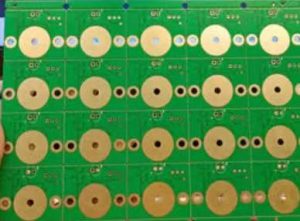
Secondary Drilling
2. Secondary-Drilling Advantages and Its Influence on PCB Performance
2.1 Secondary-Drilling and Hole Diameter Accuracy Improvement
One of the most immediate and measurable advantages of Secondary-Drilling is its ability to significantly improve final hole diameter accuracy. In primary drilling, even with high-quality CNC equipment, cumulative errors arise from tool wear, substrate hardness variation, and thermal effects. These errors often remain within “acceptable” tolerances—but acceptable does not always mean optimal.
Secondary-Drilling removes a minimal amount of material under tighter process control, allowing manufacturers to converge toward a precise target diameter rather than settling for statistical averages. From my experience, this difference becomes critical when hole tolerances fall below ±25 μm, a range increasingly common in modern PCB designs.
Improved diameter accuracy directly influences:
-
Consistency of via wall copper thickness
-
Predictability of press-fit pin retention force
-
Stability of solder joint formation
Rather than compensating later in plating or assembly, Secondary-Drilling corrects the geometry at its root.
2.2 Secondary Drilling and Positional Precision Enhancement
Beyond diameter control, Secondary Drilling plays a decisive role in improving hole positional accuracy, especially in multilayer PCBs. During lamination, inner layers may experience micro-shifts caused by resin flow, thermal expansion mismatch, or glass weave effects. Primary drilling cannot fully account for these post-lamination distortions.
Secondary Drilling, executed after lamination stabilization, enables:
-
Correction of cumulative X-Y offsets
-
Improved alignment between vias and pads
-
Reduced annular ring violation risk
In high-density designs, positional errors do not merely affect yield—they compromise electrical isolation and long-term reliability. I have seen cases where boards technically passed electrical testing but later failed in field conditions due to marginal annular rings stressed by vibration or thermal cycling.
Secondary Drilling reduces such latent risks by restoring geometric intent.
2.3 Secondary Drilling and Via Reliability Under Thermal Stress
Via reliability is not determined solely by plating thickness or copper quality; hole geometry uniformity plays an equally important role. Irregular hole walls create uneven copper deposition, leading to localized stress concentration points during thermal expansion.
By refining hole smoothness and roundness, Secondary Drilling contributes to:
-
More uniform copper grain structure
-
Reduced micro-crack initiation points
-
Improved resistance to thermal fatigue
In reliability-focused sectors—automotive, industrial control, and power electronics—this advantage is particularly valuable. PCB suppliers like SQ PCB often leverage Secondary Drilling selectively in thermally stressed designs, ensuring via structures remain stable across wide temperature cycles without excessive over-plating.
2.4 Secondary Drilling and Signal Integrity Stability
Although often discussed in mechanical terms, Secondary Drilling also influences electrical performance, especially in high-speed and high-frequency circuits. Variations in hole diameter and concentricity affect:
-
Via impedance consistency
-
Return path continuity
-
Crosstalk predictability
Secondary Drilling minimizes geometric deviation, which in turn reduces impedance discontinuities at via transitions. While the electrical impact of a single via may be small, the cumulative effect across hundreds of signal vias can become significant.
From a system-level perspective, Secondary Drilling contributes to signal integrity margin, an increasingly scarce resource in advanced PCB designs.
2.5 Secondary Drilling and Assembly Process Yield
Assembly yield is often where the benefits of Secondary Drilling become most visible. Poorly controlled hole geometry can lead to:
-
Inconsistent solder fill
-
Press-fit damage to plated barrels
-
Connector misalignment
By stabilizing hole dimensions, Secondary Drilling improves compatibility with automated assembly equipment and reduces variability in downstream processes. This advantage is not theoretical; it directly impacts manufacturing cost and delivery reliability.
3. Secondary Drilling Process Flow and Manufacturing Integration
3.1 Secondary Drilling Placement Within the PCB Manufacturing Flow
To understand the true effectiveness of Secondary Drilling, it must be viewed within the complete PCB manufacturing sequence rather than as an isolated step. In most production environments, Secondary Drilling is positioned after lamination and before final metallization, when the board structure has reached dimensional stability but before copper deposition locks in geometry.
A typical integration sequence looks like this:
-
Inner-layer fabrication and inspection
-
Lamination and thermal stabilization
-
Primary drilling (bulk hole formation)
-
Secondary Drilling (precision refinement)
-
Desmear and surface conditioning
-
Electroless and electrolytic copper plating
This positioning is intentional. Performing Secondary Drilling too early risks losing accuracy due to lamination movement, while performing it too late increases the risk of damaging plated structures.
3.2 Secondary Drilling Tooling Strategy and Control Parameters
Unlike primary drilling, which prioritizes speed and durability, Secondary Drilling tooling is optimized for precision and stability. Key characteristics include:
-
Smaller diameter tolerance windows
-
Shorter tool life with stricter replacement schedules
-
Reduced spindle speed variation
-
Lower material removal rates
Tool wear monitoring becomes especially critical. A worn secondary drill bit does not merely reduce efficiency—it undermines the very purpose of the process. High-maturity manufacturers treat tool condition as a statistical variable, not an assumption.
In facilities I have reviewed, Secondary Drilling stations often operate under tighter SPC limits than any other mechanical process in the plant.
3.3 Secondary Drilling and Registration Accuracy Management
One of the less visible but most critical aspects of Secondary Drilling is its dependence on registration accuracy. Since the process aims to refine existing holes, misalignment between drill programs and actual hole positions can cause catastrophic scrap.
To mitigate this, manufacturers employ:
-
Optical or X-ray alignment referencing
-
Fiducial-based compensation algorithms
-
Panel-level distortion mapping
Secondary Drilling, in this sense, becomes a test of a factory’s digital–physical alignment capability. It reveals whether design intent, process modeling, and physical execution are truly synchronized.
This is one reason why only manufacturers with mature process control—such as SQ PCB in complex multilayer production—can apply Secondary Drilling at scale without yield penalties.
3.4 Secondary Drilling Interaction With Desmear and Hole Wall Conditioning
Another critical integration point is the relationship between Secondary Drilling and desmear processes. While primary drilling creates most resin smear, Secondary Drilling modifies hole wall surfaces in ways that influence subsequent chemical treatments.
If not properly coordinated, Secondary Drilling may:
-
Reintroduce micro-smear
-
Alter surface roughness profiles
-
Affect chemical penetration uniformity
However, when optimized, Secondary Drilling actually improves desmear effectiveness by:
-
Removing damaged resin layers
-
Creating more consistent wall topography
-
Enhancing copper adhesion
This interdependency reinforces the idea that Secondary Drilling is not an isolated corrective action but a surface engineering step with downstream implications.
3.5 Secondary Drilling and Copper Plating Uniformity
Copper plating quality is one of the most sensitive beneficiaries of Secondary Drilling. Hole geometry uniformity directly affects:
-
Current density distribution
-
Copper thickness consistency
-
Risk of voids or thin spots
Secondary Drilling reduces geometric irregularities that can cause localized over- or under-plating. In high-aspect-ratio vias, even small improvements in wall smoothness can translate into measurable gains in plating reliability.
From an engineering standpoint, Secondary Drilling indirectly reduces the need for aggressive plating compensation strategies, allowing for more balanced electrochemical conditions.
4. Secondary Drilling Design Considerations and Cost–Value Decision Logic
4.1 Secondary Drilling and PCB Design Intent Alignment
From a design perspective, Secondary Drilling should never be treated as a generic manufacturing upgrade. Its value depends heavily on how well it aligns with the design intent of the PCB.
Designs that benefit most from Secondary Drilling usually share at least one of the following characteristics:
-
Extremely tight hole-to-pad clearance
-
High aspect ratio vias in thick boards
-
Functional dependence on hole geometry (press-fit, controlled impedance, mechanical anchoring)
In contrast, designs with wide tolerances and low mechanical or electrical sensitivity rarely justify the added complexity.
In my experience, Secondary Drilling delivers the highest return when it is anticipated during design, not retrofitted to rescue marginal layouts.
4.2 Secondary Drilling and Hole Tolerance Specification Strategy
One subtle but critical issue is how hole tolerances are specified. Designers often request very tight tolerances without considering whether primary drilling alone can realistically achieve them at scale.
Secondary Drilling changes this equation.
When explicitly planned, it allows:
-
More aggressive tolerance targets
-
Reduced safety margins in pad design
-
Greater confidence in statistical consistency
However, if tolerances are specified tightly without acknowledging Secondary Drilling, manufacturers are forced to rely on luck, over-processing, or yield loss.
From an engineering standpoint, it is far more rational to link tolerance class directly to process strategy, rather than treat tolerances as abstract requirements.
4.3 Secondary Drilling Cost Structure and Hidden Economics
The cost impact of Secondary-Drilling is often misunderstood. While it undeniably adds direct processing cost, it can simultaneously reduce indirect and downstream costs.
Additional costs include:
-
Extra machine time
-
Tooling consumption
-
Process setup and inspection
Offsetting savings may come from:
-
Higher yield
-
Reduced rework and scrap
-
Improved assembly efficiency
-
Lower field failure risk
In high-volume, low-complexity products, the cost balance often disfavors Secondary Drilling. But in low-to-medium volume, high-reliability PCBs, the economics frequently tilt in its favor.
This is why experienced manufacturers such as SQ PCB apply Secondary Drilling selectively—only where it measurably improves total lifecycle value rather than just adding process steps.
4.4 Secondary-Drilling and Risk Management in PCB Manufacturing
Another lens through which to evaluate Secondary Drilling is risk management. Many PCB failures are not catastrophic defects but statistical outliers—the worst 1–2% of boards that escape detection.
Secondary Drilling reduces:
-
Tail-end dimensional variation
-
Probability of marginal vias
-
Sensitivity to process drift
From my perspective, Secondary-Drilling functions as a risk compression mechanism. It narrows the distribution curve rather than simply shifting the average.
For applications where field failure is unacceptable, this risk reduction alone may justify the process.
Secondary-Drilling Compared With Conventional Hole Control Approaches
| Aspect | Primary Drilling Only | Secondary Drilling Applied |
|---|---|---|
| Hole diameter accuracy | Limited by tool wear and material variation | Fine-tuned to final tolerance |
| Positional precision | Dependent on early-process stability | Corrected after lamination effects |
| Via wall uniformity | Variable, especially in thick boards | More consistent and predictable |
| Plating reliability | Requires compensation | Naturally stabilized |
| Assembly compatibility | Higher variation risk | Improved consistency |
| Manufacturing cost | Lower upfront | Slightly higher upfront |
| Lifecycle reliability | Moderate | Higher, especially under stress |
| Suitable applications | Low-complexity PCBs | High-reliability and precision PCBs |
Conclusion: Precision Is Not Accidental—Secondary-Drilling as a Manufacturing Mindset
In PCB manufacturing, true precision is rarely the result of a single process executed perfectly. It is more often the outcome of intentional correction, refinement, and restraint. Throughout this article, Secondary-Drilling has been presented not as a universal solution, but as a calibrated response to real-world variability.
What makes Secondary-Drilling valuable is not simply its ability to improve hole accuracy, but its role in closing the gap between design intent and physical reality. Materials move, tools wear, layers shift—these are not failures of manufacturing, but facts of it. Secondary Drilling acknowledges these facts and responds with engineering discipline rather than assumption.
From my perspective, the most mature PCB manufacturers are not those who claim perfect first-pass results, but those who design controlled refinement into their processes. Secondary Drilling embodies this philosophy. When applied selectively and deliberately, it reduces risk, stabilizes performance, and supports long-term reliability without unnecessary over-engineering.
In an industry increasingly driven by tighter tolerances and higher reliability expectations, Secondary Drilling is less about drilling again—and more about thinking again.
FAQ
1. Is Secondary-Drilling suitable for all PCB manufacturers?
Not necessarily. Effective Secondary-Drilling requires mature process control, precise registration systems, and disciplined SPC management. Without these, the process may introduce more risk than benefit.
2. Is Secondary-Drilling the same as re-drilling or rework?
No. Secondary-Drilling is a planned precision process, not corrective rework. It is intentionally integrated into the manufacturing flow to refine hole geometry, whereas rework is an unplanned response to defects.
3. Does Secondary-Drilling always improve PCB electrical performance?
Not always directly. Its primary impact is geometric consistency. Electrical performance benefits occur mainly in designs where via geometry influences impedance, signal integrity, or current distribution.
4. Can Secondary-Drilling replace tight design tolerances?
No. Secondary-Drilling supports tight tolerances but does not replace good design practice. Optimal results occur when design intent and process capability are aligned from the beginning.
5. Does Secondary-Drilling significantly increase PCB cost?
It increases process cost, but often reduces total lifecycle cost by improving yield, assembly efficiency, and long-term reliability. Its economic value depends on application complexity and reliability requirements.

- long board pcb
- Flexible PCBs
- Special PCB
- Express Printed Circuit Board
- Pcb Prototype
- LED PCB
- PCB
- Printed Circuit Board
- Pcb meaning
- Pcb manufacturer
- Rigid pcb board
- Rigid Flex PCB
 Quote
Quote
 E-mail