Multilayer PCB Material Selection Guide: FR-4, CEM-3 and Advanced Materials
Introduction
Selecting the right material is one of the most important decisions in multilayer PCB design.
A PCB laminate system does not only determine electrical performance. It also directly affects:
- Thermal reliability
- Mechanical strength
- Signal integrity
- Manufacturing stability
- Production cost
In modern electronics, PCB requirements are becoming increasingly demanding.
Different applications require different material characteristics:
- General electronics require cost-effective and stable materials.
- Automotive and industrial products require higher thermal reliability.
- High-frequency systems require low-loss materials.
- Power applications require better thermal management.
Therefore, Multilayer PCB Material Selection is not simply choosing a laminate. It is a balance between electrical performance, reliability, manufacturability, and cost.
A suitable PCB material helps ensure:
- Stable impedance performance
- Reliable soldering
- Resistance to thermal cycling
- Long product lifetime
- Consistent manufacturing quality
From a PCB manufacturing perspective, the best material is not always the most expensive material.
The best choice is the material that matches the actual application requirements.
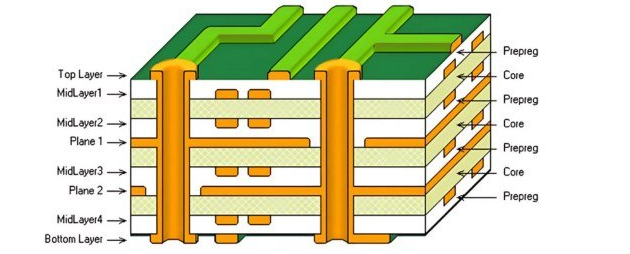
Multilayer PCB Material Selection
1. Key Factors in Multilayer PCB Material Selection
When selecting materials for multilayer PCBs, engineers usually consider several important parameters.
1.1 Dielectric Constant (Dk)
The dielectric constant affects signal propagation speed.
A stable Dk value is important for:
- High-speed digital circuits
- Controlled impedance designs
- RF applications
Materials with lower and more stable Dk values can reduce signal delay and improve signal integrity.
1.2 Dissipation Factor (Df)
The dissipation factor represents dielectric loss.
A lower Df helps reduce:
- Signal attenuation
- Transmission loss
- Heat generation at high frequency
This becomes increasingly important in:
- High-speed communication
- RF circuits
- Microwave applications
1.3 Glass Transition Temperature (Tg)
Tg represents the temperature at which the resin system changes mechanical behavior.
Higher Tg materials provide better performance under:
- High operating temperatures
- Multiple soldering cycles
- Thermal cycling environments
High TG materials are commonly used in:
- Automotive electronics
- Industrial controls
- High-reliability products
1.4 Coefficient of Thermal Expansion (CTE)
During temperature changes, PCB materials expand and contract.
A mismatch between copper and laminate expansion can cause:
- Copper cracking
- Via reliability issues
- Delamination risks
Material selection must consider long-term thermal reliability.
1.5 Mechanical Strength and Manufacturing Compatibility
PCB materials also affect:
- Drilling performance
- Layer registration
- Plating reliability
- Lamination quality
A material with excellent electrical properties may still create manufacturing challenges if it is not suitable for the production process.
2. Common Materials Used in Multilayer PCBs
Different PCB applications require different material solutions.
| PCB Material | Main Advantages | Typical Applications |
|---|---|---|
| FR-4 | Balanced cost and performance | General electronics |
| High TG FR-4 | Better thermal reliability | Automotive, industrial |
| Halogen-Free FR-4 | Environmental compliance | Global electronics |
| CEM-3 | Lower cost option | Cost-sensitive products |
| Rogers | Low dielectric loss | RF, microwave |
| PTFE | Excellent high-frequency performance | 5G, aerospace |
| Aluminum PCB | Excellent heat dissipation | LED, power electronics |
| Ceramic PCB | Extreme thermal performance | High-power applications |
3. FR-4 Material Selection for Multilayer PCBs
FR-4 remains the most widely used PCB material because it provides an excellent balance between:
- Cost
- Electrical performance
- Mechanical strength
- Manufacturing availability
FR-4 is commonly used in:
- Industrial control boards
- Consumer electronics
- Communication equipment
- General multilayer PCBs
Different FR-4 grades provide different performance levels.
Important parameters include:
- Tg
- Dk
- Df
- Moisture resistance
- Thermal reliability
For most applications, FR-4 remains the most practical and cost-effective choice.
4. FR-4 vs CEM-3: Traditional Multilayer PCB Material Comparison
FR-4 and CEM-3 are two commonly discussed PCB materials.
Both use epoxy resin systems, but their reinforcement structures are different.
| Property | FR-4 | CEM-3 |
|---|---|---|
| Resin System | Epoxy | Epoxy |
| Reinforcement | Woven glass cloth | Non-woven glass mat |
| Mechanical Strength | Higher | Lower |
| Electrical Stability | Excellent | Good |
| Thermal Reliability | Better | Moderate |
| Cost | Higher | Lower |
| Typical Application | High-reliability multilayer PCB | Cost-sensitive electronics |
When to Choose FR-4?
FR-4 is recommended when requirements include:
- Higher reliability
- Better dimensional stability
- Multiple soldering cycles
- Higher layer counts
- Better signal integrity
When to Choose CEM-3?
CEM-3 can be considered for:
- Cost-sensitive products
- Lower complexity boards
- Consumer electronics
However, for demanding multilayer PCB applications, FR-4 remains the preferred choice.
5. High TG PCB Materials for High Reliability Applications
When PCBs operate under higher temperatures or repeated thermal stress, standard materials may not provide enough reliability.
High TG PCB materials offer:
- Higher thermal resistance
- Better dimensional stability
- Improved reliability during thermal cycling
Common applications:
- Automotive electronics
- Industrial equipment
- Power control systems
- Long-life electronic products
For high-reliability multilayer PCBs, material selection should consider not only initial cost but also long-term field performance.
6. High-Frequency PCB Materials: Rogers and PTFE
As electronic systems move toward higher frequency and higher data rates, traditional FR-4 may not always meet electrical requirements.
Rogers PCB Materials
Rogers materials are widely used because of:
- Low dielectric loss
- Stable electrical performance
- Controlled impedance capability
Applications:
- RF circuits
- Antennas
- Communication systems
PTFE PCB Materials
PTFE-based materials provide:
- Very low dielectric loss
- Excellent high-frequency performance
- Stable signal transmission
Applications:
- Microwave circuits
- 5G communication
- Aerospace electronics
- High-speed interconnects
However, PTFE requires more advanced manufacturing control, including:
- Drilling process optimization
- Hole-wall treatment
- Lamination control
7. Thermal Management Materials: Aluminum and Ceramic PCB
For power applications, thermal performance becomes a critical factor.
Aluminum PCB
Aluminum PCBs provide excellent heat dissipation compared with traditional FR-4.
Applications:
- LED lighting
- Power converters
- Motor control systems
Ceramic PCB
Ceramic PCBs provide even higher thermal performance.
Common ceramic materials:
- Aluminum oxide (Al₂O₃)
- Aluminum nitride (AlN)
Advantages:
- Excellent thermal conductivity
- High-temperature resistance
- High reliability
Applications:
- High-power electronics
- Semiconductor packaging
- Advanced industrial systems
8. How PCB Material Selection Affects Cost
Material selection has a direct impact on PCB price.
Higher-performance materials usually increase cost because of:
- Higher raw material prices
- More complex manufacturing processes
- Special processing requirements
For example:
- FR-4 provides the best cost-performance balance for general applications.
- High TG increases thermal reliability but adds material cost.
- Rogers and PTFE improve high-frequency performance but require special manufacturing control.
- Ceramic materials provide excellent thermal performance but are more expensive.
The correct material choice helps avoid unnecessary cost.
9. PCB Material Selection from a Manufacturer’s Perspective
From a PCB manufacturing perspective, material selection should consider the complete production process.
The most expensive material is not always the best solution.
For example:
A general industrial control board may only require standard FR-4.
A high-temperature automotive PCB may require High TG material.
A 5G communication board may require Rogers or PTFE.
A high-power LED board may require Aluminum PCB.
The correct material depends on:
- Electrical requirements
- Thermal environment
- Reliability expectations
- Manufacturing capability
- Cost target
10. How to Select the Right Multilayer PCB Material
A practical selection approach:
Choose FR-4 when:
- Cost efficiency is important
- Standard reliability is sufficient
- Frequency requirements are moderate
Choose High TG when:
- Operating temperature is high
- Thermal cycling is severe
- Long-term reliability is required
Choose Rogers or PTFE when:
- Signal loss must be minimized
- High-frequency performance is critical
Choose Aluminum or Ceramic when:
- Thermal management is the priority
Conclusion
Multilayer PCB Material Selection is a balance between electrical performance, thermal reliability, manufacturing capability, and cost.
There is no single material that is suitable for every PCB application.
FR-4 remains the most widely used PCB material because of its excellent balance.
However, advanced applications may require:
- High TG materials
- Rogers
- PTFE
- Aluminum PCB
- Ceramic PCB
A successful PCB design starts with selecting the right material for the real application.
From a PCB manufacturer’s perspective, the best material is not the most expensive one.
It is the one that provides the right performance, reliability, manufacturability, and value.
Frequently Asked Questions (FAQ)
1. What is the most common material used for multilayer PCBs?
FR-4 is the most widely used material because it provides a good balance between cost, reliability, and manufacturing performance.
2. Is FR-4 suitable for high-temperature applications?
Standard FR-4 may not be suitable for demanding thermal environments. High TG materials are often selected for higher reliability requirements.
3. What PCB material is best for high-frequency applications?
Rogers and PTFE-based materials are commonly used for high-frequency and low-loss applications.
4. Which PCB materials provide the best thermal performance?
Aluminum PCB and ceramic PCB materials provide excellent thermal management capabilities.
5. Does PCB material selection affect PCB cost?
Yes. Material choice affects raw material cost, manufacturing difficulty, yield, and final PCB price.

- Special PCB
- long board pcb
- Flexible PCBs
- Special PCB
- Express Printed Circuit Board
- Pcb Prototype
- LED PCB
- PCB
- Pcb Meaning
- Printed Circuit Board
- Pcb manufacturer
- Rigid pcb board
 Quote
 E-mail