The Hallmark of Advanced Fabrication: Mastering Laser-Drilled Microvias for Cutting-Edge PCBs
Introduction: The Manufacturing Signature of Advanced PCBs
In modern electronics, innovation is no longer measured solely by circuit speed or component density—it is increasingly defined by manufacturing precision. As devices shrink, signals accelerate, and reliability expectations rise, the printed circuit board has quietly become one of the most critical enablers of progress. Among the many fabrication technologies that distinguish advanced boards from conventional ones, Laser-Drilled Microvias stand out as a hallmark of truly cutting-edge PCB manufacturing.
From smartphones and high-performance computing modules to automotive radar and aerospace avionics, today’s most demanding electronic systems rely on interconnect structures that were impractical just two decades ago. Traditional mechanical drilling methods, while robust and cost-effective, have reached physical and economic limits. Laser-based drilling, by contrast, offers a new paradigm—one built on precision, scalability, and design freedom.
In my experience analyzing advanced fabrication trends, it is clear that Laser-Drilled Microvias are not merely a “smaller hole.” They represent a fundamental shift in how engineers think about vertical connectivity, layer utilization, and signal integrity. This article explores that shift in depth—technically, practically, and strategically.
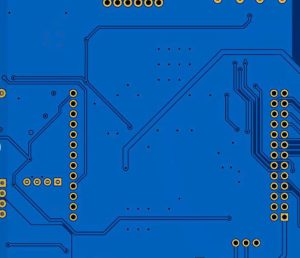
Laser-Drilled Microvias
Laser-Drilled Microvias and the Evolution of Interconnect Technology
The history of PCB interconnection is closely tied to the evolution of drilling technology. Early through-hole boards relied on large mechanical drills and generous design rules. As surface-mount technology matured, via diameters gradually shrank, but the underlying drilling method remained largely unchanged.
The introduction of Laser-Drilled Microvias marked a decisive break from this trajectory. Instead of physically cutting through laminate with rotating tools, laser systems remove material through controlled ablation. This change enabled via diameters well below 150 μm, with precise depth control that mechanical drilling simply cannot achieve economically.
From a broader perspective, Laser-Drilled Microvias emerged in response to three converging pressures:
-
Component miniaturization, particularly fine-pitch BGAs and chip-scale packages
-
Rising signal speeds, where via stubs and parasitics became performance bottlenecks
-
Layer count optimization, as designers sought thinner stacks with higher routing density
What makes this evolution particularly interesting is that it was not driven by design ambition alone. Fabrication capability matured alongside CAD tools, materials science, and inspection technology. The result is a tightly coupled ecosystem in which Laser-Drilled Microvias act as both an enabler and a constraint—powerful, but demanding respect for process limits.
Laser-Drilled Microvias as a Defining Feature of Modern HDI PCBs
High-density interconnect (HDI) PCBs are often described in terms of line width, spacing, or layer count. In practice, however, Laser-Drilled Microvias are the most reliable indicator of whether a board truly qualifies as HDI.
Unlike traditional vias that traverse the full stack, microvias are typically limited to one dielectric layer, forming blind connections between adjacent layers. This architectural difference has far-reaching implications:
-
Routing density increases because surface real estate is preserved
-
Signal paths shorten, improving high-frequency performance
-
Power and ground structures can be optimized with finer granularity
From my observation, designers sometimes underestimate how transformative this structural change can be. A PCB using Laser-Drilled Microvias is not just a denser version of a conventional board—it behaves differently, both electrically and thermally. Current distribution, impedance control, and even failure modes evolve in subtle but important ways.
This is why leading HDI manufacturers, including advanced suppliers such as SQ PCB, treat microvia capability not as an optional feature, but as a core competency. Their investment in laser systems, process tuning, and quality assurance reflects a recognition that interconnect precision defines overall board performance.
Material Interaction
One of the most critical aspects of Laser-Drilled Microvias is how different materials respond to laser energy. Copper, resin, and glass fiber each absorb and dissipate energy differently. As a result, laser parameters must be carefully optimized to:
-
Remove dielectric cleanly
-
Avoid excessive copper overhang or undercut
-
Minimize thermal damage to surrounding material
In my view, this material interaction is where much of the real engineering challenge lies. Successful microvia formation depends less on nominal equipment specifications and more on process understanding and control.
Laser-Drilled Microvias and Their Classification in Advanced PCB Stacks
Not all Laser-Drilled Microvias are created equal. Their functional role depends heavily on how they are integrated into the PCB stack-up.
Blind Microvias
Blind microvias connect an outer layer to an adjacent inner layer. They are the most common application and form the backbone of HDI routing strategies.
Stacked Microvias
Stacked configurations place one microvia directly atop another across multiple layers. While this approach maximizes density, it introduces reliability concerns related to copper fatigue and alignment tolerance.
Staggered Microvias
Staggered microvias offset each via laterally, distributing stress more evenly. Many fabricators, including SQ PCB, recommend staggered designs for high-reliability applications despite the slightly larger routing footprint.
From an engineering standpoint, choosing between stacked and staggered Laser-Drilled Microvias is a trade-off between density and long-term robustness. The “best” solution depends on operating environment, signal requirements, and cost targets.
Laser-Drilled Microvias Compared with Conventional Mechanical Vias
The contrast between Laser-Drilled Microvias and mechanically drilled vias extends beyond size.
| Parameter | Mechanical Vias | Laser-Drilled Microvias |
|---|---|---|
| Minimum diameter | ~200–300 μm | ≤150 μm |
| Depth control | Full stack | Layer-specific |
| Via stub | Significant | Minimal |
| Routing density | Limited | High |
| Equipment wear | High | Minimal |
In my assessment, the most important difference is not dimensional—it is architectural. Mechanical vias impose a vertical constraint that propagates throughout the design. Laser-drilled structures, by contrast, enable localized vertical connections that align more naturally with modern signal flow.
This is why advanced PCB designs increasingly treat mechanical vias as exceptions rather than defaults, reserving them for power, structural anchoring, or cost-sensitive designs.
Conclusion
Laser-Drilled Microvias are not simply a manufacturing technique—they are a philosophy of precision.
They represent a shift from brute-force connectivity to intentional, localized interconnection. When used thoughtfully, they enhance signal integrity, improve power delivery, optimize thermal performance, and enable form factors that would otherwise be impossible.
At the same time, they demand humility from designers. Success with Laser-Drilled Microvias comes not from pushing every limit simultaneously, but from understanding trade-offs and respecting process realities.
In advanced PCB fabrication, mastery is not measured by how small a via can be drilled, but by how consistently it performs across millions of cycles. In that sense, Laser-Drilled Microvias truly are the hallmark of advanced fabrication.
FAQs
1. When should designers avoid using Laser-Drilled Microvias?
They may be unnecessary in low-speed, cost-sensitive designs where traditional vias already meet electrical and mechanical requirements.
2. Why are Laser-Drilled Microvias preferred for HDI PCBs?
They enable smaller diameters, precise depth control, reduced via stubs, and higher routing density, all of which are critical for modern high-speed and high-density designs.
3. Are Laser-Drilled Microvias less reliable than mechanical vias?
Not inherently. When designed within process limits and properly plated, they can be equally or more reliable, especially in controlled environments.
4. What limits the minimum size of Laser-Drilled Microvias?
Material properties, plating capability, aspect ratio constraints, and long-term reliability considerations all define practical minimum limits.
5. Can Laser-Drilled Microvias be used for power delivery?
Yes. When properly designed and filled, they can significantly improve power integrity by reducing inductance and shortening current paths.

- long board pcb
- Flexible PCBs
- Special PCB
- Express Printed Circuit Board
- Pcb Prototype
- LED PCB
- PCB
- Printed Circuit Board
- Pcb meaning
- Pcb manufacturer
- Rigid pcb board
- Rigid Flex PCB
 Quote
Quote
 E-mail