With the increasing demand for high-performance PCBs in industries such as telecommunications, aerospace, and automotive, the need for high-Tg materials has become crucial. One such advanced material is S1000-2M, a high-Tg laminate designed to withstand elevated temperatures, ensuring durability and reliability in extreme conditions.
This article explores the properties, benefits, manufacturing process, and applications of S1000 2M and why it is an ideal choice for high-temperature PCB applications

High Tg Material S1000-2M
What is S1000 2M?
S1000-2M is a high-Tg FR-4 material that offers excellent thermal resistance, mechanical stability, and electrical properties. It is widely used in multilayer PCBs, especially those subjected to harsh thermal and mechanical stresses. The high glass transition temperature (Tg) of S1000-2M enhances its ability to maintain structural integrity under elevated temperatures, making it ideal for high-performance electronics.
Key Properties of S1000 2M
- High Glass Transition Temperature (Tg) – Tg ≥ 180°C, ensuring the material remains stable under high heat conditions.
- Excellent Thermal Stability – Withstand high operating temperatures, reducing the risk of delamination.
- Low Coefficient of Thermal Expansion (CTE) – Provides dimensional stability, preventing warping under thermal cycling.
- High Decomposition Temperature (Td) – Ensures the material does not break down under thermal stress.
- Superior Mechanical Strength – Enhances the durability and reliability of PCBs, especially in multilayer designs.
- Good Dielectric Properties – Offers high insulation resistance and stable signal transmission, crucial for high-frequency applications.
- Lead-Free Soldering Compatibility – Supports RoHS-compliant manufacturing processes.
S1000-2M Datasheet
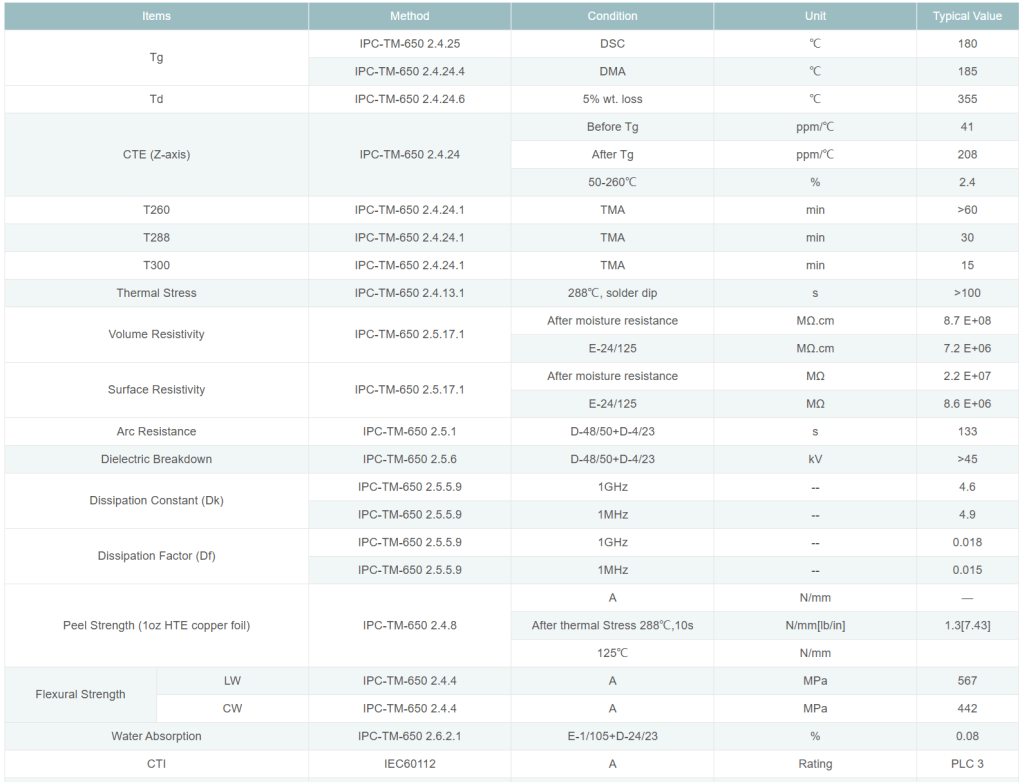
S1000-2M
Advantages of Using S1000 2M in PCB Manufacturing
1. Enhanced Thermal Reliability
The high Tg of S1000-2M ensures better thermal stability, allowing PCBs to operate efficiently at high temperatures. This makes it ideal for lead-free soldering processes and high-power applications.
2. Increased Durability and Mechanical Strength
With its low CTE and high mechanical strength, S1000-2M prevents cracking, delamination, and warping, ensuring long-term reliability, even in harsh environments.
3. Excellent Electrical Performance
S1000-2M provides low signal loss and stable dielectric properties, making it suitable for high-speed, high-frequency PCBs used in 5G networks, automotive radar, and aerospace systems.
4. Superior Heat Resistance
Compared to standard FR-4 materials, S1000-2M withstands higher temperatures, making it a preferred choice for power electronics, industrial control systems, and renewable energy applications.
5. Environmentally Friendly and RoHS Compliance
The material is halogen-free and lead-free, ensuring compliance with environmental regulations while maintaining high-performance standards.
Manufacturing Process of S1000 2M PCBs
The production of S1000-2M-based PCBs follows several key steps to ensure optimal performance and durability.
1. PCB Design and Layout
Engineers use advanced PCB design software like Altium, KiCad, and OrCAD to create layouts that optimize thermal management and signal integrity.
2. Material Selection
S1000-2M is chosen based on the application’s temperature, mechanical, and electrical requirements. The laminate is pre-treated to ensure proper adhesion and stability.
3. Layer Stacking and Lamination
For multilayer PCBs, multiple layers of S1000-2M are stacked and laminated under high pressure and temperature to achieve a uniform and stable board.
4. Drilling and Copper Deposition
Holes for vias and component mounting are precision-drilled, followed by copper deposition to create conductive pathways.
5. Circuit Pattern Etching
The desired circuit pattern is etched onto the copper layer, ensuring high accuracy and minimal signal loss.
6. Surface Finishing
To enhance solderability and longevity, surface finishing techniques like ENIG (Electroless Nickel Immersion Gold), OSP (Organic Solderability Preservative), or HASL (Hot Air Solder Leveling) are applied.
7. Testing and Quality Control
PCBs undergo Automated Optical Inspection (AOI), X-ray testing, and electrical testing to ensure they meet industry standards.
Applications of S1000-2M PCBs
Due to its high Tg, excellent thermal stability, and mechanical strength, S1000-2M is used in various high-performance applications:
1. Telecommunications and 5G Infrastructure
- High-frequency 5G base stations
- RF and microwave communication systems
- High-speed data transmission networks
2. Automotive Electronics
- ADAS (Advanced Driver Assistance Systems)
- Automotive radar systems
- High-power LED lighting modules
- Electric vehicle (EV) battery management systems
3. Aerospace and Defense
- Radar systems and satellite communication
- Avionics control circuits
- Military-grade electronics requiring extreme durability
4. Industrial and Power Electronics
- High-voltage power converters and inverters
- Renewable energy systems (solar inverters, wind power controllers)
- Motor control systems
5. Medical and Healthcare Devices
- Imaging and diagnostic equipment
- High-frequency PCBs for ultrasound and MRI machines
- Medical monitoring and life-support systems
Conclusion
S1000-2M is an advanced high-Tg laminate offering superior heat resistance, mechanical durability, and excellent electrical performance, making it an ideal choice for high-performance PCB applications. Whether used in telecommunications, automotive, aerospace, or industrial power systems, S1000-2M enhances the reliability and efficiency of electronic devices operating under extreme conditions.
For businesses seeking high-quality, high-Tg PCBs, working with a trusted manufacturer ensures superior product performance, compliance with industry standards, and long-term reliability.
If you are looking for S1000-2M PCB solutions, contact Shuoqiang Electronics today for expert consultation and customized PCB manufacturing services!

- long board pcb
- Flexible PCBs
- Special PCB
- Express Printed Circuit Board
- Pcb Prototype
- LED PCB
- PCB
- Printed Circuit Board
- Pcb meaning
- Pcb manufacturer
- Rigid pcb board
- Rigid Flex PCB
 Quote
Quote
 E-mail