FR4 Material Datasheet: Properties, Applications, and Specifications
Introduction
FR4 is the most commonly used PCB (Printed Circuit Board) substrate material, known for its high mechanical strength, excellent electrical insulation, and thermal resistance. It serves as the foundation for a vast range of electronic devices, making it essential for PCB manufacturers, engineers, and designers to understand its properties and applications.
This article provides a comprehensive datasheet for FR4 material, covering its composition, properties, advantages, applications, and key technical specifications to help you make informed decisions for PCB manufacturing.

fr4 material datasheet
What is FR4 Material?
FR4 (Flame Retardant 4) is a glass-reinforced epoxy laminate used as the primary substrate material in PCB fabrication. It consists of woven fiberglass fabric and epoxy resin, making it strong, lightweight, and electrically insulating.
Composition of FR4
- Fiberglass (Glass Fabric Layer) – Provides mechanical strength and rigidity.
- Epoxy Resin – Acts as a binding agent, giving the material its electrical insulation and heat resistance.
- Flame Retardants – Helps meet fire resistance standards (UL 94 V-0 rating).
Key Properties of FR4 Material
1. Electrical Properties
- Dielectric Constant (Dk): 4.0 – 4.8 at 1MHz
- Dissipation Factor (Df): 0.02 – 0.03 at 1GHz
- Surface Resistivity: >10⁶ MΩ/cm
- Volume Resistivity: >10⁷ MΩ/cm
- Dielectric Breakdown Voltage: 40 kV/mm
2. Mechanical Properties
- Tensile Strength: 310-400 MPa
- Flexural Strength: 415-510 MPa
- Shear Strength: 55 MPa
- Peel Strength: 1.05 – 1.50 N/mm
- Density: 1.85-1.90 g/cm³
3. Thermal Properties
- Glass Transition Temperature (Tg): 130°C – 180°C (depending on grade)
- Coefficient of Thermal Expansion (CTE):
- X/Y-Axis: ~10-16 ppm/°C
- Z-Axis: ~55-70 ppm/°C
- Thermal Conductivity: 0.3 W/mK
- Maximum Operating Temperature: ~130-150°C
4. Chemical Properties
- Water Absorption: ≤0.10%
- Flame Retardant Standard: UL 94 V-0 (self-extinguishing)
- Chemical Resistance: Resistant to acids, bases, and solvents
A Example FR4 Material Datasheet
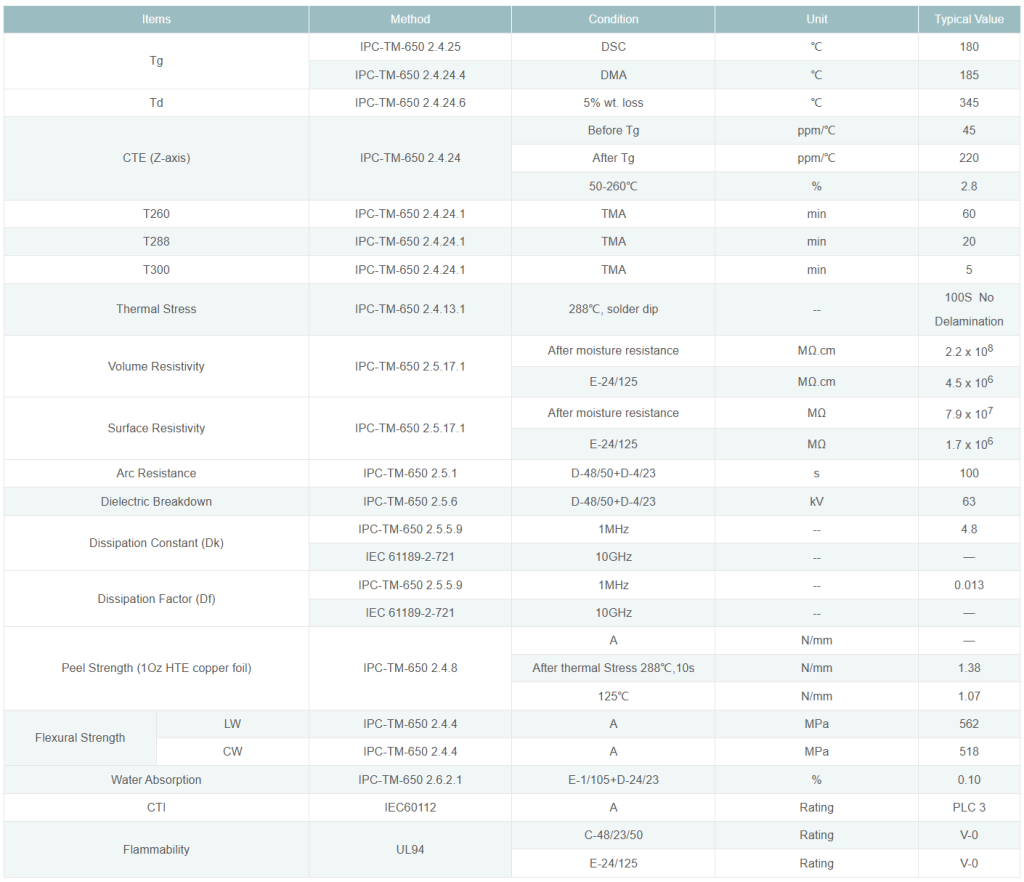
Shengyi S1000-2
Advantages of FR4 Material
1. High Mechanical Strength
- Offers stability, durability, and impact resistance.
- Ideal for multi-layer PCBs requiring rigid support.
2. Excellent Electrical Insulation
- Prevents short circuits and ensures reliable performance in high-frequency circuits.
3. Cost-Effective and Widely Available
- Compared to ceramic or PTFE laminates, FR4 is affordable and mass-producible.
4. Thermal Resistance
- Can withstand lead-free soldering processes with high Tg FR4 variants (≥170°C).
5. Versatility
- Compatible with single-layer, double-layer, and multi-layer PCB designs.
- Supports surface mount technology (SMT) and through-hole components.
Types of FR4 Material
FR4 materials are classified based on thermal performance, mechanical properties, and application requirements.
1. Standard FR4 (Tg 130-140°C)
- Suitable for general consumer electronics, low-power circuits.
2. High-Tg FR4 (Tg ≥ 170°C)
- Used for high-power PCBs, lead-free soldering, and industrial electronics.
3. Low-CTE FR4
- Offers minimal expansion, making it ideal for multi-layer HDI (High-Density Interconnect) PCBs.
4. Halogen-Free FR4
- Environmentally friendly option, reducing harmful emissions during PCB manufacturing.
Applications of FR4 Material
FR4 is widely used across various industries and electronic applications.
1. Consumer Electronics
- Smartphones, laptops, gaming consoles
- Smart home devices, IoT sensors
2. Automotive Electronics
- ADAS (Advanced Driver Assistance Systems)
- Power distribution modules
- Infotainment systems
3. Industrial Electronics
- Control panels, PLCs (Programmable Logic Controllers)
- Power supply boards, converters
- Robotics and automation circuits
4. Aerospace & Defense
- Avionics control systems
- Radar and communication equipment
- Military-grade rugged PCBs
5. Medical Devices
- Wearable health monitoring systems
- Diagnostic and imaging equipment
- Implantable medical devices
FR4 Material Selection Guide
Choosing the right FR4 variant depends on the specific application requirements. Consider these factors:
| Selection Factor | Standard FR4 | High-Tg FR4 | Halogen-Free FR4 |
|---|---|---|---|
| Max Operating Temperature | ~130°C | ≥170°C | ~150°C |
| Multi-layer Compatibility | Limited | High | High |
| Lead-Free Soldering | No | Yes | Yes |
| Environmental Compliance | Standard | RoHS Compliant | Halogen-Free |
| Cost | Low | Medium | Medium-High |
Manufacturing Considerations for FR4 PCBs
1. PCB Layer Stack-Up
- Multi-layer PCBs require precise lamination to maintain dimensional stability.
2. Drilling and Routing
- Use high-speed carbide drills to avoid delamination.
- Laser drilling is recommended for HDI PCBs.
3. Surface Finishing
- HASL (Hot Air Solder Leveling), ENIG (Electroless Nickel Immersion Gold), OSP (Organic Solderability Preservative) are commonly used to protect copper traces.
4. Thermal Management
- If high power dissipation is needed, use high-Tg FR4 or add copper heatsinks.
Conclusion
FR4 material remains the industry standard for PCB fabrication, offering cost-effectiveness, mechanical strength, and electrical insulation. Whether for consumer electronics, automotive systems, or industrial applications, choosing the right FR4 grade ensures optimal performance and longevity.
For high-quality FR4 PCBs, working with an experienced manufacturer like Shuoqiang Electronics guarantees precision fabrication, compliance with industry standards, and tailored PCB solutions.
📩 Contact us today for expert guidance on selecting the best FR4 material for your next PCB project!
our linkedin sqpcb.com

- long board pcb
- Flexible PCBs
- Special PCB
- Express Printed Circuit Board
- Pcb Prototype
- LED PCB
- PCB
- Printed Circuit Board
- Pcb meaning
- Pcb manufacturer
- Rigid pcb board
- Rigid Flex PCB
 Quote
Quote
 E-mail