Delamination of Double-Sided Aluminum PCB:Analysis of Industry-Wide Issues and Countermeasures
2026-01-26
Delamination of Double-Sided Aluminum Substrates: Analysis of Industry-Wide Issues and Countermeasures
For PCB practitioners, the delamination issue of double-sided aluminum PCB has long been a lingering concern—every time a batch of goods is received, it is inevitable to carefully inspect the boards, fearing separation between the insulation layer and aluminum core, or debonding between the copper foil and insulation layer. In fact, delamination of double-sided aluminum substrates is not an isolated case but a common quality pain point in the industry, caused by multiple factors including materials, processes, and the environment. This article will deeply analyze the core causes of delamination and provide targeted control plans to help reduce risks and avoid losses.
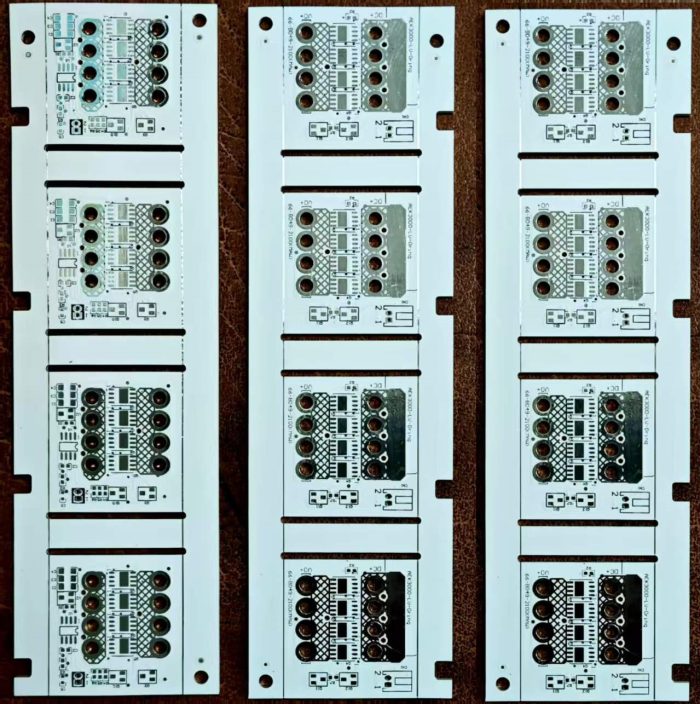
Double-Sided Aluminum PCB
I. Unavoidable Industry Status Quo: Why is Delamination of Double-Sided Aluminum PCB Common?
Double-sided aluminum substrates are widely used in high-temperature applications such as LED lighting, automotive electronics, and power modules due to their excellent heat dissipation performance and electromagnetic shielding effect. However, compared with ordinary FR-4 boards, their structure is more complex (aluminum core + two insulation layers + two copper foils), requiring extremely high compatibility and bonding strength between layers. Moreover, there are more production process steps, and deviations in any link may lay hidden dangers for subsequent delamination.
From industry data, the delamination defect rate of double-sided aluminum substrates is generally higher than that of single-sided ones, especially in high-temperature, high-humidity, or frequent thermal cycling application scenarios, where the delamination probability increases significantly. This is not only an objective problem determined by material properties but also closely related to inadequate process control, becoming a common challenge plaguing both buyers and PCB manufacturers.
II. Core Causes of Delamination in Double-Sided Aluminum PCB: Full-Link Analysis from Materials to Processes
(I) Material Issues: “Inherent Hidden Dangers” of Delamination
Substandard Insulating Adhesive Quality: Insulating adhesive is the core medium connecting the aluminum core and copper foil, and its bonding strength, temperature resistance, and moisture resistance directly determine the delamination risk. Using low-quality adhesives (such as insufficiently pure epoxy resin or imbalanced curing agent ratio) may achieve acceptable initial bonding effects, but the adhesive layer is prone to aging and embrittlement after long-term use or high-temperature treatment, losing bonding force and causing delamination. Meanwhile, poor compatibility between the adhesive and aluminum core/copper foil can lead to “false bonding,” where the layers appear tightly bonded but actually have insufficient bonding strength.
Inadequate Aluminum Core Surface Treatment: Oxide layers, oil stains, and impurities on the aluminum core surface seriously affect the bonding force between the adhesive layer and aluminum core. Regular manufacturers perform anodization, passivation, grinding, and other treatments on the aluminum core to form a rough surface and enhance bonding force. If manufacturers omit these steps to save costs, or the treated aluminum core surface is re-contaminated with oil stains or moisture, the adhesive layer cannot closely adhere to the aluminum core, making delamination between the aluminum core and insulation layer highly likely in the later stage.
Out-of-Control Lamination Process Parameters: Lamination is a critical link in the formation of double-sided aluminum substrates, requiring precise control of three key parameters: temperature, pressure, and time. Excessively high temperature causes over-curing and embrittlement of the adhesive layer, while excessively low temperature results in incomplete curing and insufficient bonding strength. Insufficient pressure fails to expel interlayer air bubbles, forming voids that expand when heated and trigger delamination. Both excessively long and short lamination times affect the cross-linking reaction of the adhesive layer, reducing bonding strength. In addition, double-sided aluminum substrates require symmetric lamination; uneven pressure or temperature on both sides causes stress concentration, increasing delamination risk.
Incomplete Curing Process: Post-lamination secondary curing is required to ensure complete cross-linking of the adhesive layer. Insufficient curing temperature or time leaves the adhesive layer in a “semi-cured” state, with suboptimal bonding strength and long-term residual stress. Stress release during use leads to delamination. Some small factories shorten curing time to increase production capacity, which is a common process flaw causing delamination.
Prepreg Storage Time and Moisture Absorption: This is a key hidden inducement for delamination related to material storage. General prepreg for aluminum substrates has large usage and unified specifications, which can be rotated within 2 weeks through FIFO (First-In-First-Out) management, resulting in low moisture absorption risk. However, prepreg for double-sided aluminum substrates has small usage and slow turnover, leading to unstable storage time. Prolonged storage makes it prone to absorbing moisture from the air, laying hidden dangers for interlayer separation even if subsequent processes are compliant.
Finished PCB Storage Time and Environment: The storage time and environment of finished double-sided aluminum substrates directly affect delamination risk. Practical experience shows that the delamination probability increases significantly after 3 months of storage. Experimental data indicates that newly produced aluminum substrates show no delamination after tin spraying (288℃ for 10 seconds, cycled 10 times), and no abnormalities occur when customers perform SMT within 1 month. However, the delamination defect rate reaches around 5% after 3 months of storage and soars to 40% after 6 months. High-humidity environments and large temperature differences will further accelerate this degradation process.
III. Prevention and Control of Delamination: Full-Process Protection Plan
(I) Receiving and Storage: Building a Strong Intermediate Defense Line
Standardize Storage Conditions: Store double-sided aluminum substrates in a dry, well-ventilated environment at room temperature (20℃±5℃) with relative humidity controlled at 40%~60%. Stack no more than 5 layers of boards to avoid deformation due to pressure. Use moisture-proof packaging during storage; use opened boards as soon as possible and seal unused portions promptly to block moisture erosion and stress accumulation from the environmental perspective.
Strict Quality Inspection Upon Receipt: Conduct multi-dimensional testing quickly after receiving goods. Visually inspect the board edges for debonding, warping, and voids; gently bend the boards by hand to check for abnormal noises indicating delamination. If conditions permit, conduct sampling peel tests (using a tensile tester to measure the bonding force between copper foil and insulation layer) and thermal shock tests (-40℃~125℃ for 10 cycles) to identify defective batches in a timely manner and prevent hidden dangers from entering subsequent processes.
Strictly Control Service Life: Try to complete SMT within 3 months after PCB production, which is crucial for reducing delamination risk. However, from the perspective of actual business scenarios, this requirement is difficult for customers to fully accept, especially for small-batch, multi-batch buyers, making timeliness control challenging. Advance risk notification and communication are necessary.
Strengthen Post-Processing Protection: Handle boards with care during assembly and transportation to avoid external impact and bending, preventing interlayer microcracks. For parts susceptible to high temperatures, adopt heat dissipation optimization measures (such as adding heat dissipation holes or matching heat sinks) to reduce the aging rate of the adhesive layer and extend the service life of the boards.
(II) Alternative Solutions: Avoiding Delamination Risks from the Source
To address the industry-wide delamination issue of double-sided aluminum substrates, if customers have low acceptance of timeliness control, the following two alternative solutions can be considered, balancing heat dissipation needs and operational stability:
Replace with High Thermal Conductivity FR4 Boards: High thermal conductivity FR4 boards have better heat dissipation performance than ordinary FR4, with strong structural stability and extremely low delamination risk. Their production and storage processes are more mature, requiring no strict timeliness control. Suitable for scenarios with moderate heat dissipation needs and high reliability requirements, they can effectively avoid delamination hidden dangers of double-sided aluminum substrates.
Replace with Double-Sided Copper Substrates: Double-sided copper substrates have superior thermal conductivity and structural stability compared to double-sided aluminum substrates, with a much lower delamination defect rate. They are suitable for high-temperature and high-frequency working conditions. Currently, a large number of automotive PCB products have switched to double-sided copper substrates, which not only meet the strict heat dissipation requirements of automotive electronics but also fundamentally solve the delamination problem, making them suitable for high-end, high-reliability scenarios.
IV. Conclusion: Delamination is Preventable and Controllable, with “Precise Control” as the Core
Although delamination of double-sided aluminum substrates is a common industry problem, it is not unavoidable. Essentially, it is a comprehensive issue involving material compatibility, process rationality, and environmental adaptability. By strictly controlling material and process quality from the procurement source, strengthening protection during receiving and storage, and optimizing operational parameters in production and application, the delamination risk can be significantly reduced.
For buyers, there is no need for excessive anxiety about delamination. The key is to establish a sound quality inspection and control system, select reliable suppliers, and put forward targeted quality requirements based on specific application scenarios. If timeliness control is difficult to implement, high thermal conductivity FR4 or double-sided copper substrates can be flexibly used as alternatives to avoid hidden dangers from the source. Only through full-process refined control and flexible adaptation can the performance advantages of the boards be fully exerted, while losses caused by delamination are eliminated.

Product Center
- long board pcb
- Flexible PCBs
- Special PCB
- Express Printed Circuit Board
- Pcb Prototype
- LED PCB
- PCB
- Printed Circuit Board
- Pcb meaning
- Pcb manufacturer
- Rigid pcb board
- Rigid Flex PCB
Contact Us
 Quote
Quote
 E-mail