Precision to a Specific Layer: Mastering Controlled Depth Drilling for Blind & Buried Vias
Controlled Depth Drilling Definition and Conceptual Foundations in PCB Manufacturing
Understanding Controlled Depth Drilling as a Precision-Limited Process
Controlled Depth Drilling refers to a drilling methodology in which the axial penetration of the drill bit is intentionally limited to terminate at a predefined internal layer within a multilayer PCB stack-up. Unlike through-hole drilling, where the objective is to fully penetrate the board thickness, this process demands an exact stopping point, typically within a tolerance window of only a few microns.
At its core, Controlled Depth Drilling enables the formation of:
-
Blind vias, which connect an outer layer to one or more inner layers
-
Buried vias, which connect internal layers without reaching the surface
Both structures rely on depth accuracy rather than full penetration. Any deviation—over-drilling or under-drilling—can render the via electrically defective or mechanically unstable.
What differentiates Controlled Depth Drilling from traditional drilling is not merely the stopping action, but the system-level control architecture required to achieve consistent depth outcomes across thousands or millions of holes in a single production batch.
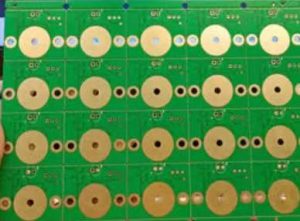
Controlled Depth Drilling
Mechanical and Process Elements Embedded in Controlled Depth Drilling
Controlled Depth Drilling is not a single-variable operation. Instead, it is governed by an interdependent set of parameters:
-
Drill bit geometry and wear characteristics
-
Spindle speed and feed rate stability
-
Z-axis motion resolution
-
Material stack uniformity
-
Dielectric thickness variation
-
Copper foil hardness and adhesion
-
Machine calibration and real-time feedback
The challenge lies in synchronizing these variables so that depth termination remains predictable, regardless of localized material variation or cumulative tool wear.
From a manufacturing perspective, Controlled Depth Drilling transforms drilling from a binary process (drilled / not drilled) into an analog precision process, where depth must be continuously measured, interpreted, and controlled.
Controlled Depth Drilling vs. Alternative Via Formation Techniques
It is important to distinguish Controlled Depth Drilling from other depth-limited via formation methods, such as:
-
Laser drilling
-
Sequential lamination microvia formation
-
Photo-defined via processes
While laser drilling excels at microvias below certain diameters, it struggles with thicker dielectrics and larger blind vias. Controlled Depth Drilling fills the gap where mechanical strength, larger diameters, and structural robustness are required.
In many high-reliability and industrial PCBs, Controlled Depth Drilling remains the preferred—or only—viable solution for specific blind and buried via geometries.
Controlled Depth Drilling and the Physics of Layer-Specific Termination
Why Stopping at the Correct Layer Is Technically Difficult
Stopping a rotating drill bit precisely at an internal copper layer is deceptively complex. Copper layers do not behave as rigid mechanical stops; instead, they introduce variable resistance depending on:
-
Copper thickness
-
Copper foil type
-
Resin content in adjacent prepreg
-
Temperature rise during drilling
Controlled Depth Drilling systems must detect the transition between dielectric and copper without relying solely on mechanical resistance. This has led to the integration of depth counters, torque monitoring, acoustic emission sensing, and spindle load analysis.
The difficulty is compounded by the fact that multilayer PCB stack-ups are never perfectly uniform. Even with tight lamination control, dielectric thickness variation of ±10–15 µm is common, which directly impacts drilling depth accuracy.
Depth Control Windows and Process Margins
In Controlled Depth Drilling, engineers define a depth control window, which represents the acceptable penetration range that:
-
Fully exposes the target copper layer
-
Avoids damaging the underlying layer
-
Preserves sufficient copper thickness for plating adhesion
This window may be as narrow as ±5 µm in advanced HDI designs. Maintaining such precision across thousands of drill hits requires not only machine capability, but statistical process control (SPC) and continuous calibration.
From my perspective, one of the most underappreciated aspects of Controlled Depth Drilling is how quickly process margins collapse as layer counts increase. What may be manageable at 6 layers becomes exponentially more difficult at 16 or 24 layers, where cumulative tolerances stack against the drilling process.
Controlled Depth Drilling Advantages and Its Impact on PCB Performance
Controlled Depth Drilling Advantages in Electrical Performance Optimization
One of the most direct benefits of Controlled Depth Drilling is its impact on signal integrity. By enabling blind and buried vias, designers can significantly reduce via stub length, which in turn minimizes:
-
Signal reflections
-
Impedance discontinuities
-
Crosstalk
-
Insertion loss at high frequencies
In high-speed digital and RF designs, via stubs are no longer a minor nuisance—they are a dominant performance limiter. Controlled Depth Drilling allows designers to terminate vias exactly where needed, eliminating unnecessary conductive length.
This precision directly translates into cleaner eye diagrams, wider timing margins, and improved EMI behavior.
Mechanical and Reliability Benefits Enabled by Controlled Depth Drilling
From a reliability standpoint, Controlled Depth Drilling contributes to:
-
Reduced thermal stress concentration
-
Improved copper plating uniformity
-
Lower risk of barrel cracking
-
Enhanced via fatigue life
Because blind and buried vias are shorter than through vias, they experience lower z-axis expansion stress during thermal cycling. This makes Controlled Depth Drilling especially valuable in applications exposed to wide temperature ranges, such as automotive, aerospace, and industrial control systems.
Controlled Depth Drilling Process Flow in Multilayer PCB Fabrication
Pre-Drilling Stack-Up Preparation for Controlled Depth Drilling
Before any drilling operation begins, Controlled Depth Drilling depends heavily on stack-up accuracy and material predictability. Unlike through-hole drilling, where minor thickness variation can often be absorbed by plating, depth-limited vias leave no margin for error.
Key preparation steps include:
-
Precise dielectric thickness modeling
-
Copper layer target definition
-
Registration tolerance analysis
-
Drill hit mapping relative to layer transitions
From a process engineering perspective, Controlled Depth Drilling starts long before the drill spindle moves. If lamination uniformity is unstable, no amount of machine sophistication can compensate for unknown depth targets.
This is where close coordination between design engineers and fabricators becomes essential. In my experience, designs that explicitly annotate blind via depth intent achieve significantly higher first-pass yield than those that rely on assumed layer thickness values.
Machine Configuration and Z-Axis Control in Controlled Depth Drilling
The heart of Controlled Depth Drilling lies in the Z-axis control system. Modern drilling machines employ high-resolution encoders capable of sub-micron positioning, combined with rigid spindle assemblies to minimize axial runout.
Key machine-level elements include:
-
Digital depth counters
-
Programmable depth offsets
-
Tool length compensation
-
Thermal drift correction
What distinguishes Controlled Depth Drilling machines from standard drill platforms is not just accuracy, but repeatability under production conditions. Maintaining consistent depth across thousands of hits requires compensation for tool wear, temperature rise, and spindle load variation.
This is where Controlled Depth Drilling transitions from a mechanical operation into a closed-loop control problem.
Controlled Depth Drilling Tooling Strategies and Drill Bit Considerations
Drill Bit Geometry Optimization for Controlled Depth Drilling
Drill bits used in Controlled Depth Drilling are optimized differently from those used for through holes. Geometry adjustments focus on:
-
Reduced thrust force
-
Controlled chip evacuation
-
Minimized exit damage
-
Predictable wear patterns
Shorter flute lengths and reinforced shanks are commonly used to improve stiffness and depth accuracy. From my observations, drill bit wear progression is one of the most underestimated risks in Controlled Depth Drilling. Even minimal edge degradation can alter penetration behavior enough to exceed depth tolerances.
As a result, tool life management is often more conservative, increasing tooling cost but protecting yield.
Tool Wear Monitoring and Compensation in Controlled Depth Drilling
Unlike through-hole drilling, where wear primarily affects hole diameter and wall roughness, Controlled Depth-Drilling is sensitive to axial wear and thrust changes.
Advanced drilling systems may monitor:
-
Spindle current
-
Acoustic emission signals
-
Penetration force trends
These signals help infer when a tool begins to cut more aggressively—or more softly—than expected. In my view, the future of Controlled Depth Drilling will increasingly depend on predictive tool replacement, rather than fixed hit-count rules.
Controlled Depth-Drilling Depth Calibration and Verification Methods
Reference Coupon and Calibration Panel Usage in Controlled Depth Drilling
Depth calibration is typically performed using reference coupons that mirror production stack-ups. These coupons allow engineers to:
-
Validate target depth
-
Adjust Z-offset values
-
Confirm copper exposure without over-penetration
This calibration step is often repeated at the start of each shift, or whenever material batches change. In high-mix production environments, Controlled Depth-Drilling calibration can become a significant time investment—but skipping it almost guarantees scrap.
a practical standpoint, calibration is not just a setup task; it is an ongoing process discipline.
Cross-Sectional Analysis for Controlled Depth-Drilling Validation
Post-drill cross-sectioning remains the most reliable verification method. Engineers examine:
-
Copper breakthrough condition
-
Residual copper thickness
-
Dielectric smear characteristics
-
Damage to underlying layers
Although destructive and time-consuming, cross-section analysis provides insights that no sensor can fully replace. I believe this step plays a critical role in process learning, especially when introducing new materials or tighter depth windows.
Controlled Depth-Drilling Summary Table: Technical Role, Benefits, and Risks
| Aspect | Controlled Depth Drilling Contribution | Key Engineering Impact |
|---|---|---|
| Via Structure | Enables blind and buried vias | Reduced via stubs and cleaner interconnects |
| Electrical Performance | Precise via termination | Improved signal integrity and impedance control |
| Reliability | Shorter vias with lower stress | Better thermal cycling endurance |
| Manufacturing | Requires calibration and SPC | Higher process discipline and maturity |
| Cost Impact | Higher drilling cost, system-level savings | Reduced layer count and redesign risk |
| Design Flexibility | Layer-selective connectivity | Increased routing density and layout freedom |
| Risk Factors | Over-drilling / under-drilling | Latent electrical and reliability defects |
Conclusion
Controlled Depth-Drilling is often discussed in technical terms—microns, layers, tolerances, and equipment specifications. Yet, after examining its principles, workflows, advantages, and limitations, one conclusion becomes clear: Controlled Depth-Drilling is not merely a drilling technique, but a strategic capability that shapes PCB performance, reliability, and manufacturability.
From an engineering perspective, its value lies in precision—but not precision for its own sake. The true benefit of Controlled Depth Drilling is that it enables intentional connectivity. By allowing vias to terminate exactly where they are needed—and nowhere else—it empowers designers to control electrical behavior, thermal stress distribution, and mechanical integrity with far greater confidence.
Equally important is what Controlled Depth-Drilling reveals about process maturity. Achieving consistent depth accuracy requires disciplined stack-up design, material understanding, calibration rigor, and feedback-driven optimization. In this sense, Controlled Depth Drilling acts as a mirror: manufacturers that perform it well tend to excel in many other areas of PCB fabrication.
From my own experience, the most successful applications of Controlled Depth Drilling share a common trait: restraint. When used selectively—where signal integrity, density, or reliability truly demand it—it delivers outsized benefits. When used indiscriminately, it becomes an unnecessary burden.
As PCB technology continues toward higher speed, higher density, and higher reliability, Controlled Depth-Drilling will remain a cornerstone process—not because it is fashionable, but because precision-to-layer control aligns perfectly with the direction of modern electronics.
FAQ
Controlled Depth-Drilling FAQ 1:When should designers avoid using Controlled Depth Drilling?
Designers should avoid Controlled Depth-Drilling when full through-hole connectivity is acceptable, signal speeds are low, and routing density is not constrained. Using it without a clear electrical or mechanical justification adds unnecessary complexity without meaningful benefit.
Controlled Depth-Drilling FAQ 2: How does Controlled Depth Drilling differ from standard through-hole drilling?
Standard through-hole drilling is designed to penetrate the entire PCB thickness, prioritizing positional accuracy over depth precision. Controlled Depth Drilling, by contrast, must stop at a specific internal layer within very tight tolerances. This makes it significantly more sensitive to material variation, tool wear, and machine calibration.
Controlled Depth-Drilling FAQ 3: Why not use laser drilling instead of Controlled Depth Drilling for blind vias?
Laser drilling is excellent for very small microvias and thin dielectric layers, but it becomes less effective for thicker materials or larger via diameters. Controlled Depth Drilling provides stronger mechanical vias, better plating robustness, and greater suitability for power, ground, and structural interconnections.
Controlled Depth-Drilling FAQ 4: What are the main risks associated with Controlled Depth Drilling?
The primary risks are over-drilling and under-drilling. Over-drilling can damage underlying layers and cause shorts, while under-drilling can result in poor copper exposure and unreliable plating. Both defects may pass initial inspection but lead to long-term failures if not properly controlled.
Controlled Depth-Drilling FAQ 5: Does Controlled Depth Drilling always increase PCB cost?
At the process level, Controlled Depth-Drilling is more expensive than standard drilling. However, at the system level, it often reduces total cost by enabling smaller boards, fewer layers, better signal performance, and fewer redesign cycles. When applied appropriately, it can lower overall project cost.

- long board pcb
- Flexible PCBs
- Special PCB
- Express Printed Circuit Board
- Pcb Prototype
- LED PCB
- PCB
- Printed Circuit Board
- Pcb meaning
- Pcb manufacturer
- Rigid pcb board
- Rigid Flex PCB
 Quote
Quote
 E-mail