FR4 Dielectric Constant: Importance, Properties, and Impact on PCB Design
Introduction
FR4 is one of the most widely used materials in PCB (Printed Circuit Board) fabrication, valued for its mechanical strength, electrical insulation, and cost-effectiveness. One of its critical electrical properties is the dielectric constant (Dk), which influences signal integrity, impedance control, and high-frequency performance.
This article explores the dielectric constant of FR4, its significance, variations, and how it impacts PCB design for various applications such as high-speed digital circuits, RF/microwave systems, and multilayer PCBs.
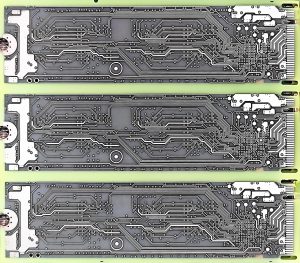
FR4 Dielectric Constant
What is Dielectric Constant (Dk)?
The dielectric constant (Dk), also known as the relative permittivity (εr), is a measure of a material’s ability to store electrical energy in an electric field. It determines how electromagnetic waves propagate through the material, affecting signal speed, impedance, and crosstalk in PCBs.
Formula for Dielectric Constant
This means that a material with a higher Dk stores more electrical energy compared to a vacuum.
Dielectric Constant of FR4
The dielectric constant of standard FR4 typically ranges between 4.0 and 4.8 at 1 MHz, but it varies based on frequency, temperature, and manufacturer specifications.
| Frequency | Dielectric Constant (Dk) |
|---|---|
| 1 MHz | 4.6 – 4.8 |
| 1 GHz | 4.2 – 4.5 |
| 10 GHz | 3.9 – 4.2 |
Factors Affecting FR4 Dielectric Constant
1. Frequency Dependence
- The dielectric constant decreases as frequency increases.
- This effect is critical for RF/microwave circuits and high-speed digital applications.
2. Temperature Variations
- High temperatures can cause fluctuations in Dk, leading to signal integrity issues.
- High-Tg FR4 materials offer better thermal stability.
3. Moisture Absorption
- FR4 has a moisture absorption rate of ~0.1%, which can slightly affect its dielectric properties.
- In humid environments, specialized low-Dk laminates (e.g., Rogers, Isola) may be preferred.
4. Glass-to-Resin Ratio
- Higher glass content results in lower Dk values.
- Manufacturers may modify the glass-resin composition to achieve specific dielectric properties.
Importance of Dielectric Constant in PCB Design
1. Signal Integrity & Propagation Delay
- Higher Dk values slow down signal transmission, affecting high-frequency circuits.
- Lower Dk values improve signal speed, reducing signal degradation.
2. Impedance Control
- Proper Dk selection ensures accurate impedance matching for controlled impedance PCBs.
- Used in high-speed differential pairs (USB, HDMI, PCIe).
3. Crosstalk and Electromagnetic Interference (EMI)
- Higher Dk values can increase signal coupling, leading to greater EMI and crosstalk.
- Designers must adjust trace spacing and shielding to minimize unwanted interference.
Comparing FR4 with Other PCB Materials
| Material | Dielectric Constant (Dk @ 1 GHz) | Loss Tangent (Df) | Application |
| Standard FR4 | 4.2 – 4.5 | 0.02 – 0.03 | General PCBs |
| High-Speed FR4 | 3.9 – 4.1 | 0.008 – 0.015 | High-speed digital |
| Rogers 4350B | 3.48 | 0.0037 | RF & Microwave |
| Isola FR408HR | 3.7 – 3.9 | 0.009 – 0.011 | High-frequency PCBs |
| Taconic RF-35 | 3.5 | 0.0018 | High-frequency RF |
How to Optimize PCB Design Based on FR4 Dielectric Constant
1. Choose the Right FR4 Grade
- Use standard FR4 for low-frequency applications.
- Use low-Dk, high-Tg FR4 for high-speed and thermal stability.
2. Adjust Trace Width and Spacing
- Higher Dk values require wider traces to maintain controlled impedance.
- Use PCB stack-up simulations to fine-tune design parameters.
3. Reduce Signal Loss with Low-Loss FR4
- Select high-frequency FR4 with lower Dk drift for better performance.
- Minimize trace lengths and use impedance-matched routing.
4. Control PCB Layer Stack-Up
- Use dielectric layers with stable Dk values.
- Design with ground planes to reduce signal distortion.
5. Use Advanced PCB Simulation Tools
- Tools like Altium Designer, Cadence Allegro, and Ansys HFSS help analyze Dk impact on signal performance.
- Simulations improve design accuracy before fabrication.
Applications Where FR4 Dielectric Constant Matters
1. High-Speed Digital PCBs
- USB 3.0, PCIe, HDMI, DDR RAM modules
- Networking equipment (routers, switches, servers)
2. RF and Microwave Circuits
- Antenna designs, RF amplifiers, satellite communications
- 5G, Wi-Fi, and Bluetooth PCBs
3. Automotive Electronics
- ADAS (Advanced Driver Assistance Systems)
- Automotive radar and infotainment systems
4. Aerospace and Defense
- Radar, avionics control, and secure military communication
Conclusion
Understanding the dielectric constant of FR4 is crucial for high-performance PCB design, impacting signal integrity, impedance, and overall functionality.
When designing high-speed, RF, or multilayer PCBs, selecting the right FR4 material and optimizing trace routing, layer stack-up, and impedance control can significantly improve performance.
For custom FR4 PCB fabrication, partnering with an experienced manufacturer like Shuoqiang Electronics ensures precise material selection, advanced processing, and superior quality.
📩 Contact us today to discuss your FR4 PCB requirements and ensure optimized circuit board performance!
our linkedin sqpcb.com

- long board pcb
- Flexible PCBs
- Special PCB
- Express Printed Circuit Board
- Pcb Prototype
- LED PCB
- PCB
- Printed Circuit Board
- Pcb meaning
- Pcb manufacturer
- Rigid pcb board
- Rigid Flex PCB
 Quote
Quote
 E-mail