The Unseen Dimension: How Antipad Clearance Influences Impedance in Multilayer PCB Manufacturing
Introduction: The Hidden Geometry Behind Impedance
In multilayer PCB manufacturing, impedance control is often discussed in terms of trace width, dielectric thickness, and material constants. These visible and measurable parameters dominate design guidelines, simulation tools, and fabrication notes. Yet beneath these familiar variables lies an often-overlooked geometric feature that silently reshapes impedance behavior: the void surrounding plated vias within reference planes.
This void—commonly referred to as the antipad—creates a localized discontinuity that can subtly but decisively alter impedance in high-speed and high-density designs. Unlike traces or planes, antipads do not conduct signals directly. Instead, they influence how electromagnetic fields expand, collapse, and couple through the PCB stack-up.
In modern multilayer boards, where signals traverse dozens of layers at gigahertz frequencies, even small geometric deviations can accumulate into measurable performance degradation. Antipad geometry, and more specifically the clearance between a via barrel and surrounding copper planes, becomes an unseen dimension of impedance control.
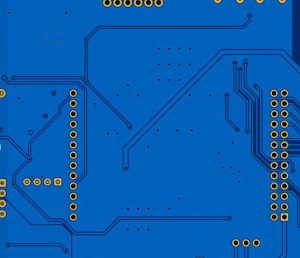
Antipad Clearance
Antipad Clearance Definition in Multilayer PCB Manufacturing
At its most basic level, Antipad Clearance refers to the radial distance between the edge of a plated via (or via pad) and the surrounding copper plane from which copper has been intentionally removed. This clearance creates an electrically isolated region that prevents unintended shorting between the via and plane layers.
However, defining Antipad Clearance purely as a spacing dimension significantly understates its functional role.
In a multilayer PCB, a via barrel passing through reference planes effectively behaves as a vertical transmission structure. The copper planes surrounding the via act as reference conductors, shaping the electric field distribution along the via length. When copper is removed to form an antipad, the size and shape of that removal directly influence parasitic capacitance, inductance, and field confinement.
From a manufacturing standpoint, Antipad Clearance is specified during the PCB layout phase and implemented during plane layer imaging and etching. The dimension must account for:
-
Via drill tolerance
-
Registration accuracy between layers
-
Copper plating growth
-
Etching variability
-
Reliability margins under thermal stress
From an electrical standpoint, Antipad Clearance defines how strongly a via couples to adjacent reference planes. A smaller clearance increases capacitive coupling, while a larger clearance reduces it—each with implications for impedance continuity.
In my experience, many impedance-related issues attributed to “via problems” are in fact Antipad Clearance problems in disguise. Engineers often focus on via diameter or back-drilling while leaving antipad dimensions at default library values that may not align with high-speed requirements.
Antipad Clearance and the Evolution of Impedance Control Theory
Early impedance control methodologies were largely two-dimensional. Engineers calculated impedance assuming uniform cross-sections and infinite planes, conditions that rarely exist in real multilayer PCBs. As data rates increased and via counts multiplied, these simplified models began to fail.
Antipad Clearance emerged as a critical parameter when designers started analyzing vias as three-dimensional structures rather than idealized connections. Field solvers revealed that the antipad region behaves like a localized impedance modifier, introducing capacitive loading that can lower via impedance relative to the connected traces.
In high-speed designs, this mismatch manifests as reflections, eye diagram closure, and increased jitter. What makes Antipad Clearance particularly challenging is its invisibility during functional testing. Unlike trace impedance errors, which often appear consistently, antipad-related impedance deviations can be highly layer-dependent and frequency-sensitive.
Modern impedance theory now treats Antipad Clearance as part of the via’s effective transmission line geometry. This shift represents a broader evolution in PCB engineering: moving from rule-based design to field-aware design.
Antipad Clearance Advantages in High-Speed PCB Design
When intentionally designed rather than passively accepted, Antipad Clearance offers several advantages that directly enhance PCB performance.
One of the primary benefits is impedance tuning. By adjusting antipad dimensions, engineers can compensate for excessive via capacitance, especially in dense multilayer stacks where vias pass through many reference planes. Properly sized clearances help maintain impedance continuity between traces and vias, reducing reflection-induced signal degradation.
Another advantage lies in manufacturing robustness. Adequate Antipad Clearance provides tolerance against layer misregistration and copper growth during plating. This reduces the risk of unintended shorts or marginal clearances that could compromise long-term reliability.
Thermally, optimized Antipad Clearance can also help balance heat dissipation paths without excessively coupling sensitive signals to power or ground planes. This becomes increasingly relevant in high-power digital systems where thermal and electrical considerations intersect.
Antipad Clearance Impact on PCB Performance
The performance impact of Antipad Clearance extends beyond impedance alone. It influences several interrelated aspects of PCB behavior:
-
Signal Integrity: Reduced impedance discontinuities improve eye opening and timing margins.
-
EMI Performance: Controlled field distribution lowers unintended radiation.
-
Crosstalk: Proper clearance limits capacitive coupling between vias in dense arrays.
-
Power Integrity: Managed plane coupling reduces noise injection into reference planes.
What is often underestimated is the cumulative effect. A single poorly optimized antipad may introduce negligible distortion, but hundreds or thousands of vias with suboptimal clearance can collectively degrade system performance.
In multilayer backplanes, high-speed connectors, and processor packages, Antipad Clearance becomes a system-level parameter rather than a local design detail.
Antipad Clearance and Impedance Discontinuities in Via Structures
In multilayer PCB manufacturing, vias are often treated as simple vertical interconnects. Electrically, however, a via is a complex three-dimensional structure whose impedance varies along its length. Antipad Clearance plays a decisive role in shaping this impedance profile.
When a via passes through a solid reference plane without clearance, it creates a direct capacitive coupling between the via barrel and the plane copper. This coupling lowers the local impedance and introduces a discontinuity relative to the characteristic impedance of the connected traces. Antipad Clearance mitigates this effect by removing copper around the via, thereby reducing parasitic capacitance.
The challenge lies in balance. Excessive clearance increases inductive effects and can raise impedance beyond acceptable limits, while insufficient clearance increases capacitance and reflection risk. The resulting impedance “bump” or “dip” is frequency-dependent and often invisible in low-speed validation tests.
From a signal integrity perspective, these discontinuities are particularly harmful in:
-
High-speed serial links
-
DDR memory interfaces
-
High-frequency RF transitions
-
Long via stubs in thick multilayer boards
In my experience, many designers attempt to correct via impedance issues through back-drilling or via-in-pad techniques, overlooking that a well-optimized Antipad Clearance could have mitigated the problem earlier and at lower cost.
Antipad Clearance in HDI and High-Layer-Count PCB Structures
As PCBs move toward higher layer counts and finer geometries, the role of Antipad Clearance becomes even more pronounced. HDI boards often contain microvias, stacked vias, and buried vias, each interacting differently with surrounding planes.
In these dense environments, antipads frequently overlap or approach minimum spacing limits. Poorly coordinated clearance rules can lead to unintended plane fragmentation, altering return current paths and increasing impedance variability.
High-layer-count boards introduce another complication: cumulative capacitive loading. A via passing through 20 or more reference planes experiences repeated capacitive interactions. Even if each antipad is marginally undersized, the total effect can significantly lower via impedance across its full length.
Designers must therefore view Antipad Clearance not as an isolated per-layer parameter, but as a systematic vertical design variable. Coordinated clearance strategies across all reference layers are essential to maintaining predictable impedance behavior.
Antipad Clearance Impact on Electrical Performance and Manufacturing
| Aspect | Small Antipad Clearance | Optimized Antipad Clearance | Excessive Antipad Clearance |
|---|---|---|---|
| Via-to-plane capacitance | High | Controlled | Low |
| Via impedance behavior | Impedance dip | Smooth impedance transition | Impedance peak |
| Signal reflection risk | Moderate to high | Low | Moderate |
| Differential pair balance | Potential imbalance | Stable | Possible inductive mismatch |
| EMI performance | Increased local radiation | Predictable field behavior | Potential field spreading |
| Crosstalk in dense via fields | Higher coupling | Reduced coupling | Variable coupling |
| Manufacturing tolerance margin | Low | Balanced | High |
| Risk of plane shorting | Elevated | Low | Minimal |
| Suitability for high-speed designs | Limited | Excellent | Conditional |
| Cost–performance balance | Poor | Optimal | Cost-increasing |
Conclusion
In multilayer PCB manufacturing, the most influential design factors are not always the most visible ones. Antipad Clearance exemplifies this reality. It exists as an absence of copper, yet it actively defines how electromagnetic fields behave when signals transition vertically through complex layer stacks.
Throughout this discussion, one core insight becomes clear: impedance control is no longer a purely planar problem. As signal speeds rise and layer counts increase, vertical structures—especially vias interacting with reference planes—become dominant contributors to impedance variation. Antipad Clearance sits at the center of this interaction.
What makes Antipad Clearance particularly important is its dual nature. Electrically, it governs capacitive and inductive coupling, shaping impedance continuity and reflection behavior. From a manufacturing perspective, it defines tolerance margins, yield stability, and long-term reliability. Poorly chosen clearance values may pass initial simulations but fail silently in production or field operation.
In my view, the true maturity of a PCB design organization is revealed by how it treats such “secondary” parameters. Teams that intentionally define, simulate, validate, and negotiate Antipad Clearance tend to experience fewer late-stage signal integrity surprises and achieve more predictable performance across product generations.
Ultimately, mastering impedance in modern multilayer PCBs requires designing not only copper—but also the controlled absence of it. Antipad Clearance transforms empty space into a purposeful engineering dimension, bridging theory, fabrication reality, and system-level reliability.
FAQs
1. Can Antipad-Clearance issues cause intermittent or temperature-related failures?
Yes. Marginal clearance combined with thermal expansion and copper movement can alter coupling characteristics over temperature, leading to instability that appears intermittent during testing or field operation.
2. Does Antipad-Clearance affect differential pair impedance?
Yes. When differential signals transition through vias, Antipad Clearance influences the impedance balance between the two conductors. Poorly optimized clearances can introduce mode conversion and skew, degrading differential performance.
3. Is larger Antipad-Clearance always better for signal integrity?
No. Excessive clearance reduces capacitive coupling but increases inductance and impedance discontinuity. Optimal Antipad Clearance balances both effects rather than maximizing one.
4. How does Antipad-Clearance interact with back-drilled vias?
Back-drilling removes via stubs but does not eliminate plane coupling along the remaining via length. Proper Antipad Clearance is still necessary to control impedance where the via passes through reference planes.
5. Should Antipad-Clearance rules be the same for all PCB layers?
Not necessarily. Signal layers associated with high-speed nets often require tighter control, while layers carrying low-speed or power-related vias can tolerate more relaxed clearances.

- long board pcb
- Flexible PCBs
- Special PCB
- Express Printed Circuit Board
- Pcb Prototype
- LED PCB
- PCB
- Printed Circuit Board
- Pcb meaning
- Pcb manufacturer
- Rigid pcb board
- Rigid Flex PCB
 Quote
Quote
 E-mail