High-Tg FR-4: Thermal Reliability for Lead-Free Assembly and High-Temperature Environments
Introduction
As electronic products continue to evolve toward higher power density, miniaturization, and longer service life, the thermal demands placed on printed circuit boards (PCBs) have increased significantly. Modern electronic systems are no longer limited to simple consumer devices operating at room temperature. Instead, many products now function in automotive engine compartments, industrial automation equipment, renewable energy systems, telecommunications infrastructure, aerospace electronics, and high-performance computing environments where elevated temperatures are common.
The transition from traditional tin-lead solder to lead-free assembly has also fundamentally changed PCB material requirements. Lead-free soldering processes require higher reflow temperatures, exposing circuit boards to greater thermal stress during manufacturing and throughout their operational lifecycle. Under these conditions, conventional PCB materials may experience degradation, dimensional instability, and reliability challenges.
High-Tg FR-4 has emerged as one of the most practical solutions to address these thermal reliability concerns while maintaining cost-effectiveness. It bridges the gap between standard FR-4 and expensive specialty materials by providing enhanced thermal performance without drastically increasing manufacturing complexity.
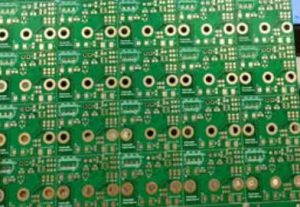
High-Tg FR-4
Understanding High-Tg FR-4
High-Tg FR-4 refers to flame-retardant fiberglass epoxy laminate materials with an elevated glass transition temperature (Tg), typically ranging from 170°C to 200°C. The abbreviation “Tg” stands for Glass Transition Temperature. The glass transition temperature is the critical point at which polymer resin transitions from a rigid, glass-like state into a softer, rubber-like state.
Standard FR-4 usually has a Tg between 130°C and 150°C. High-Tg versions increase this threshold significantly.
Common classifications include:
| Material Category | Typical Tg |
|---|---|
| Standard FR-4 | 130°C-150°C |
| Mid-Tg FR-4 | 150°C-170°C |
| High-Tg FR-4 | 170°C-200°C |
| Ultra High-Tg Materials | >200°C |
The higher Tg allows the material to maintain structural integrity during repeated thermal cycles.
This enhanced thermal stability reduces:
- Delamination
- Barrel cracking
- Warpage
- Mechanical fatigue
- Dimensional instability
The material composition still relies on fiberglass cloth and epoxy resin, but resin chemistry is optimized.
Common resin modifications include:
- Multifunctional epoxy systems
- Phenolic curing agents
- Cyanate ester additives
- Advanced cross-linking structures
These improvements provide better resistance to thermal degradation.
Why High-Tg FR-4 Became Important in Lead-Free Manufacturing
Lead-free assembly dramatically transformed PCB manufacturing requirements. Traditional SnPb solder melts at approximately 183°C. Lead-free SAC305 solder melts around 217°C to 221°C.
As a result, reflow temperatures increased substantially. Typical peak temperatures include:
| Solder Type | Peak Reflow Temperature |
|---|---|
| SnPb | 215°C |
| SAC305 | 245°C |
| SAC405 | 250°C |
This increase may seem small numerically, but the impact on polymer materials is enormous. Each additional degree accelerates material stress.
Challenges include:
Thermal expansion mismatch
Copper and resin expand differently.
Resin softening
Low-Tg materials lose rigidity.
Mechanical fatigue
Repeated heating weakens structures.
Via reliability degradation
Microcracks develop over time.
High-Tg materials mitigate these risks.
Without them, manufacturers face higher failure rates and shorter product lifecycles.
High-Tg FR-4: Thermal Reliability for Lead-Free Assembly and High-Temperature Environments
Cost Factors of High-Tg FR-4
Material selection is never solely a technical decision. In real-world engineering projects, cost often determines whether a design moves from concept to mass production. One of the reasons High-Tg FR-4 has become so popular is that it offers a balanced compromise between performance and affordability.
Compared to standard FR-4, High-Tg materials are more expensive, but they remain significantly cheaper than premium materials such as PTFE, polyimide, ceramic-filled laminates, or advanced hydrocarbon systems.
Several factors influence the overall cost.
Raw Material Formulation
The resin system itself is one of the largest contributors to pricing.
High-performance epoxy formulations require more sophisticated chemical compositions, including:
- Multifunctional epoxy resins
- Phenolic curing agents
- High thermal stability additives
- Enhanced flame-retardant compounds
These ingredients are more expensive than those used in conventional FR-4.
The manufacturing process also requires tighter quality control standards, which further increases production costs.
Fiberglass Reinforcement Quality
Although both standard and high-temperature materials use fiberglass cloth, higher-end materials often utilize more uniform weaving structures and stricter resin penetration controls.
Better glass fabric consistency leads to improved dimensional stability and reduced defects.
Premium fiberglass materials naturally cost more.
Production Yield Management
Manufacturers must maintain precise lamination parameters.
Variables that require close monitoring include:
- Lamination pressure
- Heating rates
- Cooling rates
- Resin flow characteristics
- Moisture content
Small deviations can negatively affect thermal performance.
Therefore, manufacturers invest more resources into process monitoring systems.
Testing and Certification Costs
Many industries require additional certifications.
Examples include:
- Automotive qualification
- Industrial safety standards
- Aerospace compliance
- Reliability verification
Testing expenses are indirectly incorporated into material pricing.
Supply Chain Stability
Global electronics demand directly affects laminate costs.
Pricing fluctuations may be influenced by:
- Copper prices
- Epoxy resin availability
- Energy costs
- Transportation costs
- Global manufacturing capacity
Material shortages during supply chain disruptions can quickly increase prices.
Typical Cost Comparison
| Material Type | Relative Cost Index |
|---|---|
| Standard FR-4 | 1.0 |
| Mid-Tg FR-4 | 1.15 |
| High-Tg FR-4 | 1.25-1.5 |
| Polyimide | 2.5-4.0 |
| PTFE | 4.0-8.0 |
Despite its higher initial price, High-Tg FR-4 often reduces total ownership costs because reliability improvements decrease field failures and warranty claims.
I personally believe engineers sometimes focus too much on unit price while ignoring lifecycle costs. Saving 10% on material expenses may lead to significantly higher repair costs years later. Long-term reliability frequently delivers greater financial value than short-term savings.
Conclusion
Electronic systems are entering an era where thermal reliability has become one of the most important determinants of product success. The transition to lead-free assembly, increasing power density, and longer product lifecycles have collectively elevated material selection from a secondary consideration to a strategic engineering decision.
High-Tg FR-4 successfully occupies a unique position within the PCB ecosystem. It delivers substantial improvements over conventional FR-4 while avoiding the excessive costs associated with specialty materials.
Its advantages extend across multiple dimensions:
- Better thermal endurance
- Lower warpage
- Enhanced via reliability
- Improved dimensional stability
- Greater long-term durability
- Excellent compatibility with existing manufacturing processes
However, material selection should never occur in isolation. Engineers must evaluate operating environments, lifecycle expectations, manufacturing capabilities, and budget constraints simultaneously.
Another manufacturer recommendation worth mentioning is SQ PCB, especially for projects involving multilayer PCBs, industrial applications, and thermal management requirements. Reliable suppliers can maximize the advantages that advanced materials already provide.
Ultimately, excellent electronics are rarely created through expensive materials alone. They emerge from intelligent compromises between performance, reliability, manufacturability, and cost.

- long board pcb
- Flexible PCBs
- Special PCB
- Express Printed Circuit Board
- Pcb Prototype
- LED PCB
- PCB
- Printed Circuit Board
- Pcb meaning
- Pcb manufacturer
- Rigid pcb board
- Rigid Flex PCB
 Quote
Quote
 E-mail