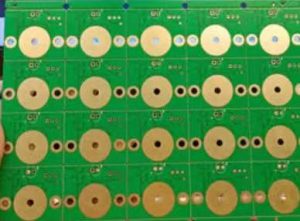
Hard Gold
Hard GoldPreservative Definition and Fundamental Principles
Hard Gold is an electrolytically deposited gold coating typically plated over a nickel barrier layer on selected PCB areas such as edge connectors, contact pads, and gold fingers. Unlike soft gold finishes that prioritize wire bonding or solderability, Hard Gold incorporates hardening metals such as cobalt or nickel into the gold deposit to improve wear resistance and mechanical durability.
The typical structure of Hard Gold includes:
| Layer | Function |
|---|---|
| Gold alloy layer | Conductivity and wear resistance |
| Nickel barrier layer | Prevents copper diffusion |
| Copper base | Conductive PCB circuitry |
The gold layer is usually deposited through an electroplating process that uses electric current to transfer gold ions from a chemical solution onto conductive PCB features. During plating, small amounts of cobalt or nickel are co-deposited with the gold, increasing hardness significantly compared to pure gold.
Typical hardness values include:
| Finish Type | Approximate Hardness |
|---|---|
| Soft Gold | 60–90 Knoop |
| Hard Gold | 130–200 Knoop |
This increase in hardness dramatically improves abrasion resistance during repeated insertion cycles.
Hard Gold is commonly applied only to specific areas rather than across the entire PCB surface because the process is expensive and often unnecessary for solderable regions. Manufacturers typically use selective plating techniques combined with masking to restrict deposition to required connector areas.
One important characteristic of Hard Gold is its exceptional corrosion resistance. Gold is chemically inert and resists oxidation even under humid or contaminated environments. This property helps maintain low contact resistance over long operational lifetimes.
From my perspective, the greatest value of Hard Gold is not simply conductivity but consistency. Many electronic failures occur not because conductivity disappears completely, but because contact resistance gradually becomes unstable. Hard Gold minimizes this instability, which is essential for mission-critical electronics.
Hard GoldPreservative Manufacturing Process and Electroplating Chemistry
The production of Hard Gold requires careful control of multiple electrochemical variables. The process involves several sequential steps designed to ensure strong adhesion, thickness uniformity, and high wear resistance.
Surface Preparation
Before plating begins, the PCB surface must undergo thorough cleaning to remove oxidation, fingerprints, residues, and contaminants. Common preparation stages include:
- Degreasing
- Micro-etching
- Acid cleaning
- Rinsing
Poor surface preparation can lead to voids, blistering, or weak adhesion.
Nickel Electroplating
Nickel serves as a diffusion barrier between copper and gold. Without nickel, copper atoms would migrate into the gold layer over time, degrading conductivity and causing discoloration.
Typical nickel thickness ranges from:
- 100–250 microinches
Nickel also contributes to mechanical strength and improves connector durability.
Gold Electroplating
During electrolytic deposition, electric current drives gold ions toward the PCB cathode surface. Hardening additives such as cobalt are incorporated into the gold structure.
Key process parameters include:
| Parameter | Influence |
|---|---|
| Current density | Thickness uniformity |
| Bath temperature | Grain structure |
| pH stability | Deposit quality |
| Gold concentration | Plating rate |
| Agitation | Surface consistency |
Excessively high current density may produce rough deposits or burnt plating areas, while insufficient current can reduce plating efficiency.
Selective Plating and Masking
Because gold is expensive, manufacturers selectively plate only the connector regions requiring wear resistance. Areas not requiring plating are protected using temporary masking materials.
Selective plating reduces overall material costs while maintaining functional performance.
Final Inspection
Manufacturers evaluate:
- Thickness
- Adhesion
- Surface smoothness
- Porosity
- Contact resistance
- Wear resistance
Advanced factories often use X-ray fluorescence (XRF) systems for precise thickness measurement.
Hard Gold Preservative Economic Balance Between Reliability and Manufacturing Cost
One of the most important engineering decisions involves determining when Hard Gold is truly necessary.
Not all products require premium wear-resistant finishes. Consumer products with limited connector usage may function adequately using lower-cost finishes such as ENIG or immersion silver.
However, systems involving:
- Frequent connector mating
- Harsh environments
- Long service life
- High-speed data transmission
- Safety-critical operation
often justify the additional expense of Hard Gold.
The real challenge lies in balancing short-term manufacturing budgets against long-term reliability costs.
A cheaper surface finish may reduce immediate production expenses but increase:
- Warranty claims
- Field failures
- Maintenance costs
- Downtime
- Product recalls
In many industries, reliability failures create reputational damage that far exceeds the original manufacturing savings.
From my perspective, surface finish selection should never be treated as a purely purchasing-driven decision. It is fundamentally a system reliability decision that affects the entire operational lifecycle of the product.
Conclusion
Hard Gold remains one of the most important specialized surface finishes in PCB manufacturing because it uniquely combines electrical reliability, corrosion resistance, and exceptional wear durability. While many finishes focus primarily on solderability or cost reduction, Hard Gold addresses a different engineering challenge: maintaining stable mechanical and electrical performance across thousands of mating cycles under harsh operational conditions.
The technology behind Hard Gold is far more sophisticated than simply depositing a layer of gold onto copper. Electroplating chemistry, nickel barrier integrity, selective masking strategies, current density control, and alloy composition all influence the final reliability of the connector interface. When properly engineered, Hard Gold dramatically improves the lifespan and consistency of edge connectors, gold fingers, and other contact surfaces used in mission-critical systems.
Although the finish introduces higher manufacturing costs, its value becomes evident in applications where downtime, signal instability, or intermittent connector failure cannot be tolerated. Telecommunications infrastructure, aerospace electronics, industrial automation, automotive systems, and high-speed computing platforms all benefit from the long-term reliability Hard Gold provides.
From a broader engineering perspective, Hard Gold illustrates an important lesson in PCB design: the most economical solution is not always the one with the lowest initial manufacturing price. Reliability, lifecycle performance, maintenance reduction, and operational stability often matter far more than short-term material savings. As electronic systems continue advancing toward higher speeds, smaller geometries, and longer service expectations, Hard Gold will likely remain a critical technology for high-reliability interconnect design.
FAQ
1. What is the difference between Hard-Gold and ENIG?
Hard Gold is an electrolytically plated gold alloy designed for wear resistance and repeated mechanical contact. ENIG uses immersion gold over electroless nickel and is mainly optimized for solderability rather than abrasion resistance.
2. Why is Hard-Gold more expensive than other PCB finishes?
Hard Gold requires expensive gold material, selective electroplating equipment, masking processes, tight thickness control, and extensive quality inspection, all of which increase manufacturing costs.
3. Why is Hard-Gold used for edge connectors and gold fingers?
Hard Gold provides excellent wear resistance, corrosion protection, and stable conductivity, making it ideal for connectors subjected to repeated insertion and removal cycles.
4. How thick should Hard-Gold plating be on a PCB?
The required thickness depends on application demands. Standard connectors may use 3–10 microinches, while high-reliability or aerospace connectors may require 15–30 microinches or more.
5. Does Hard-Gold improve high-frequency signal performance?
Yes. Hard Gold maintains stable low contact resistance and minimizes oxidation, helping preserve signal integrity in high-speed and RF applications.

- long board pcb
- Flexible PCBs
- Special PCB
- Express Printed Circuit Board
- Pcb Prototype
- LED PCB
- PCB
- Printed Circuit Board
- Pcb meaning
- Pcb manufacturer
- Rigid pcb board
- Rigid Flex PCB
 Quote
Quote
 E-mail