How Much Electricity Does It Take to Produce 1 Square Meter of Double-Sided PCB manufacturing?
2026-03-09
Introduction: With 25 years of experience in the PCB manufacturing industry, we often receive questions from peers and downstream customers about the electricity consumption of double-sided PCB production. This article shares real production data, statistical premises, influencing factors, and practical experience from our factory (monthly output 20,000-30,000 square meters), providing a reliable reference for customers and industry peers.
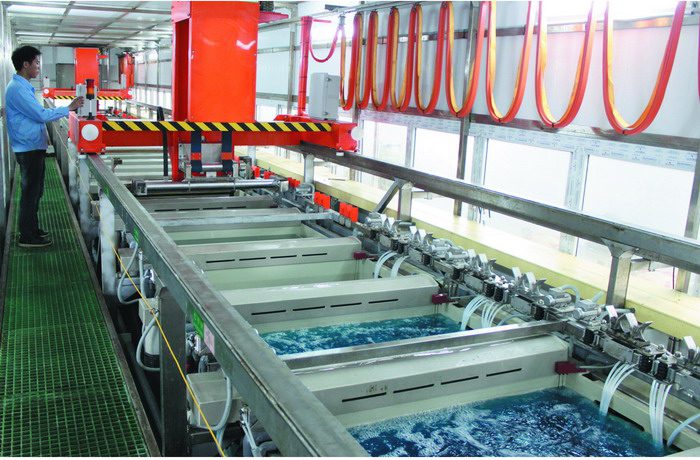
PCB manufacturing
Core Conclusion: Electricity Consumption of 1 Square Meter of Double-Sided PCB manufacturing
Based on the actual production data of our circuit board factory with a monthly output of 20,000-30,000 square meters, it takes about 28 kWh (28 degrees of electricity) to produce 1 square meter of double-sided PCB. This energy consumption level is above the medium level in the industry:
Smaller-scale factories: Higher energy consumption (slightly higher than 28 kWh) due to low equipment utilization and automation rate.
Larger-scale factories: Slightly lower unit energy consumption through large-scale operation, but the difference is basically within 10%.
Statistical Premises (Avoid Misunderstandings)
To ensure the accuracy of the data, we clarify three key statistical premises:
Excluding CCL Energy Consumption: We only count the electricity consumption during the PCB production process, excluding the energy consumption of CCL (Copper Clad Laminate) itself. CCL is an upstream raw material with an independent production process and energy consumption.
No Single-Sided PCB Data: Single-sided PCBs account for a very low proportion of our factory’s production, so the statistical data is not accurate enough and will not be elaborated on.
Multi-Layer PCB Not Included: For multi-layer PCBs, natural gas is mainly used in the lamination and heating process. In addition, factors such as the number of layers, inner layers, and multiple laminations make it difficult to accurately calculate power consumption, so we focus on double-sided PCBs here.
Why Is PCB Production Energy-Consuming?
The PCB production process is long and complex, which is the core reason for its high energy consumption. Each process requires special equipment to operate continuously at high speed, including:
Initial links: Substrate cutting, precision drilling
Middle links: Electroplating, developing, etching
Later links: Solder mask, screen printing, high-temperature curing
Final links: Tin spraying, shape processing, testing
Core high-power-consuming equipment includes drilling machines, electroplating equipment, high-temperature curing furnaces, and tin spraying machines. In addition, precise control of workshop temperature and humidity is also a key power consumption link — PCB production has extremely high requirements for environmental conditions, and this part of energy consumption cannot be ignored.
Seasonal Fluctuations in Energy Consumption
The average power consumption per square meter of double-sided PCBs is stable at around 28 kWh, but there are obvious seasonal fluctuations, mainly affected by temperature and production capacity:
Low Energy Consumption Months (January, February, March, October, November, December)
Unit energy consumption: About 25 kWh per square meter. Reasons:
Peak production season: High production capacity, full-load operation of equipment, optimal energy consumption utilization rate.
Low ambient temperature: No need to turn on air conditioning for cooling, reducing auxiliary power consumption.
High Energy Consumption Months (June, July, August, September)
Unit energy consumption: About 31 kWh per square meter. Reasons:
High-temperature season: 24-hour air conditioning operation to adjust temperature and humidity, additional power consumption.
Off-season: Low production capacity, low equipment operation efficiency, higher energy consumption per unit product.
Summary
For the PCB production process (excluding CCL), the average power consumption per square meter of double-sided PCBs in our factory (monthly output 20,000-30,000 square meters) is about 28 kWh. This data is affected by the complexity of the production process, core equipment energy consumption, seasonal temperature changes, and production capacity fluctuations, showing a law of “less power consumption in peak seasons with low temperature and more power consumption in off-seasons with high temperature”. This law provides an important reference for our factory’s energy consumption management and production cost control.
FAQs (Frequently Asked Questions)
Q1: Why is 28 kWh per square meter considered above the medium level in the industry?
A1: Smaller factories have lower equipment utilization and automation rate, resulting in higher unit energy consumption (slightly higher than 28 kWh); larger factories can reduce unit energy consumption through large-scale operation, but the difference is within 10%. Therefore, 28 kWh is at the upper-middle level in the industry.
Q2: Why is CCL not included in the statistical scope?
A2: This article focuses on the power consumption during the PCB production process (cutting, drilling, electroplating, etc.). CCL has its own independent production process and energy consumption, belonging to the upstream raw material link, so it is not included to ensure data accuracy.
Q3: Can seasonal energy consumption fluctuations be reduced?
A3: It is difficult to completely avoid, but it can be optimized. For example, improving equipment efficiency in the off-season, adopting energy-saving air conditioning, and adjusting production plans can reduce the impact of fluctuations.
Q4: Is the 28 kWh data applicable to all double-sided PCB factories?
A4: It is mainly applicable to medium-scale factories with a monthly output of 20,000-30,000 square meters. Factories with different scales, equipment levels, and processes will have small differences, but the overall range is 25-31 kWh.
Q5: What are the key links to reduce double-sided PCB energy consumption?
A5: Key links include optimizing the efficiency of high-power-consuming equipment, adopting energy-saving environmental control systems, improving production capacity utilization, and optimizing production processes to reduce energy waste.
Keywords: #PCBManufacturing #DoubleSidedPCB #PCBEnergyConsumption #GreenPCB #PCBProduction

Product Center
- long board pcb
- Flexible PCBs
- Special PCB
- Express Printed Circuit Board
- Pcb Prototype
- LED PCB
- PCB
- Printed Circuit Board
- Pcb meaning
- Pcb manufacturer
- Rigid pcb board
- Rigid Flex PCB
Contact Us
 Quote
Quote
 E-mail