The Inner-Layer Killer: How Drill Break-Through Compromises Reliability in PCB Manufacturing
Introduction: When Microns Decide the Fate of a PCB
In modern PCB manufacturing, reliability is no longer determined only by schematic correctness or material selection. It is increasingly dictated by micron-level execution accuracy during fabrication. As layer counts increase, trace widths shrink, and interconnect density rises, seemingly minor process deviations can evolve into latent reliability threats. Among these threats, Drill Break-Through stands out as one of the most underestimated yet destructive phenomena in multilayer PCB production.
Unlike catastrophic defects such as gross misregistration or open circuits, Drill Break-Through often hides beneath copper layers and dielectric stacks. It may pass electrical testing, survive assembly, and even operate normally for months before triggering intermittent failures in the field. From an engineering perspective, this makes Drill Break-Through not just a manufacturing defect, but a time-delayed reliability risk.
Drill Break-Through Definition: Understanding Drill Break-Through at the Inner-Layer Interface
Drill Break-Through refers to a condition in PCB manufacturing where a drilled hole penetrates beyond its intended target layer or depth, breaching an inner copper layer, dielectric boundary, or controlled-stop interface. This typically occurs during mechanical drilling or controlled depth drilling operations when depth calibration, material stack-up variation, or tool wear is not adequately compensated.
At its core, Drill Break-Through is not simply “over-drilling.” It is a failure of depth control relative to functional copper structures, especially inner layers that were never designed to be exposed, contacted, or mechanically disturbed.
How Drill Break-Through Occurs in Practice
Drill Break-Through commonly manifests in the following scenarios:
-
Blind via drilling that unintentionally penetrates the next copper layer
-
Back-drilling operations that exceed calculated stub removal depth
-
Mechanical drilling through thin inner cores with uneven dielectric thickness
-
Stack-up compression during drilling causing unexpected depth variation
What makes Drill Break-Through particularly dangerous is that the drill bit does exactly what it is told to do—but the process assumptions behind that instruction are flawed.
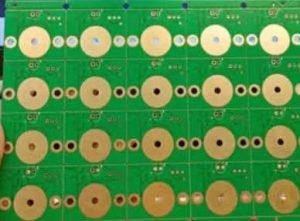
Drill Break-Through
Drill Break-Through Root Causes: Why Drill Break-Through Is So Difficult to Eliminate
Drill Break-Through persists not because it is impossible to prevent, but because its root causes are multidimensional.
1. Material Stack-Up Variability
No laminate stack is perfectly uniform. Even with tight IPC tolerances:
-
Prepreg flow variation
-
Copper thickness deviation
-
Resin content inconsistency
can alter effective drilling depth by tens of microns—enough to cause Drill Break-Through in HDI or thin-core designs.
2. Tool Wear and Thermal Expansion
Drill bits wear progressively, altering:
-
Point geometry
-
Effective cutting length
-
Heat generation
As temperature rises, both the drill bit and PCB panel expand, subtly shifting penetration depth. When not dynamically compensated, this drift increases Drill Break-Through risk.
3. Machine Calibration vs. Real-Time Reality
Most drilling machines rely on static calibration models. However, PCB panels are dynamic systems. Vacuum pressure, panel flatness, and stack compression evolve during the drilling cycle.
In my view, relying purely on static depth tables is fundamentally incompatible with next-generation PCB complexity.
Drill Break-Through Advantages: Are There Any Practical Benefits of Drill Break-Through?
At first glance, it may seem counterintuitive to discuss advantages of Drill Break-Through. However, in manufacturing reality, some engineers view certain forms of controlled or accepted break-through as process compromises rather than outright failures.
Perceived Advantages of Drill Break-Through
-
Improved Via-to-Copper Contact (in rare cases)
In specific legacy designs, slight Drill Break-Through has been used to ensure electrical continuity when layer alignment tolerances were poor. -
Reduced Process Complexity
Allowing minor Drill Break-Through can simplify drilling programs by reducing the need for ultra-tight depth control, particularly in cost-sensitive products. -
Higher Throughput
Less conservative drilling parameters may increase machine utilization and reduce cycle time.
Why These “Advantages” Are Technically Dangerous
While these points may appear attractive from a short-term production standpoint, they introduce long-term reliability liabilities. In my opinion, Drill Break-Through advantages only exist when reliability expectations are intentionally lowered.
High-reliability sectors—automotive, aerospace, medical, and industrial control—cannot afford such compromises.
Drill Break-Through Impact on PCB Performance: Electrical, Mechanical, and Thermal Consequences
Drill Break-Through affects PCB performance across multiple dimensions, often in ways that are not immediately measurable.
Electrical Performance Degradation
-
Unintended copper exposure can cause micro-shorts
-
Inner-layer signal impedance may be altered
-
Return path discontinuities increase EMI risk
These effects may not fail initial testing but degrade performance margins.
Mechanical Integrity Loss
Drill Break-Through introduces:
-
Stress concentration points
-
Micro-cracks around breached copper
-
Reduced interlaminar adhesion
Over time, thermal cycling amplifies these weaknesses.
Thermal Reliability Risks
Breached inner layers disrupt heat flow paths, especially in power or high-current designs. This leads to localized hot spots and accelerated aging.
From a system-level perspective, Drill Break-Through transforms the PCB from a predictable engineered structure into a probabilistic failure model.
Drill Break-Through and Supplier Capability: Why Process Discipline Matters
Preventing Drill Break-Through is not only about equipment—it is about process philosophy. Manufacturers that invest in:
-
Stack-up simulation
-
Depth-sensing drilling
-
Cross-sectional verification
demonstrate a fundamentally different reliability mindset.
Drill Break-Through Design Responsibility: How Designers Accidentally Enable Drill Break-Through
While Drill Break-Through is often labeled as a fabrication issue, design decisions frequently set the stage for its occurrence.
Design Choices That Increase Drill Break-Through Risk
-
Ultra-Thin Dielectric Layers
Aggressive stack-ups with thin prepregs leave minimal depth margin. -
High Inner-Layer Copper Weight
Thick copper increases drill resistance variability. -
Tight Via-to-Inner-Copper Clearances
Reduces tolerance for drilling depth deviation. -
Overuse of Blind Vias Without Depth Budget Analysis
In my experience, many designers assume that fabrication houses will “figure it out.” Unfortunately, Drill Break-Through is often the result of unspoken assumptions between design and manufacturing.
Why DFM Rules Often Fail to Address Drill Break-Through
Most DFM guidelines focus on:
-
Annular ring size
-
Via aspect ratio
-
Trace spacing
Very few explicitly quantify depth control margin. This blind spot allows Drill Break-Through to remain a hidden reliability threat.
Drill Break-Through Economics: Short-Term Savings vs. Long-Term Failure Costs
One reason Drill Break-Through persists is economic pressure. Preventing it costs money; repairing its consequences costs much more—but often much later.
Why Drill Break-Through Is Economically Misjudged
-
The cost of deeper process control is immediate
-
Field failures occur months or years later
-
Warranty data rarely traces root cause back to drilling
This disconnect allows Drill Break-Through to survive as a “statistically acceptable” defect in some production environments.
Lifecycle Cost Reality
In my experience, a single field failure caused by Drill Break-Through can outweigh the cost of:
-
Additional cross-sections
-
Tool replacement
-
Conservative depth margins
The problem is not lack of data, but misaligned accountability timelines.
Drill Break-Through and Reliability Standards: Why Drill Break-Through Is Underrepresented
Industry standards such as IPC focus heavily on:
-
Annular ring
-
Plating thickness
-
Electrical clearance
While these are critical, Drill Break-Through often exists between categories—part mechanical, part electrical, part material-related.
The Standards Gap
Drill Break-Through is frequently treated as a secondary defect, evaluated only when it causes an obvious failure. I believe this underrepresentation is one of the reasons it remains widespread despite decades of PCB process advancement.
In high-reliability sectors, internal standards often exceed IPC requirements specifically to manage this gap.
Drill Break-Through Risk Evaluation Table for Different PCB Applications
| PCB Application Type | Drill Break-Through Risk Level | Primary Risk Driver | Recommended Industry Practice |
|---|---|---|---|
| Consumer Electronics | Medium | Thin stack-ups and cost pressure | Statistical depth control and sampling |
| Industrial Control | High | Long service life and thermal cycling | Tight depth tolerance and verification |
| Automotive Electronics | Very High | Vibration + temperature extremes | Zero-tolerance Drill Break-Through policy |
| Medical Devices | Very High | Patient safety and long-term stability | Conservative design and mandatory cross-sections |
| Aerospace & Defense | Critical | Mission-critical reliability | Redundant inspection and over-controlled drilling |
| HDI / High-Speed PCB | Critical | Ultra-thin dielectrics and blind vias | Advanced depth sensing and adaptive drilling |
Conclusion: Why Drill Break-Through Redefines PCB Reliability Thinking
After examining Drill Break-Through from definition, process origin, perceived advantages, performance impact, economic consequences, and future risk, one conclusion becomes unavoidable:
Drill Break-Through is not a minor drilling defect—it is a structural reliability disruptor.
What makes Drill Break-Through particularly dangerous is its ability to hide. It often survives electrical testing, escapes visual inspection, and passes shipment approval. Yet internally, it compromises copper integrity, weakens dielectric isolation, and seeds future failure mechanisms. In high-density and high-reliability PCBs, this makes Drill Break-Through a silent reliability killer rather than an obvious manufacturing error.
From my own perspective, the real issue is not whether Drill Break-Through can be fully eliminated—because absolute elimination is unrealistic in any physical process. The true challenge is whether organizations are willing to acknowledge depth control as a first-class reliability parameter, equal in importance to impedance control, annular ring size, or plating thickness.
Another critical insight is that Drill Break-Through often reflects system-level immaturity. When it appears frequently, it signals gaps in communication between design, CAM engineering, material selection, and shop-floor execution. In that sense, Drill Break-Through is less a defect and more a process diagnostic indicator.
As PCB technology continues toward thinner dielectrics, higher layer counts, and more aggressive interconnect strategies, Drill Break-Through will only grow in significance. Manufacturers and designers who treat it as a tolerable side effect of complexity will face increasing field failures. Those who design stack-ups, drilling strategies, and verification methods around preventing Drill Break-Through will gain a decisive advantage in long-term reliability.
Ultimately, Drill Break-Through forces the industry to confront an uncomfortable truth:
Reliability is not guaranteed by passing tests—it is earned by controlling the processes that never show up on test reports.
FAQs
1. How can designers reduce the risk of Drill Break-Through at the design stage?
Designers can significantly reduce Drill Break-Through risk by:
-
Allowing sufficient dielectric thickness margin
-
Avoiding unnecessary blind via depth aggressiveness
-
Coordinating stack-up decisions with fabrication capability
-
Treating drilling depth as a constrained parameter, not a flexible one
In my view, the most effective prevention strategy begins before the PCB ever reaches the factory floor.
2. Is Drill Break-Through always considered a defect in PCB manufacturing?
Not always. In some low-reliability or legacy designs, limited Drill Break-Through may be tolerated or go unnoticed if it does not immediately affect electrical performance. However, in modern HDI, automotive, aerospace, and medical PCBs, Drill Break-Through is widely regarded as a latent reliability defect, even if it does not cause an immediate failure.
3. How does Drill Break-Through differ from over-drilling or mis-drilling?
Over-drilling generally refers to exceeding the intended hole depth, while mis-drilling focuses on positional error. Drill Break-Through is more specific—it describes unintended penetration into functional inner layers, regardless of whether the hole position is correct. This makes Drill Break-Through particularly damaging because it compromises internal structures that were never designed to be exposed.
4. Can Drill Break-Through be detected without destructive testing?
Detection without destructive testing is extremely difficult. Electrical testing rarely reveals Drill Break-Through unless a short or open is created. AOI cannot see internal damage. X-ray may help in some cases but lacks sufficient resolution for subtle copper breaches. Cross-section analysis remains the most reliable detection method, which is why Drill Break-Through is so often discovered only after failures occur.
5. Does Drill Break-Through affect signal integrity directly?
Yes, in many cases. Drill Break-Through can alter reference plane continuity, introduce impedance discontinuities, and increase electromagnetic interference. These effects may not cause immediate functional failure but can reduce signal margin, making the PCB more sensitive to temperature, voltage variation, and aging.

- long board pcb
- Flexible PCBs
- Special PCB
- Express Printed Circuit Board
- Pcb Prototype
- LED PCB
- PCB
- Printed Circuit Board
- Pcb meaning
- Pcb manufacturer
- Rigid pcb board
- Rigid Flex PCB
 Quote
Quote
 E-mail