Essential for Advanced Packaging: Mastering Via-in-Pad Technology in Modern PCB Fabrication
1. Introduction
Among these innovations, the technique often referred to as Via-in-Pad has become a defining capability for advanced packaging and high-density interconnect (HDI) fabrication. While it might appear at first glance as a simple relocation of a via into a component pad, its engineering implications reach far deeper. It represents a thoughtful structural reconfiguration designed to shorten electrical paths, reduce parasitics, improve thermal transfer, and optimize land-use efficiency. This is not merely a layout tactic; it is a manufacturing-driven interconnect solution that impacts nearly every aspect of the PCB’s performance envelope.
The rise of Via-in-Pad aligns perfectly with the trajectory of modern electronics. Semiconductor pitch continues to shrink, and component density on the PCB grows in response. Traditional routing methods struggle under these pressures because escape routing becomes increasingly constrained, and the available surface area is insufficient to accommodate both signal vias and pad structures. In such an environment, the use of advanced via structures is no longer optional—it is essential. Many OEMs today mandate Via-in-Pad for their next-generation BGA, CSP, and flip-chip components, particularly when signal speeds exceed 10 GHz or where advanced thermal management is required.
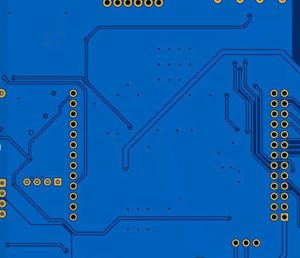
Via-in-Pad
2. Understanding Via-in-Pad: Definition, Core Principles, and Engineering Significance
Via-in-Pad technology represents one of the most significant structural innovations in modern printed circuit board engineering. While it may appear deceptively simple from a surface perspective—a via placed directly inside the pad area of a BGA, CSP, QFN, or other fine-pitch component—the underlying engineering considerations are intricate. Understanding the real definition and purpose of this structure is essential for engineers who work in high-density, high-reliability, or high-frequency design environments.
2.1 Via-in-Pad: A Precise Definition for Modern PCB Fabrication
At its core, Via-in-Pad is a PCB interconnect technique that places a plated or filled via directly beneath or within a component’s solderable pad rather than adjacent to it. Traditionally, vias are placed near the pad and connected through a short trace known as a “dog bone” structure. In contrast, Via-in-Pad eliminates this breakout geometry, allowing signals to transition directly from the pad surface to an internal layer or opposite side of the PCB.
To define Via-in-Pad precisely from an engineering standpoint, it must include the following characteristics:
-
A via drilled within the copper pad rather than in the routing area outside the pad.
-
The via is filled (typically with conductive copper, non-conductive resin, or hybrid materials), preventing solder wicking during assembly.
-
The pad surface is planarized, usually via copper plating and mechanical or chemical leveling, creating a smooth, uniform solderable surface.
-
The structure enables fine-pitch breakout, improved routing efficiency, or controlled impedance in high-speed designs.
This definition is essential because many designers mistakenly assume that any hole inside a pad qualifies as Via-in-Pad. In reality, only a filled and planarized structure meets industry standards for SMT assembly and advanced packaging requirements. Without filling and planarization, the pad becomes unsuitable for soldering, leading to voids, wicking, and severe assembly defects.
2.2 Structural Mechanics Behind Via-in-Pad
The functional mechanics of Via-in-Pad rely on a combination of drilling, filling, copper plating, and pad treatment processes. Each stage introduces mechanical and material characteristics that influence reliability.
Microvia vs. Through-Hole Structures
Via-in-Pad does not refer to a specific via type but rather a placement strategy. The via may be:
-
Laser-drilled microvias in HDI designs
-
Mechanically drilled buried or blind vias
-
Copper-filled through-holes for high-current or thermal transfer
The decision between these structures depends on design intent:
-
Microvias provide the shortest electrical path and minimal parasitic inductance.
-
Filled through-holes offer better thermal and mechanical robustness.
Filling Materials and Mechanical Stability
The filling material significantly affects the structure’s mechanical behavior:
-
Copper filling provides the highest thermal and electrical conductivity.
-
Non-conductive resin reduces cost but may introduce CTE mismatch.
-
Conductive epoxy is used when thermal needs exceed electrical demands.
The planarized copper cap reinforces the pad and prevents deformation under reflow, which is essential for fine-pitch components that cannot tolerate uneven solder volume.
2.3 Electrical Behavior Introduced by Via-in-Pad
Via-in-Pad impacts signal performance through several electrical mechanisms:
Shorter Signal Paths
The direct path from pad to inner layers reduces:
-
Inductance
-
Propagation delay
-
Reflection points
-
Potential impedance discontinuities
This is especially important for signals above 10–20 GHz, common in 5G mmWave, high-speed SerDes, PCIe Gen5/6, and DDR5/DDR6 architectures.
Improved Power Delivery
Placing a via directly under a power pad offers:
-
Lower voltage drop
-
Reduced loop area
-
More uniform power distribution to internal planes
Noise and Crosstalk Considerations
Although Via-in-Pad reduces parasitics, designers must still consider:
-
Antipad clearance
-
Stub length
-
Layer transition frequency effects
When engineered properly, Via-in-Pad contributes to significantly cleaner high-speed channels.
2.4 Thermal Influence and Heat Transfer Paths
One of the most overlooked advantages of Via-in-Pad is its ability to enhance thermal conduction.
Direct Heat Conduction Path
By connecting a component pad directly to internal copper planes, the thermal path becomes more efficient. This is particularly useful for:
-
Power MOSFETs
-
High-power PMICs
-
RF amplifiers
-
CPU and GPU package substrates
The via acts as a thermal pillar, conducting heat downward into the PCB stack, which can distribute and dissipate heat more evenly.
Thermal Balancing Across Layers
With multiple filled vias in the pad, heat spreads across inner copper planes, preventing localized hotspots and improving overall thermal reliability under harsh conditions.
3. Cost Structure of Via-in-Pad Technology and Its Impact on PCB Performance
Via-in-Pad technology delivers clear advantages in density, signal performance, and thermal management; however, those benefits come with a more complex and expensive manufacturing process. To fully leverage Via-in-Pad, engineers must understand not only how it enhances PCB performance but also how its cost structure is formed through material, equipment, and process constraints. The economics and technical performance of Via-in-Pad are tightly linked, and optimizing one often requires balancing the other.
3.1 Direct Manufacturing Costs of Via-in-Pad
The most immediate cost factor associated with Via-in-Pad is the manufacturing process itself. Compared to standard via structures, Via-in-Pad requires more advanced equipment, additional steps, and higher material precision.
Key direct cost drivers include:
1. Advanced Drilling Technologies
Laser drilling for microvias accounts for a significant portion of cost, especially when the stack-up requires multiple sequential laminations. Fine-pitch packages often require microvias with diameters of 75–100 µm, which can only be achieved with high-precision laser equipment.
2. Via Filling Materials
The cost varies depending on whether the via is filled with:
-
Copper (most expensive, highest performance)
-
Conductive epoxy (moderate cost, specialized)
-
Non-conductive resin (least expensive but limited thermal conductivity)
Copper filling alone can drastically raise costs due to both material and electroplating time.
3. Planarization Processes
After filling the via, the pad must be mechanically or chemically planarized to ensure a completely flat solderable surface. This step increases:
-
Equipment time
-
Abrasive material consumption
-
Process control costs
4. Tighter Tolerances and Quality Control
Via-in-Pad requires:
-
X-ray registration checks
-
Void detection
-
Fill height verification
-
Copper cap uniformity inspection
Every inspection adds incremental cost.
These direct costs can add 20–50% over the cost of a conventional HDI board, depending on the density and complexity. For high-density advanced packaging, this investment is often justified by performance necessity.
3.2 Hidden Cost Drivers and Yield Considerations
Beyond direct process costs, there are hidden or secondary costs that arise because Via-in-Pad increases manufacturing sensitivity.
1. Yield Loss from Inconsistent Filling
If:
-
the via fill is not uniform,
-
voids occur inside the via,
-
the cap layer is uneven,
the PCB may fail during reflow or assembly. Reworking such boards is nearly impossible, and scrap rates can increase significantly.
2. Higher Scrap Risk During Sequential Lamination
Stacked microvias require flawless layer alignment. Misalignment by as little as 25 µm can render an entire panel unusable.
3. Increased CAM and Engineering Time
DFM (Design for Manufacturing) review becomes more intensive, requiring more engineering hours before production can begin.
4. Longer Turnaround Time
More process steps mean:
-
longer fabrication cycles,
-
increased lead time,
-
potential delays in product launch.
These costs are not always visible upfront but impact total project economics.
3.3 Design-for-Manufacturing Factors Affecting Via-in-Pad Cost
Cost can be reduced when designers follow certain DFM principles.
1. Avoiding Excessive Stacked Microvias
Stacking microvias multiple layers deep greatly increases lamination cycles and drilling cost.
Staggering them instead reduces risk and cost.
2. Optimizing Pad Size vs. Via Diameter
Oversized pads waste space and require excessive planarization.
Undersized pads increase assembly defects.
Finding the balance improves both cost and yield.
3. Reducing the Number of Copper-Filled Vias
Where thermal or electrical requirements allow it, using resin-filled vias can lower cost.
4. Simplifying Layer Transition Paths
Shorter and fewer transitions reduce laser drilling and plating time.
5. Avoiding Unnecessary High-Density Zones
Designers sometimes place Via-in-Pad structures in areas that do not require them.
A strategic placement approach significantly reduces cost.
3.4 How Via-in-Pad Modifies PCB Reliability and Signal Integrity
While Via-in-Pad adds cost, its performance impact can be transformative.
Signal Integrity Improvements
-
Reduced inductance due to shorter current loop
-
Less reflection and impedance disruption
-
Better high-frequency transmission
-
Cleaner differential pair transitions
This is crucial for interfaces like:
-
PCIe Gen5 / Gen6
-
USB4
-
56–112 Gbps SerDes
-
mmWave RF antennas
Thermal Benefits
Direct thermal conduction through filled vias helps:
-
reduce hotspot formation,
-
stabilize junction temperature,
-
improve power device reliability.
Mechanical Reliability
With a filled and planarized structure:
-
pads are more resistant to lift-off
-
joints withstand vibration better
-
cycling fatigue is reduced
This is essential in automotive and aerospace environments.
Copper-Filled vs. Resin-Filled Structures
| Structure Type | Cost | Thermal Performance | Electrical Performance | Best Use Case |
|---|---|---|---|---|
| Copper-Filled | High | Excellent | Excellent | High-power, high-speed, advanced packaging |
| Conductive Epoxy | Medium | Good | Moderate | Thermal pads, RF modules |
| Non-Conductive Resin | Low | Poor–Moderate | Moderate | Consumer-grade HDI |
Via-in-Pad technology has matured from a specialized HDI technique into a critical enabler of modern electronic systems. As packaging densities rise and interconnect performance becomes a limiting factor for high-speed computing, RF modules, and advanced consumer electronics, Via-in-Pad provides clear advantages in electrical behavior, mechanical reliability, and thermal management.
Key Factors Influencing Via-in-Pad Performance
| Category | Key Factors | Impact on Performance |
|---|---|---|
| Material | Dielectric constant, copper purity, resin stability | Affects impedance, plating adhesion, and reliability |
| Drilling | Laser alignment accuracy, via diameter | Influences stacking, fill behavior, and breakout risk |
| Copper Fill | Plating chemistry, current density, void ratio | Determines mechanical strength and thermal path efficiency |
| Planarization | CMP flatness, surface roughness | Affects solder joint quality and BGA assembly yield |
| Thermal Cycling | CTE mismatch, via barrel integrity | Impacts long-term reliability and fatigue resistance |
| Cost Drivers | Number of vias, process time, inspection requirements | Defines overall PCB cost and manufacturability |
Conclusion
Via-in-Pad technology stands at the center of a profound transformation in modern PCB fabrication and electronic packaging. As devices demand higher functionality within ever-shrinking physical boundaries, traditional routing and via strategies fall short. The rise of HDI architecture, chiplet ecosystems, high-speed signaling, and ultra-compact consumer electronics have collectively established Via-in-Pad as a structural and electrical necessity—not simply an optional design feature.
Throughout this comprehensive analysis, several key insights emerge that define the critical role of Via-in-Pad in shaping the future of electronic interconnects. Via-in-Pad enables designers to overcome the constraints imposed by fine-pitch BGAs, RF components, and multi-gigabit channels. By integrating vias directly into the landing pad, vertical interconnects become shorter and electrically cleaner. This architectural change not only improves manufacturing density but also enhances system performance across high-frequency and high-power domains.
In summary, mastering Via-in-Pad technology is not just beneficial—it is essential. Engineers, researchers, and manufacturers who build expertise in this domain will be the ones leading the next wave of electronic innovation, defining the standard for reliability, performance, and integration in modern PCB fabrication.
FAQs
1. How do manufacturers ensure Via-in-Pad reliability?
Through strict control of plating chemistry, X-ray inspections, cross-sections, thermal cycling tests, and void detection during quality assurance.
2. Why is Via-in-Pad preferred for high-speed and RF applications?
Because it reduces parasitic inductance and shortens interconnect length, improving signal integrity and reducing transition loss.
3. Does Via-in-Pad significantly increase PCB cost?
It increases fabrication cost due to laser drilling, copper filling, and planarization. However, it can reduce overall system cost by lowering layer count and improving assembly yield.
4. Can Via-in-Pad improve thermal dissipation?
Yes. A filled via acts as a vertical copper pillar, creating an efficient thermal path from the device to lower copper layers.
5. Are conductive paste–filled vias as reliable as copper-filled vias?
Conductive pastes are cost-effective but typically less reliable for high-power or high-speed applications. Copper-filled structures offer superior conductivity and structural stability.

- long board pcb
- Flexible PCBs
- Special PCB
- Express Printed Circuit Board
- Pcb Prototype
- LED PCB
- PCB
- Printed Circuit Board
- Pcb meaning
- Pcb manufacturer
- Rigid pcb board
- Rigid Flex PCB
 Quote
Quote
 E-mail