Understanding 2oz Copper Thickness PCB: What IPC-6012F Actually Requires
When a customer specifies “2 oz copper” for a PCB, the requirement may appear straightforward. In theory, 2 oz/ft² of copper corresponds to approximately 68.6 μm, commonly rounded to 70 μm.
However, when the finished board is microsectioned, the measured copper thickness may be close to 60 μm—or sometimes lower. This often leads to disagreement between PCB buyers and manufacturers.
Does a measurement below 70 μm automatically mean that the PCB is nonconforming?
Not necessarily.
The answer depends on what “2 oz copper” means in the procurement documentation:
- 2 oz starting copper foil;
- 2 oz finished conductor weight;
- or a specified minimum finished copper thickness.
These descriptions are not interchangeable. IPC-6012F treats them differently.
2OZ Copper Thickness
1. Why “2 oz Copper” Is Not a Complete Specification
Copper weight is a nominal mass-per-area designation, not an automatic guarantee that every finished conductor will measure exactly 70 μm.
During PCB manufacturing, copper thickness can be affected by:
- Copper foil manufacturing tolerance;
- Surface preparation and cleaning;
- Etching and pattern formation;
- Mechanical brushing or planarization;
- Copper plating;
- Rework, when permitted;
- The location and method of microsection measurement.
For this reason, an accurate PCB specification should clarify whether the required copper weight refers to the starting foil or the finished conductor.
For multilayer PCBs, this distinction is particularly important because inner-layer copper and plated outer-layer copper are evaluated differently.
2. IPC-6012F Requirements for 2oz Inner-Layer Copper
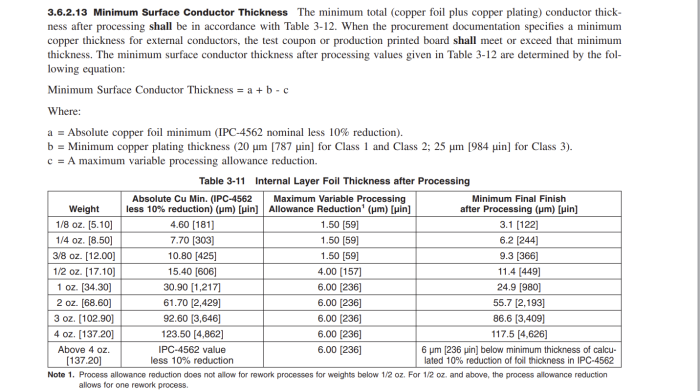
IPC-6012F Table 3-17 defines the minimum copper thickness after processing for internal layers.
For nominal 2 oz copper, the table provides:
| Item | IPC-6012F value |
|---|---|
| Nominal copper weight | 2 oz/ft² |
| Nominal equivalent thickness | 68.6 μm |
| Absolute copper foil minimum | 61.7 μm |
| Maximum variable processing allowance | 6.0 μm |
| Minimum thickness after processing | 55.7 μm |
Therefore, a 2 oz inner layer does not have to measure exactly 68.6 or 70 μm after processing. Under IPC-6012F, the minimum thickness after processing is 55.7 μm.
However, one important point must be understood:
The 6 μm processing allowance already includes one permitted rework process for copper weights of 1/2 oz and above.
It must not be deducted a second time.
Therefore, the acceptable minimum remains:
55.7 μm
It is incorrect to calculate:
55.7 μm − 6 μm = 49.7 μm
Even after one permitted rework process, the finished inner-layer copper must still meet the 55.7 μm minimum.
3. IPC-6012F Requirements for 2 oz Starting Copper on Outer Layers
Outer-layer conductors normally consist of copper foil plus subsequently deposited copper plating.
IPC-6012F Section 3.6.2.15 and Table 3-18 define the minimum total thickness of finished external conductors when the starting foil weight is specified.
For 2 oz starting copper foil, the finished external conductor requirements are:
| Starting copper foil | Class 1 and Class 2 | Class 3 |
|---|---|---|
| 2 oz | 78.7 μm minimum | 83.7 μm minimum |
These values apply to the total external conductor thickness after processing and plating.
If rework is performed, the finished board must still satisfy these minimum values:
- Class 1 and Class 2: ≥78.7 μm
- Class 3: ≥83.7 μm
It is incorrect to subtract another rework allowance and reduce the acceptance limits to 75.7 μm or 80.7 μm.
The processing allowance is a manufacturing allowance used in deriving the minimum requirement. It is not an additional concession that may be deducted from the finished-board acceptance limit.
4. What If “2 oz” Refers to the Finished Conductor?
IPC-6012F also addresses situations in which the overall finished conductor is specified by weight rather than by a specific thickness.
In this case, Section 3.6.2.15 refers to the minimum thickness after processing in Table 3-17 for the applicable copper weight.
For a 2 oz finished conductor specified by weight, this corresponds to a minimum of:
55.7 μm
This does not mean that every order described simply as “2 oz copper” can automatically be accepted at 55.7 μm.
It means the procurement documentation must first establish what the 2 oz requirement represents:
- Starting foil weight;
- Finished conductor weight;
- Or a specific minimum finished thickness.
If the customer specifies an explicit minimum, such as:
Finished copper thickness: minimum 70 μm
then the finished PCB must meet or exceed 70 μm. IPC processing allowances cannot be used to reduce a clearly specified contractual minimum.
5. Can 1 oz Starting Copper Plus Plating Be Called 2 oz?
This is one of the most common sources of commercial disagreement.
IPC-6012F Table 3-18 gives the following minimum finished external conductor thicknesses for 1 oz starting copper foil:
| Starting copper foil | Class 1 and Class 2 | Class 3 |
|---|---|---|
| 1 oz | 47.9 μm minimum | 52.9 μm minimum |
These values are the IPC minimum requirements for an external conductor manufactured from 1 oz starting foil.
They are not automatically the acceptance criteria for a customer’s 2 oz finished-copper requirement.
A manufacturer may start with 1 oz copper and add sufficient copper by plating to produce a 2 oz finished conductor. This is a normal manufacturing route. However, the actual finished copper must satisfy the agreed requirement.
Therefore:
- If the requirement is a minimum of 70 μm, the finished conductor must measure at least 70 μm.
- If the requirement is defined by finished copper weight, the applicable IPC interpretation and acceptance limit should be stated.
- If only “2 oz copper” is written, the manufacturer and customer should clarify the meaning before production.
Calling a board “2 oz finished copper” simply because it was produced from 1 oz foil plus plating—while accepting only the 47.9 μm minimum for 1 oz starting foil—can create a legitimate dispute.
The construction may comply with the IPC minimum for 1 oz starting foil, but that does not prove compliance with an independently specified 2 oz finished-copper requirement.
6. Does IPC Allow an Additional Copper Reduction After Rework?
No.
IPC-6012F permits rework for all product classes, provided the rework does not affect the functional integrity of the printed board.
However, permission to rework a board does not waive the finished-product acceptance requirements.
For copper weights of 1/2 oz and above, the processing allowance in Table 3-17 already accounts for one rework process. After rework, the board must still meet the applicable minimum copper thickness.
The correct interpretation is:
One rework operation is included within the processing allowance, but the final minimum copper thickness does not change.
This distinction is important for both manufacturers and incoming-quality inspectors.
7. What About 1.5 oz Copper?
IPC-6012F Table 3-17 and Table 3-18 do not provide a specific row for 1.5 oz copper.
For copper foil weights not listed in the table, the final requirements are AABUS—As Agreed Between User and Supplier.
Therefore, an order requiring 1.5 oz copper should define one of the following:
- Starting copper foil weight;
- Minimum finished copper thickness;
- Required plating thickness;
- Applicable IPC class;
- Measurement and sampling method.
Without an agreed numerical requirement, “1.5 oz copper” remains open to interpretation.
8. Why Manufacturers May Recommend Different Copper Constructions
Starting with 2 oz foil and starting with 1 oz foil followed by additional plating are not identical manufacturing routes.
Using thicker starting foil may:
- Increase laminate and material cost;
- Make fine-line etching more difficult;
- Require wider conductor spacing;
- Increase undercut risk;
- Reduce manufacturing yield on dense designs.
Using thinner foil followed by plating may offer better line-definition capability, but plating distribution and finished thickness must be carefully controlled.
For heavy copper PCBs, copper construction should therefore be selected according to:
- Current-carrying requirements;
- Thermal performance;
- Trace width and spacing;
- Layer count and stack-up;
- Hole-wall plating requirements;
- Reliability class;
- Cost and delivery expectations.
Neither construction is automatically superior. The correct choice depends on the design and the acceptance criteria.
9. How Buyers Should Specify 2OZ Copper Thickness
To avoid disagreement, procurement documentation should not state only:
Copper thickness: 2 oz
A clearer specification would be one of the following:
Inner-layer copper: 2 oz starting foil, IPC-6012F Table 3-17.
Outer-layer copper: 2 oz starting foil, finished conductor thickness per IPC-6012F Table 3-18, Class 2.
Finished external copper thickness: minimum 70 μm after all processing.
Finished copper: 2 oz by weight, with the minimum thickness agreed between customer and manufacturer.
The documentation should also state:
- Applicable IPC revision;
- Performance Class 1, 2 or 3;
- Whether copper weight refers to starting foil or finished conductor;
- Minimum acceptable thickness in micrometres;
- Whether local thin areas or average thickness will be evaluated;
- Microsection location and sampling requirements.
More information about the roles of IPC-6012, IPC-A-600 and other commonly referenced documents can be found in this IPC Standards guide.
10. SQPCB’s Approach to Copper-Thickness Requirements
At SQPCB, copper requirements are reviewed before production to determine whether the customer is specifying:
- Starting copper foil;
- Finished copper weight;
- Minimum finished conductor thickness;
- Or a current-carrying and thermal-performance target.
For multilayer, high-current and heavy-copper designs, we also evaluate line width, spacing, plating distribution, via structure and stack-up before confirming the pcb manufacturing method.
Where a specification is ambiguous, clarification before fabrication is far less costly than debating a microsection result after delivery.
The objective is not simply to claim that a board is “2 oz.” The objective is to ensure that the manufactured PCB meets the customer’s electrical, thermal, reliability and inspection requirements.
Final Thoughts
The statement “2 oz copper equals 70 μm” is useful as a nominal conversion, but it is not a complete finished-PCB acceptance criterion.
According to IPC-6012F:
- A 2 oz inner layer has a minimum thickness after processing of 55.7 μm.
- The processing allowance already includes one rework for copper weights of 1/2 oz and above.
- The 55.7 μm minimum cannot be reduced again after rework.
- An external conductor made from 2 oz starting foil must reach 78.7 μm for Class 1 and Class 2, or 83.7 μm for Class 3.
- An external conductor made from 1 oz starting foil has different IPC minimums and cannot automatically be treated as satisfying a 2 oz finished-copper requirement.
- Any explicit minimum copper thickness stated in the procurement documentation must be met.
The most effective way to avoid copper-thickness disputes is simple:
Define the starting foil, finished copper requirement, IPC class and minimum thickness before production begins.
Frequently Asked Questions
1. Is 2 oz copper always exactly 70 μm?
No. Approximately 68.6 μm is the nominal theoretical thickness represented by 2 oz/ft². Actual acceptance depends on the copper construction, processing condition and procurement requirements.
2. Can a 2 oz inner layer measure 55.7 μm and still comply with IPC-6012F?
Yes. Table 3-17 specifies 55.7 μm as the minimum thickness after processing for nominal 2 oz internal copper.
3. Can the copper thickness be reduced to 49.7 μm after one rework?
No. The 6 μm processing allowance already accounts for one rework process for copper weights of 1/2 oz and above. The finished copper must still meet the 55.7 μm minimum.
4. Can 1 oz base copper plus plating be used to produce 2 oz finished copper?
Yes, provided sufficient copper is plated and the finished conductor meets the agreed minimum. However, the 47.9 μm IPC minimum for 1 oz starting foil cannot automatically be presented as compliance with a 2 oz finished-copper requirement.
5. What is the best way to specify 2 oz copper?
State whether 2 oz refers to the starting foil or finished conductor, specify the IPC revision and performance class, and include a numerical minimum finished thickness whenever thickness is critical.

- Special PCB
- long board pcb
- Flexible PCBs
- Special PCB
- Express Printed Circuit Board
- Pcb Prototype
- LED PCB
- PCB
- Pcb Meaning
- Printed Circuit Board
- Pcb manufacturer
- Rigid pcb board
 Quote
 E-mail